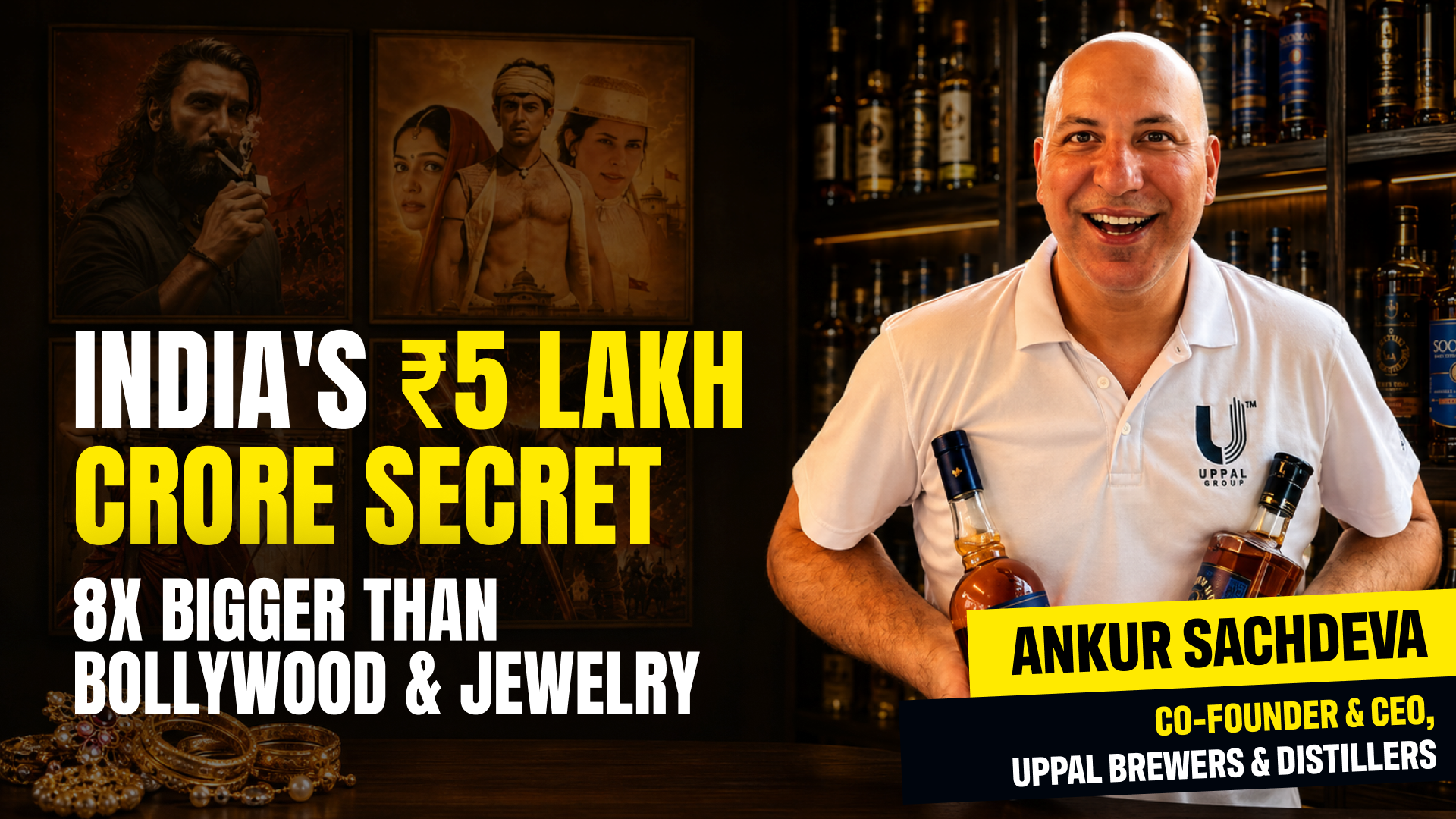
When Ankur Sachdeva helped bring Glenfiddich to India in the early 2000s, single malt whisky was barely understood as a category. He remembers pitching the brand to a senior food and beverage professional at a leading hospitality group, explaining that Glenfiddich was a single malt Scotch whisky.
“The only thing that sells in my hotels is Scotch,” came the response.
For Sachdeva, the exchange captured where the Indian market was at the time. William Grant & Sons spent years educating consumers and the trade, even taking journalists, F&B professionals, and connoisseurs to Scotland several times a year to understand the category.
Two decades later, Sachdeva says India has gone from "not knowing anything about single malts, to having the most esoteric malts in the bar".
It is a shift he has witnessed over a 25-year career spanning William Grant & Sons, Radico Khaitan and Allied Blenders and Distillers. Today, as he builds Uppal Brewers & Distillers (UBD), the company behind Indian whisky brands Soorahi and Madhvan, he believes another major shift is underway.
The Indian consumer is experimenting more, premiumising faster, and increasingly willing to consider homegrown spirits.
A Rs 5 lakh crore market that looks different from the rest of the world
Globally, beer is the dominant alcohol category. India looks markedly different.
“In contrast, in India, spirits is the giant. In value terms, it’s about three-fourths of the entire market,” says Sachdeva, on the Prime Venture Partners Podcast.
He estimates India’s alcobev industry at around Rs 5 lakh crore, with significant economic linkages across agriculture, manufacturing, logistics, packaging, hospitality, distribution and retail. He also estimates the ecosystem generates around 10 million direct and indirect jobs.
Whisky accounts for 60-65% of Indian spirits, while whisky, brandy and rum together make up more than 90%.
The geography of consumption is equally counterintuitive.
According to Sachdeva, southern India consumes more than the north, west and east combined. Karnataka alone accounts for approximately 60 million cases out of a roughly 420 million case market.
“Punjabis don’t drink as much as people in Tamil Nadu or in Karnataka,” he says.
How single malt became ‘social currency’
Sachdeva’s Glenfiddich experience offers an early example of how new alcohol categories get created in India.
A seemingly unrelated change helped. When the duty-free allowance for incoming passengers moved from one litre to two litres, Sachdeva noticed a change in purchasing behaviour.
The first bottle typically remained a familiar blended Scotch such as Chivas Regal or Johnnie Walker Black. The second became an experimentation purchase, increasingly a single malt.
Over time, single malt knowledge itself became aspirational.
“That was the new social currency,” says Sachdeva.
Being able to pronounce an unfamiliar distillery name or bring home an unusual bottle signalled travel, knowledge and sophistication.
The broader lesson is relevant to what is happening today. New categories do not necessarily replace old consumption overnight. They can emerge alongside familiar choices as consumers gain confidence to experiment.
That experimentation is visible in other categories too. Sachdeva says vodka accounts for less than 4% of Indian spirits compared with over 15% globally, yet it is growing much faster than the overall IMFL market.
India also behaves unusually within vodka. While plain vodka dominates internationally, Sachdeva says around 60% of vodka sold in India is flavoured.
The new consumer is less loyal, more experimental
Sachdeva believes one of the most consequential changes is the decline of rigid brand loyalty. The traditional premium whisky drinker, he says, was often an older male who stuck to the same brand. The younger consumer is more experimental, increasingly includes women, and uses products as a form of self-expression.
“That kind of brand loyalty now doesn’t exist, in my opinion,” he says.
This also changes the meaning of premiumisation.For Sachdeva, premiumisation is not simply taking a Rs 1,000 product and charging Rs 1,100. It is a consumer moving from a Rs 600 or Rs 800 product to Rs 1,000, and later aspiring towards Rs 2,000.
“The same consumer in its life journey wanting better, aspiring for better,” he says.
Better can mean the liquid, but also packaging, presentation, storytelling and discovery. That shift is creating room for Indian brands. Sachdeva estimates that nearly 80% to 90% of the approximately 420 million case industry still sits below the Rs 800 level.
“Imagine even if a tiny, tiny percentage graduates or premiumises to a higher price point, imagine what it opens up. It’s massive.”
‘If you think it will cost one, plan for three’
Opportunity, however, does not translate into an easy startup.
“If you think it’s going to cost you one, plan for three,” says Sachdeva.
One reason is working capital. Before alcohol can reach the market, companies may already have paid excise duty on it. If the ex-distillery value is Rs 100, Sachdeva says another Rs 100 or more may need to be funded before the eventual recovery through sales.
UBD itself illustrates the capital requirements, Sachdeva says the Uppal family committed around Rs 100 crore to the business from the beginning, giving the company patient capital.
“Normally for people, the first year is all about raising funds, whereas for us it was about building brands,” he says.
That patience allowed the company to test before scaling. Within the first two months of launching Soorahi in Delhi, Sachdeva personally got more than 1,100 people to sample the product at an alcobev trade exhibition at Pragati Maidan.
“It was that reaction that told me that we are onto a winner here,” he says.
UBD subsequently expanded from Delhi into Punjab, Haryana, Odisha, Goa, Daman and Karnataka.
Why a second brand can change the economics
Soorahi also taught UBD an important lesson about portfolio economics.
In Delhi, Soorahi operates at around Rs 1,700, competing in a relatively premium segment. By its 18th month, Sachdeva says the brand had reached approximately 5% market share within that operating segment.
But the higher the price point, the smaller the addressable market becomes.
That led UBD to launch Madhvan, whose potential market Sachdeva estimates to be four to five times larger than Soorahi’s.
There was another consideration. Established competitors often approach distributors with four, five or even seven brands, allowing them to spread sales and distribution overheads across the portfolio.
“They can spread their overheads across a sort of array of brands,” he explains.
For UBD, a second product was therefore not merely about launching another brand. It could alter the economics of distribution itself.
India’s regulatory complexity is also a moat
Perhaps the hardest part of the business appears only after the product has been created.
Alcohol is regulated state by state. Excise rules, label registrations, pricing, wholesale structures, retail systems and routes to market can all change across borders.
“All states are different and I think for most part I would say that’s the moat for this industry,” says Sachdeva.
Incumbents build years of knowledge about how each state operates. A private market can behave differently from a government-controlled market, while hybrid systems create yet another set of operating challenges.
Sachdeva calls the capability required to navigate this “operational dexterity”.
“Your next state is always easier than the previous one because the blueprint is now set,” he says.
Even the decision to shift manufacturing from Punjab to Goa was driven primarily by regulation. Sachdeva says regulatory flexibility accounted for about 80% of the decision, followed by Goa’s perception as a travel destination and its growing ecosystem of skilled talent, bottlers and alcohol companies.
‘More than money, you’ll waste your years’
For all the complexity, Sachdeva calls this “perhaps the best time in the last 25 years” to explore premium Indian spirits.
He sees white space across whisky, rum, gin and vodka as consumers premiumise and become more confident buying Indian brands.
But his final advice to founders is deliberately less celebratory.
“Don’t fall so much in love with your idea and then let ego come in the way.”
In a business where regulation, capital, consumer preference and distribution can all challenge the original plan, founders have to recognise when something is not working.
Mistakes will cost money, refusing to recognise them can cost something harder to recover - “More than money, you’ll waste your years.
Source: YourStory