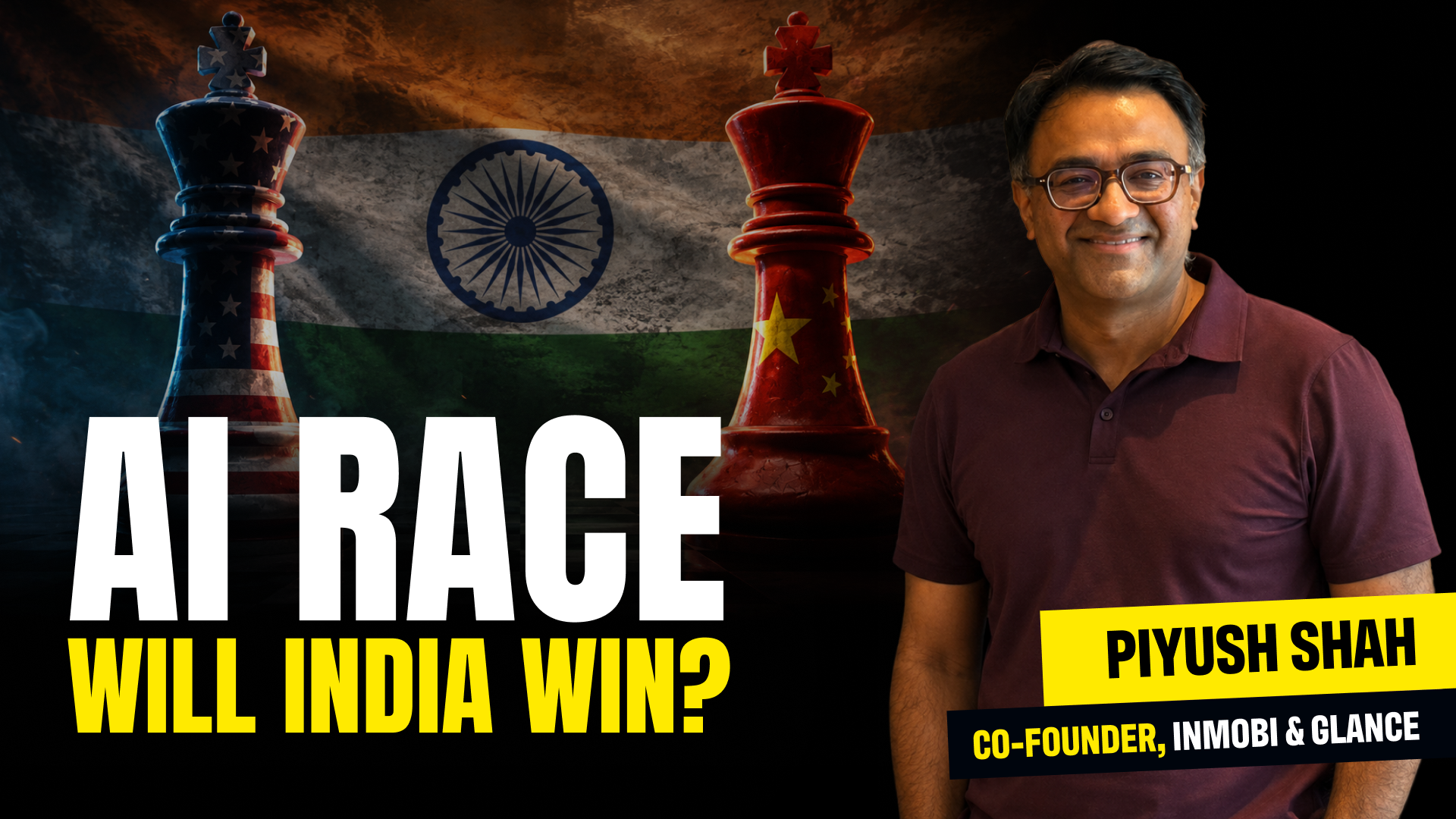
Piyush Shah, a legendary Indian Founder of two unicorns (InMobi & Glance) shares why India's AI strategy has to look nothing like Silicon Valley's or Beijing's, and what founders should build instead.
Having built two technology companies that scaled globally from India, Shah has spent nearly two decades operating across Silicon Valley, Beijing and Bengaluru. That vantage point has convinced him that every region is playing a different AI game. The real opportunity for Indian founders lies in recognising where the country's strengths truly are.
For Shah, the next decade of AI will not be won solely by building bigger models. It will be won by solving real-world problems, mastering distribution and creating sustainable business models.
The AI race is not one race
Shah believes the AI ecosystem is already dividing into distinct strengths.
"The US is inventing AI. China is industrialising AI."
While American companies continue to lead frontier models, research and computing infrastructure, China is embedding AI into manufacturing, robotics, logistics, warehouses and factories.
"What should be India's game?"
That philosophy is rooted in how InMobi and Glance themselves evolved. Rather than viewing India as their only market, both companies constantly looked outward.
"I always say we have innovated because we always stood at the intersection of the Bay Area, Bangalore and Beijing."
That ability to observe different ecosystems and identify gaps has shaped Shah's view that India's biggest AI opportunity is neither frontier research nor manufacturing dominance.
Instead, it is using AI to improve everyday life for millions.
Raising the floor for a billion people
Unlike countries focused on pushing technological boundaries, Shah believes India can create disproportionate value by making AI accessible to everyone.
"While the US is trying to raise the ceiling substantially, I think we can raise the floor itself for a billion people."
He points to AI tutors for education, healthcare advisors, financial coaches, agricultural experts and multilingual voice interfaces as examples of where India can build solutions that combine inclusion with scale.
India has repeatedly demonstrated its ability to create digital public infrastructure that reaches hundreds of millions of users. Shah believes AI presents a similar opportunity.
"Pick a problem, do this well, solve it inclusively, raise the floor and then catch hold of a billion people across almost 100 countries."
For him, India's competitive advantage lies not in building technology for a handful of advanced users, but in democratising AI for the masses.
Why consumer AI has an economics problem
While consumer AI applications continue to attract enormous attention, Shah believes the industry is overlooking one of its biggest challenges - Inference economics.
Traditional software companies are largely worried about customer acquisition costs and lifetime value. AI companies must now contend with another significant expense: the cost of generating every AI response.
Shah refers to this as "Inference CAC, I mean how much are you spending to acquire that customer and retain the customer versus the cost it took to power that AI-based experience."
Unlike conventional cloud infrastructure, inference costs become directly linked to user engagement. Every prompt, recommendation and AI-generated response consumes computing resources. As usage scales, so does the bill.
"The biggest consumer AI companies out there have not solved for their inference CAC. That fundamentally changes the economics of building consumer AI products.”
"You would never think twice before you had an app to say I'll put it in the store and I'm okay if hundreds of millions of users download it and use it. Today, you are scared that if you have an AI experience and you launch it and 100 million people download and use it, you are bankrupt."
It is a problem Shah understands firsthand.
Glance is building AI-powered shopping and discovery experiences for consumers, while InMobi works with consumer AI companies globally. Rather than focusing only on engagement, Shah says both companies spend significant effort solving distribution and inference economics.
He believes the next phase of consumer AI will require entirely new monetisation models, much like advertising enabled the growth of the open internet.
"Advertising democratised the open Internet. A new form of advertising is needed to democratise consumer AI." This is where InMobi is helping global enterprises with this specific problem.
Enterprise AI is creating value today
If consumer AI is still searching for sustainable economics, Shah believes enterprise AI has already found clearer business value.
During a recent OpenAI event, he expected conversations around the latest consumer products. Instead, the focus was overwhelmingly on enterprise transformation.
"If I can fathom a guess, 70% of their revenue this year onwards is going to be through enterprise AI, not the consumer AI-led subscriptions or advertising."
That shift is also reflected in how InMobi and Glance are approaching AI partnerships.
Beyond building AI-native shopping experiences, the companies are investing in infrastructure optimisation, recommendation systems and AI compute efficiency while actively partnering with startups working across advertising, personalisation and commerce.
For founders, Shah believes the biggest opportunities lie in solving deep, domain-specific workflows. Whether it is manufacturing, warehousing, tax filing, pharmaceutical approvals or healthcare operations, enterprises increasingly value AI products that can demonstrate measurable outcomes within weeks instead of months.
Distribution remains the biggest moat
Despite AI dramatically lowering the barriers to building products, Shah argues that one competitive advantage has not changed.
"Distribution is the moat."
Drawing on InMobi's own global journey, he believes founders often underestimate how difficult go-to-market execution remains. Selling into global enterprises still requires trusted relationships, local presence and credibility.
"You still need that guy in New York in my opinion for large-scale distribution."
He also encourages founders to think beyond traditional sales motions. Building thought leadership, publishing insights and creating domain expertise can become powerful distribution channels, particularly for AI startups solving specialised enterprise problems.
Shah even suggests partnering with large IT services firms instead of competing against them. Companies like Infosys and TCS already possess the enterprise relationships many startups struggle to build. Rather than viewing them as competitors, founders can leverage those networks to accelerate adoption.
Technology may be easier to build than ever before. Winning customers, however, remains just as difficult.
India's opportunity goes beyond frontier models
For someone who has spent decades building globally from India, Shah's optimism about AI does not stem from larger models or faster chips.
It comes from solving meaningful problems at scale. Whether through InMobi's work in advertising technology, Glance's AI-powered consumer experiences or his broader observations across the US, China and India, Shah returns to the same belief.
India’s opportunity lies in building AI that reaches more people, solves everyday problems and creates businesses with sustainable economics.
In Shah's view, that may ultimately prove to be India's most enduring contribution to the AI era.
(Disclaimer: The views and opinions expressed in this article are those of the author and do not necessarily reflect the views of YourStory.)
Source: YourStory - Startups