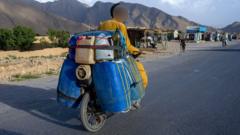
Mazaar's small motorbike is so laden with plastic canisters filled with petrol that there's barely room for him to sit.
His worn-out bike is carrying five 70-litre oil containers, weighing roughly 600 pounds (272kg) in total.
The fuel hangs precariously from the sides of his bike, strapped on with rope and string.
He bought it at an open-air fuel market in Mastung, in Balochistan, Pakistan's biggest and poorest province, where he lives.
Pick-up trucks loaded with plastic containers take fuel there to sell, having smuggled it across the border from Iran.
While the illegal smuggling of petroleum products from Iran into Pakistan has been taking place for decades, there are signs it has been increasing in recent months as a result of the US-Israeli war against Iran.
With the war heavily disrupting flows of oil through the Strait of Hormuz, fuel prices have surged, boosting demand in Pakistan for cheaper smuggled petrol and diesel from Iran.
Like thousands of smugglers in Balochistan, Mazaar, whose name we've changed for his safety, ferries fuel to other open-air markets and unofficial petrol stations.
He's getting ready to travel 350km (about 220 miles) through one of the hottest regions on Earth to take the fuel to the neighbouring province, Sindh.
Temperatures in Balochistan can reach up to 50C (120F), causing the plastic fuel canisters to swell and soften.
If they split or the lid leaks while Mazaar is riding, there's a risk of the fuel catching fire and even exploding. Smugglers are regularly killed this way.
There are other dangers here too.
For decades there have been clashes in Balochistan between Pakistani forces and insurgent separatist groups demanding greater autonomy. Amid the conflict, activists say thousands of people have disappeared.
"We do this because we don't have any other option," Mazaar tells the BBC World Service.
"The weather is hot, the prices are high and we spend day and night on the road."
The exact scale of smuggling operations is not known, but in 2024 the Japanese news website Nikkei Asia reported that a leaked report from Pakistan's intelligence agencies estimated that fuel worth $1bn (£745m) was smuggled from Iran into Pakistan annually.
In May this year, Pakistan's five major oil refineries said the cross-border flow of petroleum products was increasing and sent a letter to the government urging it to intervene.
Separately, this month the Oil Companies Advisory Council, which represents Pakistan's oil industry, wrote to the government to say official petroleum sales for this time of year had hit a 27-year low, in part due to the rise in fuel smuggling.
Mazaar, who is in his late 30s, is the main breadwinner for a large family that includes his one child and many brothers.
He says he became a fuel smuggler three to four months ago when drought meant he was no longer able to farm.
He is among 2.4 million people in Balochistan's population of about 15 million estimated to be involved in fuel smuggling between Iran and Pakistan, according to the leaked Pakistani intelligence report seen by Nikkei Asia.
Fuel smuggling is illegal in Pakistan, with punishments ranging from fines and vehicle seizures in smaller cases to prison sentences for larger operations.
But Fida Hussain Dashti, former president of the Quetta Chamber of Commerce and Industry in Balochistan, argues that it is vital for the region's economy because there are so few opportunities for work.
Bordering Iran to the west and Afghanistan to the north, Balochistan covers around 44% of Pakistan's landmass but has just 6% of its population.
Although it is rich in mineral resources, it has poverty levels similar to some of the poorest parts of the world, which has been a source of anger in the region.
"People are helpless and have no other way," says Dashti, who argues that the Pakistani government should have done more to create employment opportunities in the region.
"Even a student who graduates with an MA degree ends up joining this oil business."
Irfan, whose name we have also changed for his safety, says there's no other work he can do because of his disability.
After contracting polio, movement in one of his legs and one of his hands is severely limited.
He has also been smuggling for several months, and transports diesel because it is safer than petrol and less likely to ignite.
"I can't carry petrol because what if it catches fire? If I can't stand up, I'll get badly burned," he says.
The politics behind smuggling operations are complicated - especially with Pakistan playing the role of mediator between Iran and the US as they seek to bring a permanent end to hostilities.
Pakistan has at various times cracked down on the illegal trade, only for smuggling levels to go up again.
It is hard to stop it completely because remote parts of the 900km border are difficult to police.
There's also an understanding in Pakistan's government that for many in Balochistan the work is a lifeline.
In addition, oil companies don't deliver fuel to some places in the region, deterred by transport costs, security issues and competition from cheaper smuggled products.
Iran blames the smuggling on criminal groups, who are able to buy fuel cheaply because the regime sells petrol and diesel at subsidised prices to Iranian citizens.
But Paddy Ginn, of the Global Initiative Against Transnational Organised Crime, which monitors illicit markets, says: "The main traffickers, we believe, are either part of or closely linked to IRGC [Islamic Revolutionary Guards Corps]" and that their aim is "of course to avoid sanctions that are imposed by the US".
He adds that he believes groups linked to the regime are now trying to smuggle more fuel to take advantage of rising prices caused by the war.
The BBC asked the Iranian government to comment on the allegation that it is involved in fuel smuggling. It did not respond.
Several smugglers have told the BBC that officials and security forces in Pakistan turn a blind eye in return for bribes.
Pakistan's government denies any of its departments or security forces are involved in fuel smuggling.
It says Pakistan's Prime Minister, Shehbaz Sharif, has directed law enforcement to crack down on fuel smuggling, and that security forces have seized fuel worth approximately 1.3 billion Pakistani rupees (almost $5m) in the last year.
Mazaar says the war has added to the costs of his work.
The price he pays for smuggled petrol has gone up, but the amount he sells it for has stayed the same.
After the costs of petrol, food and leasing his bike, he used to make 5,000 rupees (£13) a day, but this has fallen to 3,000 rupees - about twice as much as Pakistan's minimum wage.
"The war started and we were ruined," he says.
As Mazaar and his group of 11 motorbike riders leave the Mastung district in Balochistan to head towards his home, they're hit by a heat storm - a prolonged heatwave that includes dust storms.
Asked about the risks of injury and even death, Mazaar says: "I don't worry about it.
"I have to die one day anyway. I could die now. Who knows? That is Allah's decision, whether he lets me live or takes my life."
Source: BBC News - World