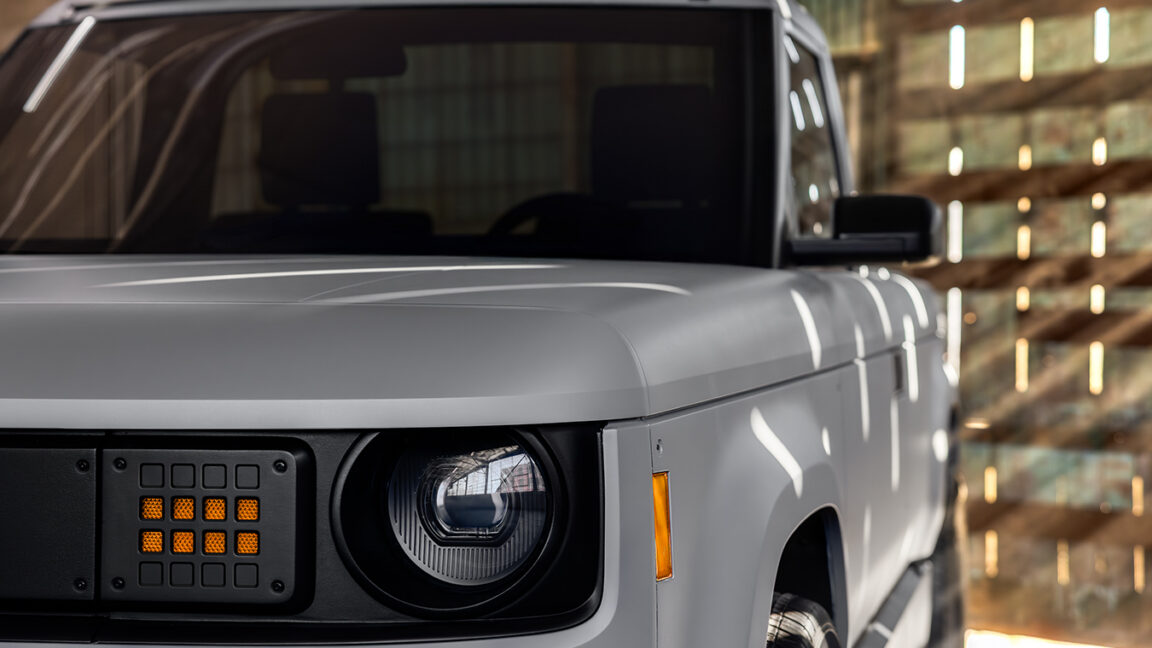
With no embedded modem, the Slate Truck is the antithesis of today’s connected cars.
Slate Auto may be one of the most interesting companies in the American automotive industry right now. Based in Warsaw, Indiana, the startup is taking a completely different approach to building an electric pickup truck. Forget Ford’s clean-sheet “skunk works” story; the Slate Truck’s design has been stripped down to just 600 parts and components. That minimalism includes the interior, where you’ll find two seats and manually wound windows, but no infotainment system. If you’re one of Ars’ many readers who want an electric car that won’t track you, Slate might have what you’re looking for.
It’s not an entirely analog experience, though; a Slate smartphone app can manage settings, change drive mode, and provide range and charging info. But only when connected locally to the car—there’s no embedded modem, so forget about remote access. And the company says that while it may use data from the app to improve its products, it won’t sell that data.
That’s according to a new report from SAE International’s (and sometime Ars contributor) Roberto Baldwin. “We are building it around ownership value,” Slate said. “We collect data to make ownership better, not to turn the owner into the product. The app will collect data only when it directly contributes to enabling or improving a customer experience. Privacy is paramount. For Slate, privacy is not a compliance footnote. It is part of the product experience.”
“Customers should understand what is being shared, why it matters, and how it helps them own the vehicle with more confidence,” the company said. “That may include data needed to support account setup, device-to-vehicle connection, diagnostics, maintenance guidance, service support, charging context, OTA update status, customer support, and product improvement. Slate is being intentional about what the app can do and what data it collects. We would rather be precise and trusted than overpromise connected features or collect data without a clear customer benefit.”
Of course, you don’t need to bring a smartphone with you to drive your Slate; leave it at home, and you’re as untraceable as someone riding around in a Toyota SR5 in 1985. Well, apart from all the automated license plate reading cameras out there, obviously.
Unless the Slate Truck reveals a vast and previously untapped preference for unconnected cars among car buyers, I’m not sure the rest of the industry will rush to follow Slate’s example.
The connected services integrated into cheap Chinese cars are frequently highlighted as a key reason those vehicles are so much better than anything anyone can buy in the US, according to their boosters. Indeed, those connected services and their possible links to the Chinese state were scary enough to US lawmakers to drum up bipartisan support for new regulations that bar their import, absent an authorization from the Department of Commerce. Meanwhile, surveys indicate that US car buyers are aware of the concerns but don’t care.
In Europe, all cars have been required since 2018 to include an embedded modem capable of calling emergency services. But the European Union also has far more robust data protection laws than the US, treating data gathered by a connected car as personal and thus covered.
In the US, though, automakers collect customer data, and often with very poor digital security, as the Mozilla Foundation detailed in 2023. And some OEMs have very much viewed that data as an extra revenue stream. In 2024, after General Motors was caught selling driver data, often without those drivers’ clear consent, the Federal Trade Commission warned the industry that OEMs “do not have the free license to monetize people’s information beyond purposes needed to provide their requested product or service,” though whether that policy remained in effect after January 2025 remains unclear.
Source: Ars Technica