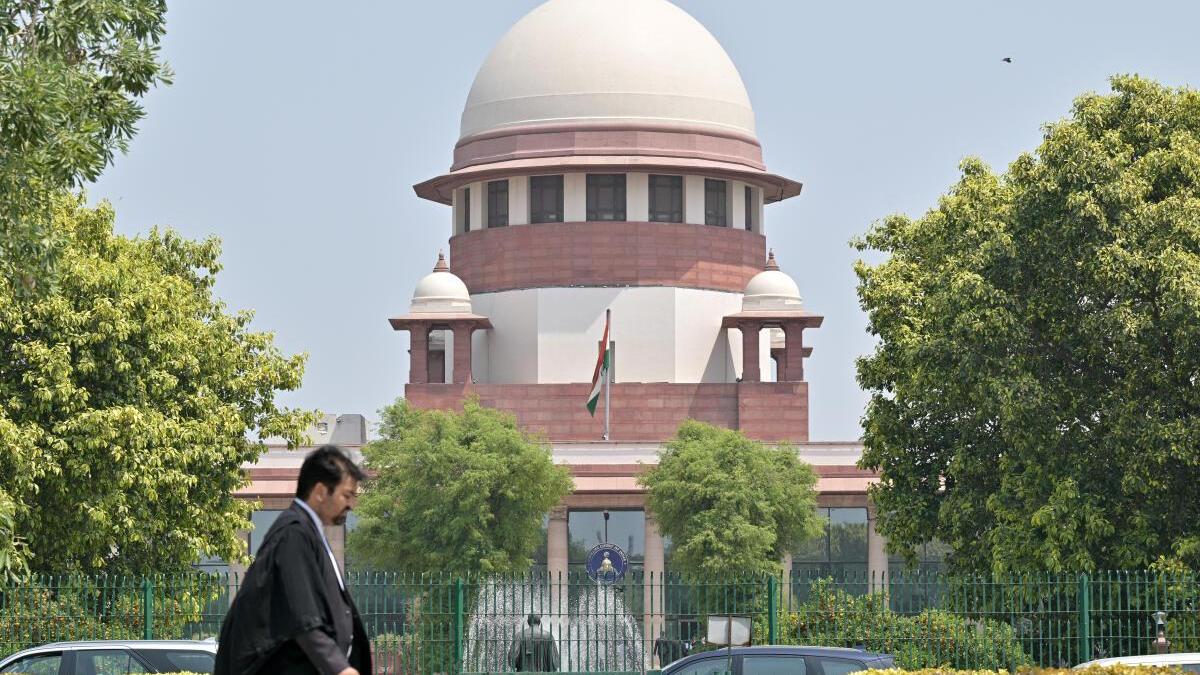
The Supreme Court on Tuesday (June 2, 2026) got five new judges, taking its working strength to 37 judges, with only one position remaining vacant.
The appointments come shortly after the Union Government increased the Court’s sanctioned strength from 33 to 37 judges, excluding the Chief Justice of India (CJI), through the Supreme Court (Number of Judges) Amendment Ordinance, 2026. The ordinance, promulgated on May 16, was aimed at addressing the Court’s mounting backlog of over 93,000 cases and facilitating the regular convening of Constitution Benches.
CJI Surya Kant administered the oath of office to former Punjab and Haryana High Court Chief Justice Sheel Nagu, former Chief Justice of Bombay High Court Shree Chandrashekhar, former Chief Justice of Madhya Pradesh High Court Sanjeev Sachdeva, former Chief Justice of High Court of Jammu and Kashmir and Ladakh Arun Palli, and Senior Advocate V.S. Mohana.
Senior advocate Mohana’s elevation to the Bench is particularly significant as it increases the number of women judges on the Supreme Court Bench, which currently has only one woman judge, Justice B.V. Nagarathna. She also becomes only the second woman to be elevated directly from the Bar to the Supreme Court, after Justice Indu Malhotra in 2018.
The swearing-in ceremony, attended by judges of the Supreme Court and members of the Bar, marked the first set of appointments to the top court recommended by the collegium headed by CJI Kant. Upon assuming office as the 53rd CJI in November last year, the Chief Justice had identified reducing the Supreme Court’s pendency as one of his foremost priorities.
The collegium had, on May 27, recommended the elevation of the four High Court Chief Justices and senior advocate V. Mohana to the apex court. The recommendations were subsequently forwarded to the Union Government for approval and the issuance of warrants of appointment by the President.
The new appointments come at a time when the Supreme Court is adjusting to its expanded sanctioned strength while also preparing for a series of retirements. Justice Pankaj Mithal is due to retire on June 6, followed by Justice J.K. Maheshwari on June 28, Justice Sanjay Karol on August 28 and Justice Satish Chandra Sharma on November 29. The latest inductions are therefore expected to help maintain the court’s working strength during the tenure of CJI Kant, who is set to retire in February 2027.
ALSO WATCH Supreme Court nears full strength with 5 new judges
The recommendations, made by the collegium comprising CJI Kant and Justices Vikram Nath, J.K. Maheshwari, B.V. Nagarathna and M.M. Sundresh, have also been viewed as an attempt to balance regional representation and improve gender diversity on the Bench.
On June 1, the Union government formally notified the appointments. Announcing the decision on X, Union Law Minister Arjun Ram Meghwal said the President had appointed the five judges under Article 124(2) of the Constitution after consultation with the CJI.
Ms. Mohana graduated from the Government Law College, Coimbatore, in 1988 as part of the inaugural batch of its five-year law programme. After beginning her career under advocate M. Panchapakesan, she moved to New Delhi and trained in the chambers of Justice Indu Malhotra, then a practising advocate, and senior advocate C.S. Vaidyanathan. Over the years, she built a substantial practice before the Supreme Court and other forums, earning designation as a senior advocate from the apex court in 2015.
Justice Sheel Nagu joins the Supreme Court from the Punjab and Haryana High Court, where he served as the Chief Justice. His judicial career began in the Madhya Pradesh High Court, where he was elevated as a judge in 2011. He was later appointed Chief Justice of the Punjab and Haryana High Court in 2024.
Justice Shree Chandrashekhar, who was serving as Chief Justice of the Bombay High Court, was elevated as a judge of the Jharkhand High Court in 2013. He later served as Acting Chief Justice of the Jharkhand High Court before being appointed Chief Justice of the Bombay High Court last year.
Justice Sanjeev Sachdeva, who recently took over as Chief Justice of the Madhya Pradesh High Court, was previously a judge of the Delhi High Court, where he served since his elevation in 2013. Before being elevated to the Bench, he had a substantial practice in the Delhi High Court and the Supreme Court.
Justice Arun Palli, who headed the High Court of Jammu & Kashmir and Ladakh, began his legal career at the Punjab and Haryana High Court in 1988 and was designated a senior advocate in 2007. He was elevated as a judge of the Punjab and Haryana High Court in 2013 and was appointed Chief Justice of the High Court of Jammu & Kashmir and Ladakh last year.
Published - June 02, 2026 08:06 am IST
judiciary (system of justice) / justice and rights / court / judge
Source: The Hindu - India News