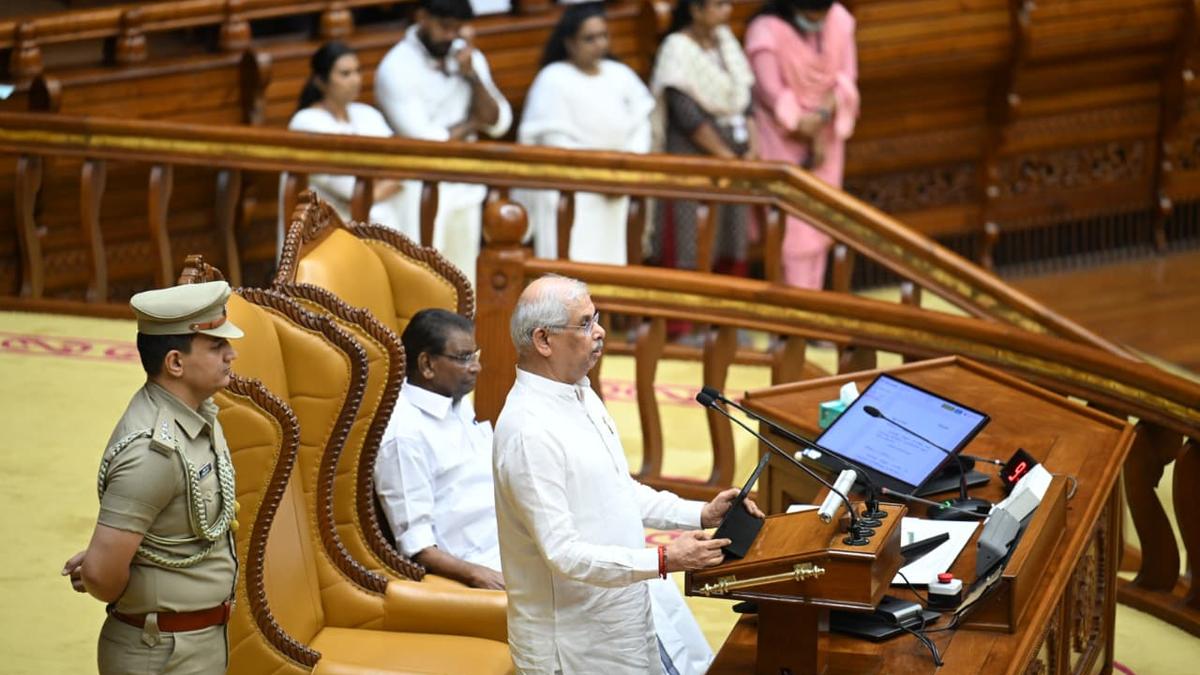
The Kerala Police band skipped playing ‘Vande Mataram’ in its entirety at the opening session of the 16th Kerala Assembly on Friday (May 29, 2026), laying the groundwork for a dispute between the Congress-led United Democratic Front (UDF) government and the Lok Bhavan.
Returning to the Lok Bhavan after his policy address, Governor Rajendra Arlekar took strong exception to the government’s decision to restrict the law enforcement’s brass band from rendering the song from beginning to end.
He told reporters that the Lok Bhavan had insisted that the song be “sung and not played” in full. Mr Arlekar said his office had broached the matter with Speaker Thiruvanchoor Radhakrishnan. “Let us see how things develop”, he told reporters.
According to sources, the government had reportedly directed the players to stick to the initial “secular stanzas” of the song based on the “reasoning of the Freedom Struggle’s leaders” that the first two metrical compositions were “secular, civic and inclusive”, while the subsequent verses had “a Hindu religious tint, risking national unity.”
Close on the heels of Mr Arlekar winding down his policy address in the Assembly, senior Bharatiya Janata Party (BJP) leader and former Union Minister V. Muraleedharan stated that the government had “insulted the national song.”
In a Facebook post, Mr. Muraleedharan wrote: “The V.D. Satheesan government had caved in to pressure from the Jamaat-e-Islami and Communist Party of India (Marxist) [CPI(M)]. It had callously given the Central government’s directive to the State governments to render the song in full, go by.”
Mr Muraleedharan termed the “redacted Vande Mataram an affront to the Governor and the Lok Bhavan. He said the government has “explicitly endorsed” the Jamaat-e-Islami and CPI(M) narrative that Vande Mataram, which inspired the national movement, was “anti-secular and divisive.”
Mr Muraleedharan asked Chief Minister V. D. Satheesan to explain why Vande Mataram, first sung publicly at the Indian National Congress’s All India Conference in 1896, became an anathema for the party.
The Vande Mataram controversy came to the fore on a day when Mr Arlekar stated on the floor of the Assembly that “his government believed in cooperative federalism and constructive engagement with the Union government, while firmly safeguarding the constitutional and financial rights of Kerala.”
The squabble between the Central government and non-BJP-ruled States has its provenance in the Union government’s directive, issued on the 150th anniversary of Vande Mataram in October last year, to render Vande Mataram in full at State functions.
Published - May 29, 2026 01:08 pm IST
Source: The Hindu - India News