When the priceless Chola bronzes from Sivapuram and Pathur villages in Tamil Nadu were returned to India in 1986 and 1991 after protracted legal battles in the U.S. and U.K., it created a sensation. A formidable team of experts from diverse fields helped repatriate the bronzes after they were smuggled abroad. On February 17, 1988, Justice Ian Kennedy of a London court, awarding the idol to Tamil Nadu, praised R. Nagaswamy, who testified in the case, as “an acknowledged expert in the field of Chola bronzes.” Then Director of the Tamil Nadu State Department of Archaeology, Nagaswamy was an epigraphist, iconographer, archaeologist, and scholar of Tamil and Sanskrit.
It was celebration time again for epigraphists and scholars of Chola history when Leiden University in the Netherlands handed over the Anaimangalam copper-plate charter, popularly known as the Leiden plates, to Prime Minister Narendra Modi at The Hague on May 16, 2026.
The Pallava, Pandya, Chola and Chera copper plates from the collections of the Government Museum, Chennai and the Department of Archaeology, Chennai. | Photo Credit: The Hindu Archives
Repatriating smuggled artefacts to their countries of origin is a tedious process. It involves prolonged court battles and testimonies from scholars, iconographers, epigraphists, forensic specialists and police officers. More importantly, the country in which the artefacts are discovered must be willing to return them, noted K. Muniratham, Director of Epigraphy, Archaeological Survey of India (ASI), Mysuru.
The roles played by ASI Director General Y.S. Rawat, S. Swaminathan, epigraphist and Professor Y. Subbarayalu, a scholar of Chola history, were crucial in persuading The Netherlands to return the plates to India. “We had been trying for the past 14 years. The real process began in 2024, when UNESCO asked me to prepare a dossier on the Leiden plates. I did so, with the help of epigraphist Swaminathan. We worked closely with UNESCO,” said Munirathnam. The ASI also prepared a video presentation and successfully established the provenance of the plates, proving that they belonged to Tamil Nadu but had been taken to Holland. “We have brought back 155 artefacts in the last 13 years,” he added.
Lennart Bes, assistant professor, Indian and Asian History, Institute for History (Colonial and Global History), Leiden University, wrote to Subbarayalu, seeking clarifications.
According to Subbarayalu, “South Indian historians regard the two sets of Leiden copper plates, weighing about 30 kg and held by the university since 1862, as important sources for 11th‑century history. While thousands of stone inscriptions document Chola history, copper‑plate grants are comparatively rare. These plates, therefore, are invaluable records.”
The statement of Leiden University’s Colonial Collections Committee (CCC), which conducted an independent provenance investigation before deciding to return the plates, noted that the artefacts were “most likely excavated during the construction of Fort Vijf Sinnen and the redevelopment of the site at the Chinese Pagoda in Nagapattinam by the Dutch East India Company (VOC) between 1687 and 1700. At the time, the VOC had captured Nagapattinam. The plates had been carefully buried in the ground, most likely to protect them during a period of upheaval.” Florentius Camper “brought” the plates to the Netherlands in 1712, and they were later donated to Leiden University in 1862.
(from left) Director of Leiden University Libraries (UBL) Kurt de Belder, president of the executive board of Leiden University Luc Sels, Indian Prime Minister Narendra Modi and Prime Minister of the Netherlands Rob Jetten during the official restitution of the 11th-century Anaimangalam Chola copper plates in The Hague on May 16, 2026. | Photo Credit: AFP
“The Leiden copper plates relate to the Chulamani Vihara, a Buddhist establishment in Nagapattinam, an important port town of the Chola kingdom. The institution, and the grants made to it by the Chola kings, testify to the strong international ties between South India and Southeast Asia,” explained Subbarayalu.
The copper plates consist of two sets. The larger set comprises 16 Tamil plates and five engraved in Sanskrit in Grantha script. The inscriptions on the larger plates reveal that the Sailendra king, Sri Mara Vijayotunga Varman of Srivijaya (Java), approached Rajaraja Chola I (r. 985–1014 CE) for permission to build a Buddhist vihara at Nagapattinam, in memory of his father, Sri Chulamani Varman. Rajaraja granted permission in 1006 CE and endowed the vihara with revenues from land in Anaimangalam village, including 8,943 kalam (a unit of measurement) of paddy and other materials for its maintenance.
The Chulamani Vihara was also called Raja Raja Perum Palli (a big vihara). Another vihara built at Nagapattinam was named Rajendra Chola Perum Palli. So there were two Buddha viharas at Nagapattinam.
An intriguing tale surrounds the golden Buddha idol once installed in the Chulamani Vihara. In his Substack article dated November 15, 2025, T.S. Krishnan, a specialist on the Chola, Pandya, Chera and the Nayaka dynasties, and author of several books wrote: “…it is important to address a piece of misinformation often repeated — that Tirumangai Azhwar, one of the Vaishnava saints, robbed a golden Buddha statue from the Vihara and used it to build the Srirangam temple wall. There is no historical evidence for this claim. Records refer to the monastery as ‘Chudamani Vihara,’ which was constructed centuries after Tirumangai Azhwar’s time.”
Referring to the plates, Krishnan said, “They are not merely inscriptions. They are living evidence of Chola administration, land grants, maritime connections, Tamil–Southeast Asian relations, and the civilisational confidence of the Chola age.”
Nagaswamy felt that people wrote on metal for two reasons. One was the belief that inscribing mystical diagrams (yantras) on metal would bestow spiritual powers; the other was to create durable documents.
Arulmozhivarman (Rajaraja Cholan) is said to have stayed at this Chulamani Vihara in Nagapattinam | Photo Credit: B. Velankanni Raj
All the major dynasties of the Tamil region and the Vijayanagara dynasty issued these copper plate inscriptions, which were discovered at different places and times. Some were unearthed by farmers while ploughing fields; others were found in locked rooms or religious mutts. “They are replete with historical facts and together with stone records have benefitted historians and archaeologists. Fascinating as they may seem, these copper plate inscriptions are broad sheets of copper, held together by a thick ring passing through holes in the plates, and crowned by the seal of the dynasty that issued them,” said R. Balasubramanian, former curator, Government Museum, Chennai.
The Chola-era Sri Brahadeeswarar temple at Gangaikondacholapuram, a proof of the majestic architectural heights of the empire whose rulers commissioned the copper plates | Photo Credit: M. Srinath
Somehow, Rajaraja’s command was not engraved on the copper plates as was the custom. After he attained deiva thanmai (his passing) as the inscription mentions, his son ‘Madurantaka’ Rajendra Chola I got his father’s decree engraved on the copper plates. “This is mentioned in the Sanskrit portion,” shared veteran epigraphist V. Vedachalam.
“Importantly, the word ‘Anaimangalam’ has been carved in Tamil on the ring that connects the larger plates,” he pointed out.
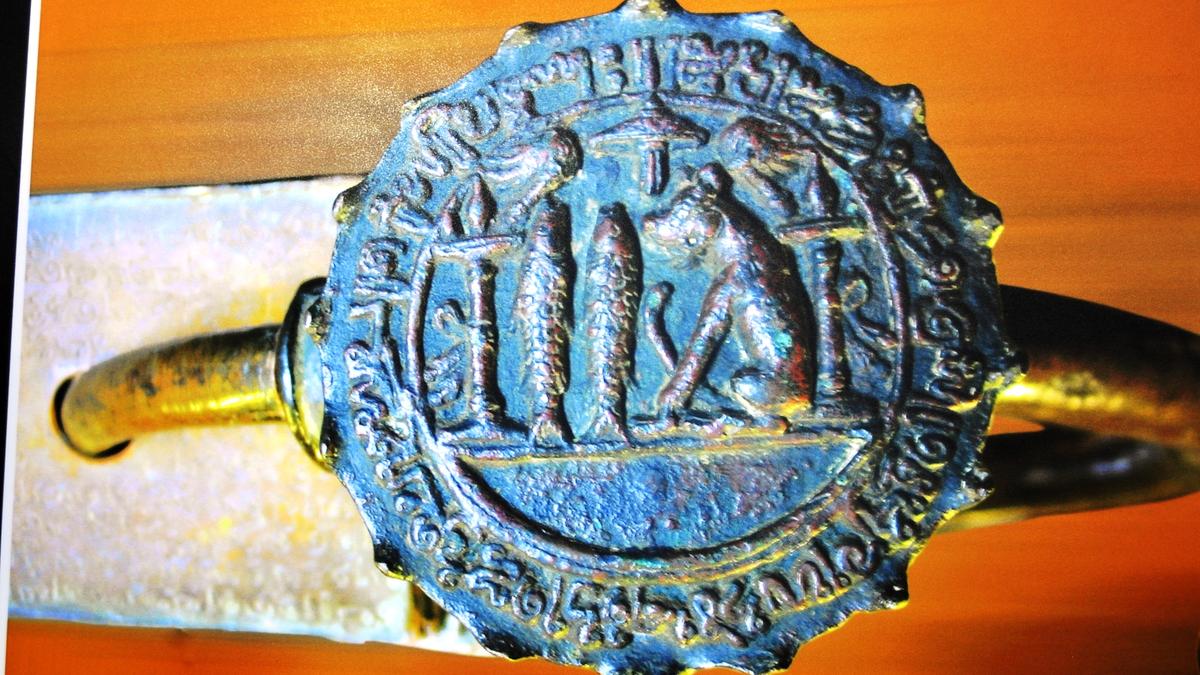
The seal on the larger plates features a tiger, the royal emblem of the Cholas, the twin fish of the Pandyas, and the bow of the Cheras, flanked by two fly-whisks and two lamps — symbols of royal authority. Around these runs a Sanskrit sloka praising Rajendra.
The smaller plates were issued by Kulottunga Chola I (r. 1070–1120 CE) in 1090 CE, after two emissaries — Raja Vidhyadhara Sri Samanthan and Abhimanothunga Sri Samanthan — from a Javanese ruler met him to seek reconfirmation of Rajaraja’s earlier grant, as the rulers had since changed. Kulottunga not only reaffirmed the grant but also augmented it, endowing additional land and 4,400 kalam of paddy to the Chulamani Vihara. The seal on these plates bears a brief Sanskrit sloka in praise of Kulottunga I, underscoring both royal patronage and the continued ties across the seas.
Subbarayalu said he had once visited the Leiden University library and observed the care taken by its officials to preserve the plates for so long. He requested ASI officials to take good care of the plates and provide access to scholars to study them.
Published - May 29, 2026 10:38 am IST
Source: The Hindu - India News