India produces hundreds of millions of tonnes of agricultural residue every year. Much of it is burned, contributing to seasonal air pollution, or simply discarded.
At the same time, industries across packaging, cosmetics, textiles, and chemicals continue to rely heavily on fossil-derived raw materials. The disconnect is structural. altM was founded to bridge it.
A manufacturing lens on climate
The company emerged from two parallel experiences. After leaving Tesla, Apoorv Garg joined Prometheus Fuels, a company working on sustainable aviation fuel through carbon capture. Immersed in climate-focused technologies, he repeatedly encountered the same problem. Strong scientific breakthroughs struggled to move beyond the lab.
Meanwhile, Yugal Raj Jain was back in India exploring industrial biomaterials and bio-plastics, thinking about India’s potential as a manufacturing hub for sustainable materials. Both founders had spent years at Tesla, helping scale manufacturing programmes including Model 3, Model Y, and Model S/X Plaid variants, while supporting expansion into China and Germany.
That background shaped how they approached the opportunity. The challenge was not only scientific discovery. It was industrialisation. The founders believed India could move beyond being a consumer of global materials innovation and become a producer at scale.
Turning residue into raw material
altM, short for “alternate materials”, develops bio-based chemicals and biomaterials using agricultural residue as feedstock. The company works with lignocellulosic biomass such as rice straw, wheat straw, and sugarcane bagasse.
Its process operates in two stages. First, the biomass is broken down into constituent fractions, including cellulose, hemicellulose, lignin, and silica. Then those fractions are upgraded into speciality biochemicals and biomaterials through proprietary upgradation pathways developed by the in-house R&D team.
The aim is to replace petrochemical-derived raw materials across industries such as beauty and personal care, packaging, construction, textiles, and industrial chemicals. 3 products have already been advanced to demo scale and selected for pilot plant production.
These include a cellulose-based rheology modifier for cosmetics, a lignin-based wood adhesive that is formaldehyde-free, and a lignin-derived SPF Booster for cosmetic applications.
The broader approach differs from many existing bio-based material companies. Most players extract value from a single fraction of biomass. altM’s integrated biorefinery model is designed to process the full agri-residue stream and generate multiple outputs simultaneously. That improves utilisation and economics together.
Building from the plant floor up
The company was founded in Bengaluru in 2022 and initially incubated at the Bangalore Bioinnovation Centre before moving into its own R&D and pilot manufacturing facility in late 2024. Its structure reflects a manufacturing-first philosophy. The R&D team develops and scales new molecules.
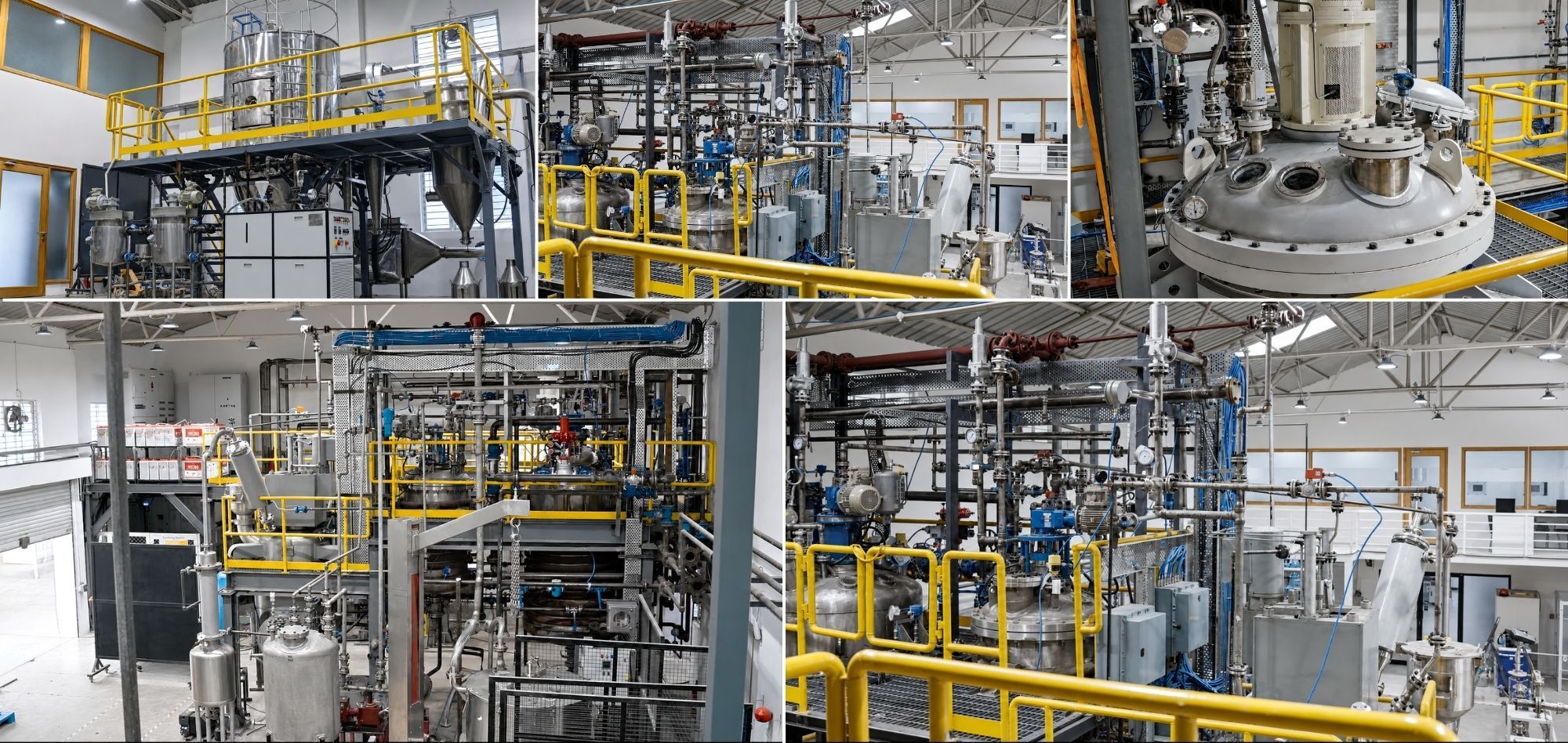
Engineering converts those processes into manufacturable systems. Business development manages customer relationships and market validation. Manufacturing operates the pilot facility and throughput systems.
The Chief Scientific Officer, Dr. Harshad Velankar, brings more than two decades of expertise in microbial and catalytic bioprocesses across India, the US, and South Africa. This mix of scientific and manufacturing expertise shapes how the company builds products. The founders began with a manufacturing system and built backwards from there.
The harder part of deeptech
The company describes India’s deeptech ecosystem as improving, but still early. One of the recurring challenges has been finding specialised technical talent and identifying equipment suppliers capable of supporting advanced process development.
The difficulty extends beyond research. In industrial materials, scientific performance alone is not enough. Products must meet commercial requirements around scale, consistency, pricing, and integration into existing systems.
That lesson emerged repeatedly in customer discussions. Manufacturers were often interested in sustainable materials but assumed they would require compromises on economics or performance. The company’s positioning is built around removing that assumption.
Scaling towards commercial production
altM currently generates early validation revenue through pilot operations. Commercial sales are expected to begin in Q3 2026. Its pilot facility operates at 15–50 tonnes per annum. The first commercial plant, targeted for H1 2027, is expected to operate at approximately 1,500–2,000 tonnes per annum.
The company’s five-year target is 10,000 tonnes per annum of cumulative installed capacity. Moreover, the firm raised $3.5 million in seed funding in August 2023, led by Omnivore, with participation from Theia Ventures, Thai Wah Ventures, and strategic investors including Suyog Kotecha, Mirik Gogri, and Paula and Ravi Mariwala.
Most of the capital has gone into pilot infrastructure, R&D expansion, customer trials, and engineering capability.
Building materials out of transition
The company’s thesis operates across climate, manufacturing, and industrial supply chains. Agricultural residue becomes an industrial feedstock rather than waste. Industries reduce dependence on fossil-derived inputs.
Farming communities gain economic value from biomass that would otherwise be discarded or burned. Europe is expected to become the company’s first international market, driven by regulations around sustainable content and emissions reduction.
The science behind bio-based materials has existed for years. The harder question has always been whether they can be manufactured on an industrial scale. That is the layer altM is trying to build.
Source: YourStory - Startups