Ahead of World Museum Day on May 18, here’s a look at Visakhapatnam’s varied museum circuit where naval history stands beside biodiversity archives, Buddhist interpretation spaces, folk heritage collections and experimental travelling exhibits.
School children looking at the realistic models of fisherwomen on display at the Visakha Museum in Visakhapatnam. | Photo Credit: V Raju
Located near the Beach Road stretch, Visakha Museum remains among the city’s oldest cultural repositories. Opened in 1991, the museum brings together artefacts connected to the region’s social and maritime past.
Why the Indian museum makeover is important
Its galleries contain ancient armour, coins, portraits, maps and palm leaf manuscripts from earlier decades. Sections devoted to the Kalinga region, colonial Visakhapatnam and local trade routes provide glimpses into a coastline that once served as an active mercantile corridor.
The dome of Pakistan Submarine Ghazi, which was destroyed by the Indian Navy when it tried to sneak in to the Visakhapatnam Harbour on December 04, 1971, on display at the Visakha Museum, in Visakhapatnam. | Photo Credit: K R Deepak
One of the museum’s enduring attractions is its collection of maritime memorabilia, including ship models and navigational equipment connected to the port city’s seafaring identity. Old photographs of Visakhapatnam before industrial expansion continue to draw residents who arrive seeking fragments of a familiar but altered cityscape.
Unlike immersive digital galleries now common elsewhere, Visakha Museum still carries the atmosphere of a conventional archive where history is encountered through objects rather than spectacle.
Musuem is open from 10am till 7pm.
A view of the Sea Harrier Museum, the British-made reconnaissance-and-attack aircraft, at the Beach Road in Visakhapatnam. | Photo Credit: KR Deepak
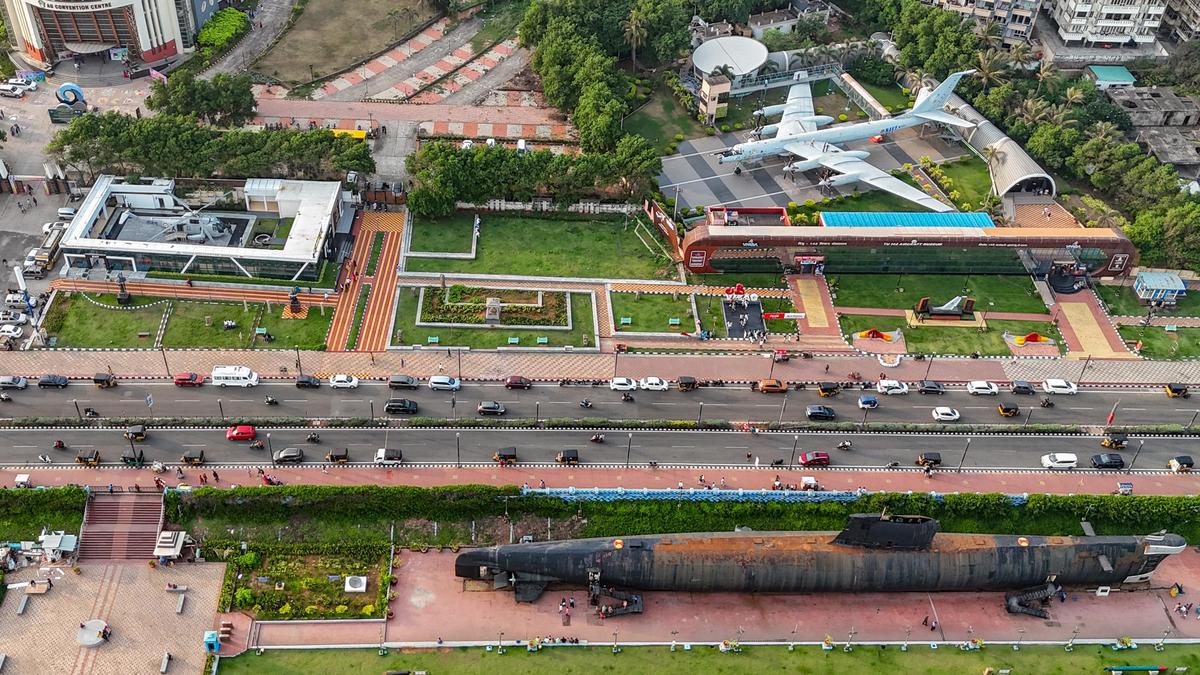
Visakhapatnam’s shoreline has gradually developed into an unusual open-air maritime museum corridor. Along the RK Beach promenade stand retired naval assets that once served in active military operations and now function as public museums.
The INS Kursura Submarine Museum remains the most recognised among them. The Soviet-built submarine, commissioned into the Indian Navy in 1969, completed several operational assignments before being decommissioned and converted into a museum. Visitors walking through its narrow passageways encounter torpedo sections, sleeping berths, control rooms and operational panels that reveal the confined realities of submarine life.
Just across the street stands the TU-142 Aircraft Museum, built around the long-range maritime surveillance aircraft used extensively by the Indian Navy. The massive aircraft, once deployed for reconnaissance and anti-submarine warfare, now introduces visitors to naval aviation systems, cockpit operations and maritime defence technology.
The Sea Harrier Museum adds another dimension to the city’s military museum landscape. The aircraft, known for its vertical take-off capability, once formed an important part of India’s naval aviation fleet. Interactive displays and visual installations inside the museum trace the aircraft’s operational history and technological features.
Tourists visiting the Helicopter Museum featuring a Sikorsky UH-3H Sea King, added to the maritime corridor on Beach Road near the TU-142 Aircraft Museum and the Kursura Submarine Museum in Visakhapatnam. | Photo Credit: K R Deepak
The newest addition to this maritime chain is the UH-3H Helicopter Museum. The helicopter, previously used for search-and-rescue operations and naval logistics, offers visitors a closer understanding of airborne naval support systems. Together, these museums have brought retired military equipment into public spaces, allowing visitors to understand their history and role beyond defence establishments.
The submarine museum and integrated maritime museum circuit is open for visitors 4pm to 8pm (except Mondays).
A view of the 3rd century BC Buddhist site of Thotlakonda where an interpretation centre is coming up in Visakhapatnam. | Photo Credit: KR Deepak
The ancient hilltop Buddhist site of Thotlakonda Buddhist Complex continues to attract archaeologists, students and travellers. Dating back to the second and third centuries BCE, the site once functioned as an active Buddhist monastic settlement overlooking ancient maritime trade routes along the Bay of Bengal.
The interpretation centre at Thotlakonda is set to strengthen public engagement with the site by contextualising the excavated remains through scaled models, illustrated panels and historical explanations. Rather than presenting ruins in isolation, the centre aims to help visitors understand the daily rhythms of Buddhist monks, the architectural layout of the monastery and the coastal trade links that contributed to the spread of Buddhism.
The interpretation centre has also become an important educational stop for school groups, many of whom encounter Buddhist archaeology for the first time through these displays. Archaeological fragments, pottery remains and reconstructed visual narratives help bridge the distance between excavation reports and public understanding.
(Complex timings are 9am to 5pm)
A boy watching the exhibits on display at the Nature Interpretation Centre at the Eastern Ghats Biodiversity Centre in Visakhapatnam. | Photo Credit: V Raju
While conventional museums often focus on human civilisation, the Eastern Ghats Biodiversity Centre at PM Palem shifts attention towards the ecological richness of the region.
A 'life like' model of the endangered 'pangolin', made by Fine Arts students of Andhra University, at the Eastern Ghats Biodiversity Centre at PM Palem in Visakhapatnam. | Photo Credit: V Raju
Situated amid the green landscape adjoining the Kambalakonda Wildlife Sanctuary, the centre introduces visitors to the biodiversity of the region. Exhibits document endemic flora, butterflies, reptiles, mammals and birdlife found across the hill ecosystems surrounding Visakhapatnam.
A view of the Eastern Ghats Biodiversity Centre at PM Palem in Visakhapatnam. | Photo Credit: K R Deepak
Educational installations at the centre explain forest interdependence, watershed systems and conservation pressures affecting the Eastern Ghats. Specimen displays, taxidermy models and interpretive graphics are designed to familiarise younger visitors with regional ecology that often remains absent from urban conversations.
The centre has gradually emerged as an important outreach space for nature education programmes, biodiversity workshops and guided walks.
(Timings are 9am to 4pm).
Nature group Wilded's portable natural history museum in Visakhapatnam. | Photo Credit: Special Arrangement
Among the city’s lesser-known museum initiatives is Nature group Wilded’s portable natural history museum, an unconventional travelling collection developed to bring natural history closer to people and community spaces.
Specimens on display at a portable natural history museum session by Wilded, a nature education group, in Visakhapatnam. | Photo Credit: K R Deepak
Unlike permanent museums housed within fixed buildings, this portable format carries preserved specimens, insect collections, skull replicas, feathers, fossils and educational material directly to schools, workshops and public gatherings. Founded by Vimal Raj, the initiative attempts to remove the formal distance that often separates museums from everyday learning environments.
Participants experiencing the portable natural history museum by Wilded, a nature education group, in Visakhapatnam. | Photo Credit: K R Deepak
The exhibit encourages tactile engagement and observation-based learning, particularly for children encountering natural history collections outside textbook illustrations.
Wilded’s portable natural history museum has been built around collections gathered through non-invasive methods, with specimens sourced without disturbing wildlife or natural habitats. According to founder Vimal Raj, the idea was to create a museum that sparks curiosity while helping children and adults understand how ecosystems function and coexist.
The travelling museum now features more than 250 exhibits classified into sections such as marine ecosystems, the Eastern Ghats and insects. The collection includes naturally found feathers, nests, fossils, insect specimens and replicas that introduce visitors to biodiversity through close observation and hands-on learning. Vimal Raj says the museum encourages visitors to identify the birds, trees and insects around them and develop a stronger connection with the natural world. Nature walks are often integrated with the sessions so that children can immediately relate what they see inside the exhibit to the environment around them.
By moving across educational spaces, public parks, libraries and communities instead of waiting for visitors to arrive, the portable museum aims to expand the definition of how museum experiences can be delivered.
Contact Wilded at 7330880274 to host a museum session.
Published - May 16, 2026 11:17 am IST
Source: The Hindu - India News