India’s startup ecosystem has become very good at building companies at speed. Professor Shashikanth believes building genuinely new technology is a different game altogether.
Nearly two decades ago, a group emerging from an IIT Bombay lab started Sedemac with an ambition that sounds deceptively simple: build new control technologies and see them achieve widespread adoption.
Today, the numbers tell a remarkable story. Sedemac has crossed Rs 1,000 crore in annual revenue, with around Rs 200 crore in EBITDA, Rs 150 crore in profit before tax and Rs 100 crore in profit after tax. The company operates at roughly 40% return on capital employed, ships one million motor controllers every quarter, and its technology sits inside millions of two-wheelers on Indian roads.
But Shashikanth’s story is less about one company’s growth and more about what happens when engineers attempt something that the market itself may not yet know it needs.
“Creators of technology are market creators,” he says. “You don’t start with, ‘Oh, this market is going to grow big.’ Therefore, it will grow big or not because of you.”
Solving a problem the market was not asking to solve
At the heart of Sedemac’s growth is its work on motor controllers and sensorless commutation. A motor controller manages the flow of power between a power source such as a battery and an electric machine. For that motor to operate, the controller needs to determine which coils should be energised based on the position of the rotor. Conventionally, a physical sensor can provide that information.
Sensorless commutation attempts to do this without such a physical position sensor, instead estimating the rotor’s position using other information.
At higher speeds, this has been understood for decades. At zero and low speeds, the physics becomes significantly harder because one of the phenomena used for estimation, back EMF, reduces with speed and disappears at zero speed.
“We are the first company globally, globally, it is a very big statement, that has made as much progress in sensorless commutation as we have,” says Shashikanth.
But Sedemac did not start in 2007 with a grand plan to solve this particular problem. The opportunity emerged years later through its work with the two-wheeler industry. Around 2014-15, while developing an Integrated Starter Generator or ISG, the team realised the system could be improved if it made progress on sensorless commutation.
In 2018, a TVS moped became the first vehicle to use the system. According to Shashikanth, it was also the world’s first sensorless ISG application.
From one moped to millions of vehicles
What followed was not an overnight deep-tech success story.
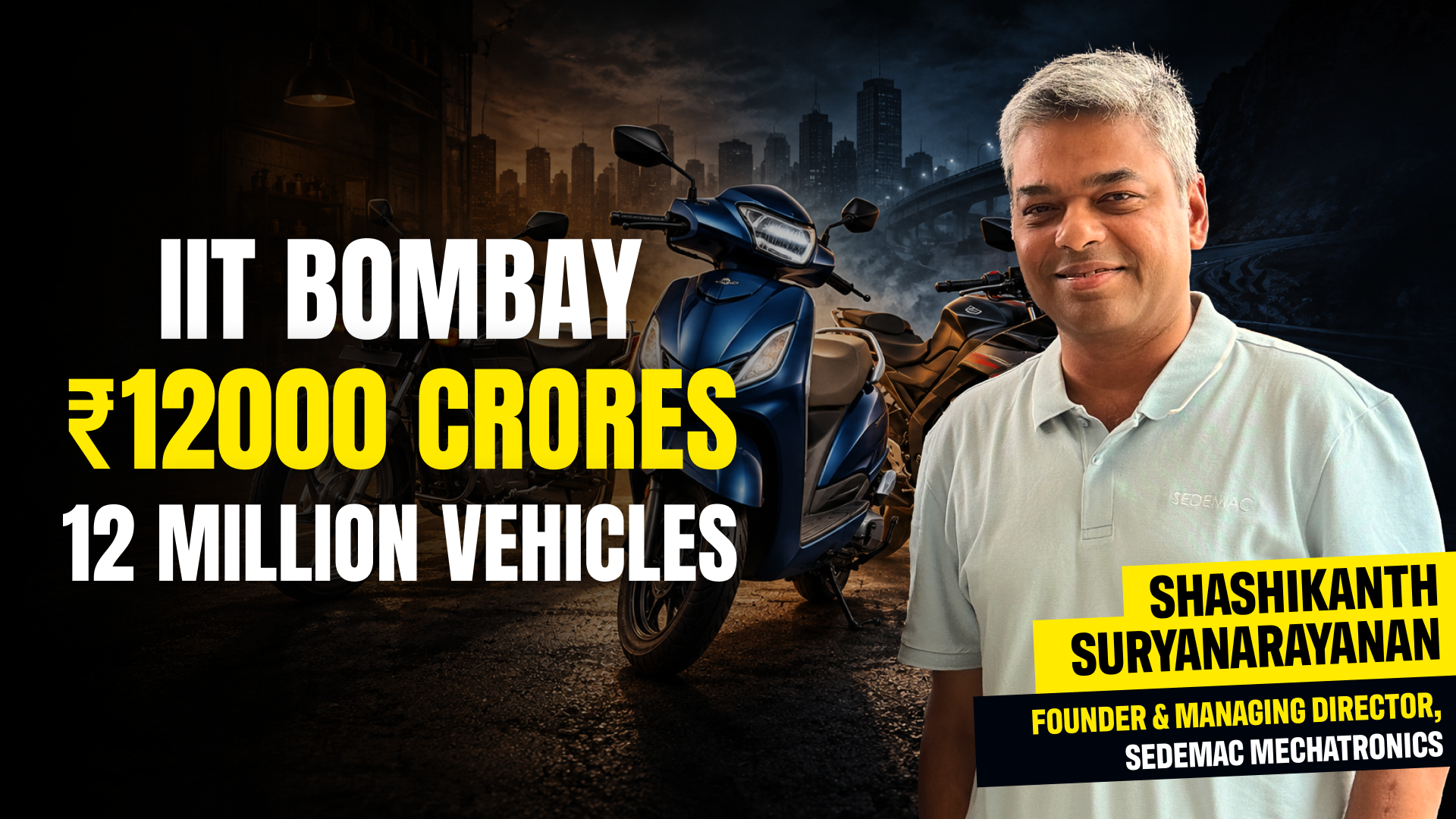
Sedemac estimates that 12 to 13 million vehicles carrying its ISG are now on Indian roads. Five of the top 10 two-wheeler models selling in India use its ISG in at least one variant, including models from TVS, Bajaj and Hero.
Another Sedemac technology, Shashikanth says, has already gone into around 50 million vehicles.
This scale matters because Sedemac had to break into an industry dominated by enormous incumbent suppliers. Four manufacturers, Honda, Hero, TVS and Bajaj, account for around 85% of India’s two-wheeler market, according to numbers Shashikanth cites in the conversation. Sedemac today supplies three of those top four.
“You cannot enter and grow very rapidly unless you have something special,” he says.
The company’s approach to finding customers has remained surprisingly straightforward. Build something new, create a working demonstration, and write directly to the leaders of that industry.
“If something is really fresh, usually you will get some response.”
Getting a response, however, is only the beginning. A demonstration has to work on the customer’s equipment. Pricing has to make sense. The technology has to survive its first commercial introduction. Users have to value it. Quality problems cannot emerge. Only then can serious scaling begin.
In two-wheelers, Shashikanth says the journey from demonstration to the first introduction could take three to four years if everything went right.
And sometimes, he says, the timeline can simply be “infinity”.
Deep tech needs technical talent and adopters, not just capital
For Shashikanth, Sedemac’s journey depended on two ingredients above everything else.
The first was “extraordinary technical ability”.
The second was having large, sophisticated customers capable of adopting what those engineers created.
“If you have the technical smarts who are like absolute top notch in very good density and you have adopters who can potentially adopt these cool things that these people are building, then those are very good setups for that to progress.”
Capital mattered, but he places it below those two factors.
In 2008, Nexus invested ₹2 crore in Sedemac. Shashikanth acknowledges that without an ecosystem willing to finance engineers without substantial capital of their own, the company might never have emerged.
But he draws a sharp distinction between enabling a business and creating one.
“Investors are betting on that business doing well,” he says. “They can never create the business. They can only support it.”
That distinction also shapes his view of India’s deep-tech ecosystem. Funding can create infrastructure, support experimentation and give engineers the runway to try difficult things. But money alone cannot manufacture technical excellence.
“You can never produce the talent just by throwing some money.”
The best engineers come for the work, not the vision statement
Sedemac today has roughly 250 engineers, with Shashikanth estimating that 60 to 70% come from IITs, NITs and BITS.
His philosophy for attracting them is unusually unsentimental.
“I feel that most employees, if you ask them honestly, they don’t care a damn about your vision.”
Instead, he argues that exceptional technical people primarily care about the quality of the work and whether they are rewarded fairly.
“The absolute top thing is that you should have high quality work. Otherwise the high quality employee will not come.”
Culture comes after those fundamentals. At Sedemac, he describes a workplace where hierarchy carries less weight than the strength of an argument. “If you’re talking nonsense, people will say you’re talking nonsense.”
For a technology company, this engineering density is not merely a hiring advantage. It is the engine that allows the company to repeatedly create new technologies.
As Shashikanth puts it, Sedemac’s achievement is not only sensorless commutation. More importantly, “we built an engine that can build such technologies”.
₹36 crore to ₹1,058 crore, but profitability is the bigger statement
Sedemac’s revenue was around ₹8 crore in 2014, ₹18 crore in 2015 and ₹36 crore in 2016. By FY26, Shashikanth said it had reached ₹1,058 crore, close to 30 times its 2016 revenue.
ISG became the biggest growth contributor from FY19 onwards, while the company is also pursuing opportunities across generators, electric vehicles and power tools.
Yet Shashikanth is particularly emphatic about another set of numbers: profitability and capital efficiency.
His argument is provocative. If a company claims to have created genuinely differentiated technology, that differentiation should eventually translate into competitive advantage and pricing power.
“If you claim that you are a technology company that has succeeded, how can you not make money?”
He qualifies this as an argument about companies that have already reached scale, rather than businesses still investing to establish themselves. But once meaningful adoption has happened, he believes technological advantage should become visible in economics.
“If you do not have strong enough EBITDAs and good ROCE, you are not a technology company. Straight.”
Sedemac’s ROCE is currently around 40%, according to the conversation. For Shashikanth, there is no financial trick behind it.
“You cannot financially engineer your way into this.”
Build something fresh. Make it valuable enough that customers want it. Earn some pricing power. Keep costs and capital expenditure under control. Profitability and capital efficiency follow.
India’s deep-tech opportunity is ultimately an imagination problem
Perhaps Shashikanth’s strongest argument is that India’s constraint is not simply capital or talent. It is whether enough engineers believe they can create something the world has not already created.
He compares technological ecosystems to sport. India can produce Virat Kohli because generations of young cricketers can realistically imagine becoming world-class. Spain can produce Lionel Messi because a similar pyramid exists around football.
For engineering, he believes India still lacks that depth.
“You cannot have excellence in an ecosystem without the top of the world being in that ecosystem.”
He does see progress. More engineers can now access capital, more young people are attempting difficult problems, and India has pockets of serious technical excellence. But ecosystems take generations to build.
Sedemac itself offers one glimpse of what that future could look like: a company that began with engineers trying to build “fresh technologies”, spent years persuading large manufacturers to adopt them, and eventually saw those technologies disappear almost invisibly into everyday products used by millions of Indians.
The lesson is not that every deep-tech company needs to follow Sedemac’s path.
It is that original technology often begins before there is an obvious market to measure, a customer asking for the solution, or even certainty that adoption will happen.
Source: YourStory