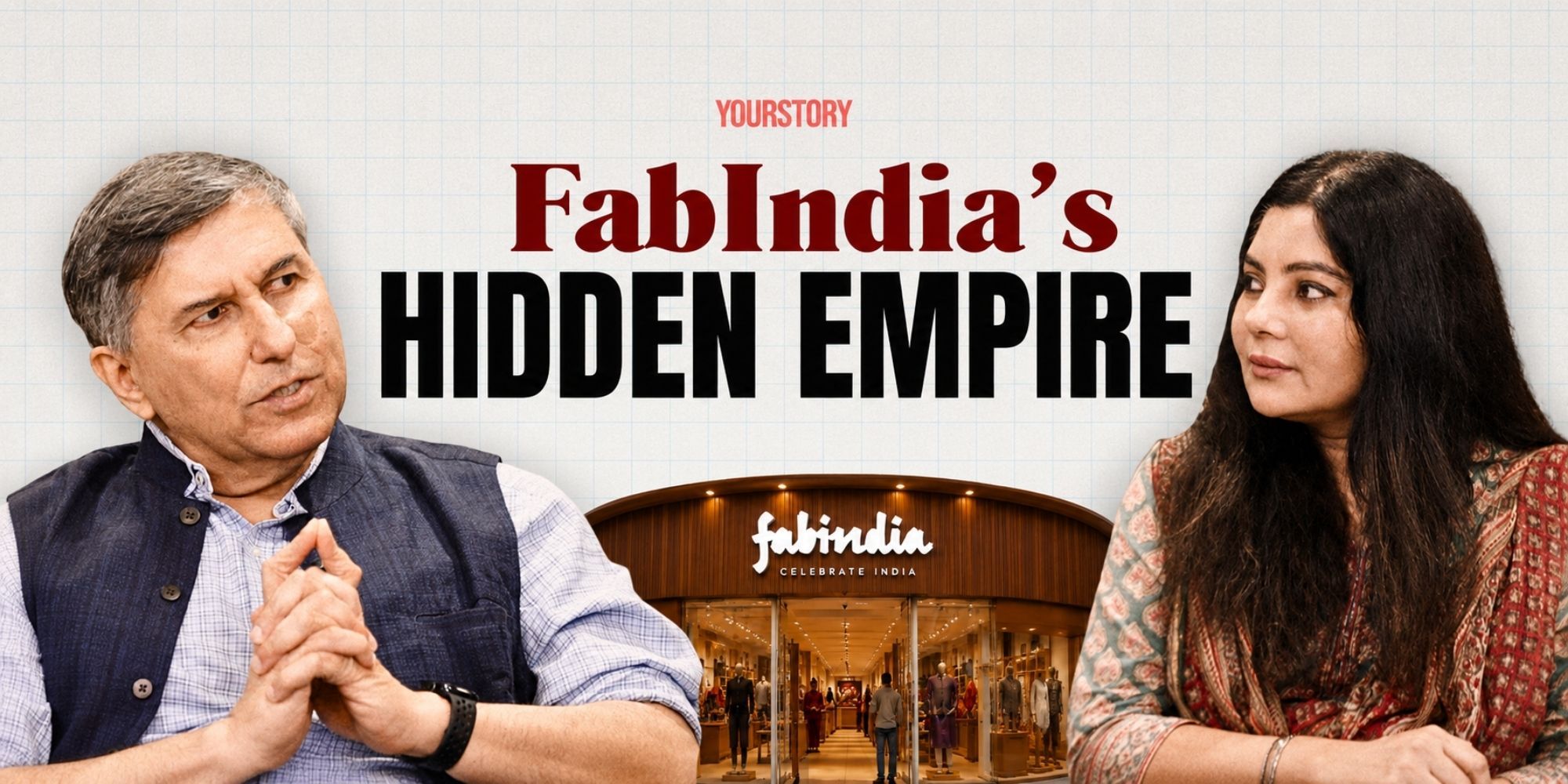
Fabindia has spent 66 years selling handcrafted Indian apparel and home goods, and Managing Director William Nanda Bissell says the lesson of that stretch is that a brand should be a constant rather than a trend. In a conversation with Shradha Sharma, Founder and CEO of YourStory and The Bharat Project, he set out how the company is applying that thinking to a retail market being reshaped by quick commerce, adding services to its stores and entering premium western wear with a sub-brand called Fabels, launched on 26 June 2026.
Fabindia operates more than 340 stores across 127 cities in India, along with 13 international outlets across seven countries, according to a company statement issued in June 2026. Its supply base sits with craft-based micro-enterprises, a network Bissell describes as a million small engines that need only the right fuel. Its proposed public listing remains pending, with no dates or price band announced as of July 2026.
Why a 66-year-old brand refuses to chase trends
Fabindia was started in 1960 by John Bissell and spent its early years as an exporter before turning to the domestic market after the reforms of 1991 created a rapidly expanding Indian middle class. Bissell said most brands are considered fortunate to last 20 years, and that longevity of this kind says something about rootedness.
He described the ambition as being a compass brand rather than a fashionable one. A brand that is in for three years, he said, becomes an out brand in year four, and Fabindia would rather be one of the constants in a customer's life. He framed a retail brand as essentially recall, the associations and memories a customer attaches to a name.
That rootedness extends to how the company sources. Bissell said India's advantage in the world is its micro entrepreneurs, and that artisans are best understood as micro entrepreneurs rather than as beneficiaries. Some supplier relationships now run three generations deep. Among them is Rangsutra, the community-owned company founded in 2006 by Sumita Ghose, in which more than 2,000 artisans, a majority of them women, hold shares, and which also supplies IKEA.
Moving stores from selling goods to selling services
Bissell identified two shifts reshaping retail globally. The first is that physical retail has gone from being the only channel to one among many, alongside quick commerce, marketplace commerce and social commerce. The second is a data asymmetry. Digital players know who is browsing and can segment accordingly, while a customer who walks through a store and leaves remains anonymous.
His conclusion is that stores need a moat, and that the moat is services. Alongside alterations and bespoke tailoring, the company has added interior design solutions, treating the store as a place people choose to travel to for an experience rather than a place they visit out of necessity.
Fabels is part of the same repositioning. Rather than build an undifferentiated western wear label, Bissell said the company spent a few years working out how to translate its craft techniques into western silhouettes, so that a dress or a jacket still carries the brand's design DNA. Compounded growth in western wear has been running at around 18%, he said.
Why does a physical store need a moat
Quick commerce and marketplaces hold two advantages a shop cannot match. They know who is browsing, and they can act on that in seconds.
A moat, in this context, is whatever a competitor cannot copy at speed. Fabindia's answer is service work that has to happen in person. A garment altered to fit, a room designed around a customer's home.
The bet is that convenience and craft are different purchases. Toothpaste goes to an app in 10 minutes. A kurta that fits does not.
Why the company automated instead of simplifying
Supporting this is a quieter operational overhaul. Fabindia has deployed radio frequency identification, or RFID, which allows a staff member to walk through a store with a handheld device and capture the full inventory in 12 to 18 minutes, against three days earlier. That data feeds an artificial intelligence layer the company calls the self-driving enterprise, which Bissell expects to run back-end operations within a year, issuing instructions directly to village suppliers.
The point, in his telling, is not automation for its own sake. India is not a homogenised market, and tailoring product region by region was always the most complicated part of the business. Most retailers simplify their range to scale. Technology lets Fabindia keep that variety rather than flatten it.
Whether services can hold footfall against quick commerce is the question the next few quarters will answer, and Fabindia will answer it in public if its listing goes ahead. For a company whose margin depends on thousands of small producers, the outcome matters well beyond its own shelves.
Source: YourStory - Startups