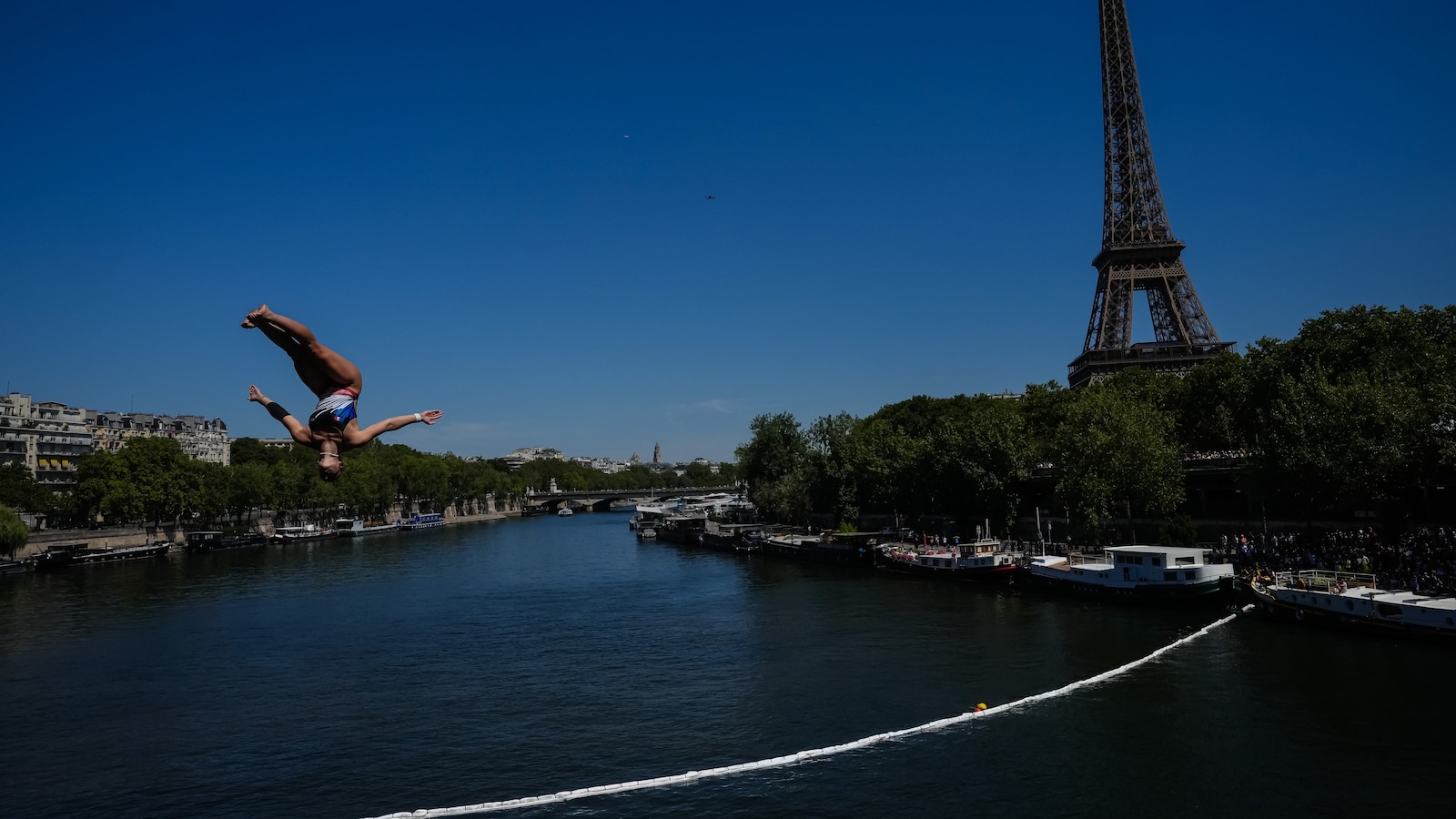
Paris is hosting its first high-diving competition in the Seine, with athletes diving from a 20-meter platform near the Eiffel Tower
PARIS -- Paris is staging its first high-diving competition in the Seine, with athletes launching themselves from a 20-meter platform in front of the Eiffel Tower — a spectacular new test of the city’s effort to reclaim its river for sport.
The event on the Bir-Hakeim Bridge has also exposed the fragility of that ambition: Organizers suspended training Thursday when traces of hydrocarbons were detected upstream. By Friday, the French Swimming Federation said the affected area had been treated, allowing athletes to return to the water and the event to proceed as planned.
High diving concludes Saturday with the final two rounds and medal events, while the broader European Aquatics Championships run through Aug. 16.
“There are things that are within our control, and there are uncertainties that are inevitably linked to any outdoor activity,” said Maxime Sauvage, Paris deputy mayor in charge of sports, sports facilities and equal access to sport.
Among the things within the city’s control, he said, are the massive investments made before the 2024 Olympic and Paralympic Games to make the river safe for swimming, from work to prevent sewage from flowing directly into the Seine to improvements in stormwater management.
“There is always a small risk, but that is also part of what makes outdoor events special,” Sauvage said. “When they work, it is magical.”
Hundreds of people gathered along the riverbanks Friday to watch the divers. Some stopped during their lunch break, while others stumbled across the competition by chance.
Among them was Rebecca Kapogiannis, a 45-year-old visitor from London, Ontario, who was visiting Paris with her daughter to celebrate her graduation. Her daughter had even packed a bathing suit in case she got the chance to swim in the Seine.
“We just headed down to the (Eiffel) Tower today and thought we would walk along the Seine and stumbled upon this and thought it was a really cool activity to watch,” she told The Associated Press.
“I was not expecting a competition to take place in the Seine, but I think it’s such a cool use of this water that runs right through the city.”
For Cynthia Matz, who was visiting Paris with her husband, Sean, the setting itself was part of the draw. She said they probably would not have sought out the competition had it been held inside an aquatics center.
“Anybody can go. I don’t have to know anything about diving. I can just say, ‘This is really cool to see,’” Matz said.
“Having it out in public, people will just stop and go, ‘Huh, what’s going on?’ and stop and spend some time and enjoy it.”
That ability to stumble across elite sport in the middle of the city reflects a broader transformation Paris officials have been pushing for years: turning the Seine from a river associated largely with commerce, transport and tourism into a place where people can also swim, play and compete.
The 38th European Aquatics Championships, from July 31 to Aug. 16, mark the centenary of the inaugural championships, held in Budapest in 1926. For Paris, they are a return of another kind: The French capital last hosted the event in 1931.
More than 1,000 athletes are competing across five disciplines: swimming, diving, artistic swimming, open-water swimming and high diving.
The Seine is hosting both open-water swimming and high diving, placing the river back at the center of a major international sporting event two years after the Paris Olympics.
Swimming in the Seine was officially banned in 1923 amid pollution and the dangers of river traffic. Public swimming returned only in 2025, after Paris and its partners mobilized 1.4 billion euros to make the river swimmable, an effort accelerated by the Olympics.
For many French people, former President Jacques Chirac’s 1988 pledge, when he was mayor of Paris, to make the Seine clean enough for swimming again seemed like a distant dream.
But since the 2024 Olympics, images of athletes competing — and now residents swimming — in the river have become almost familiar.
Around 70,000 people used the city’s designated Seine swimming areas in July, according to Paris City Hall, compared with nearly 100,000 during the entire summer last year, suggesting growing public interest in reclaiming the river for recreation.
Bringing sport into daily Parisian life has been an objective across successive city administrations. Under Emmanuel Grégoire, elected mayor in March, Sauvage said the mission is to “make the entire city increasingly favorable to physical activity and sport.”
“For decades, the Seine was limited to economic purposes, tourism with sightseeing boats, and logistics with ships loading and unloading goods in Paris,” Sauvage said. “It was a river with high levels of pollution that also had a significant impact on its biodiversity.”
Now, he says, the aim is to add another identity to the river without erasing the others.
“Paris is not just a postcard image, it is also a magnificent sporting venue,” Sauvage said. “It is a city that people come to visit, but it is also a city to be experienced by bike, through running, through sport, through play and through swimming.”
Associated Press writer Thomas Adamson in Paris contributed
24/7 coverage of breaking news and live events
Source: ABC News - International