Malaysian durian farmers face challenges as climate change impacts their crops
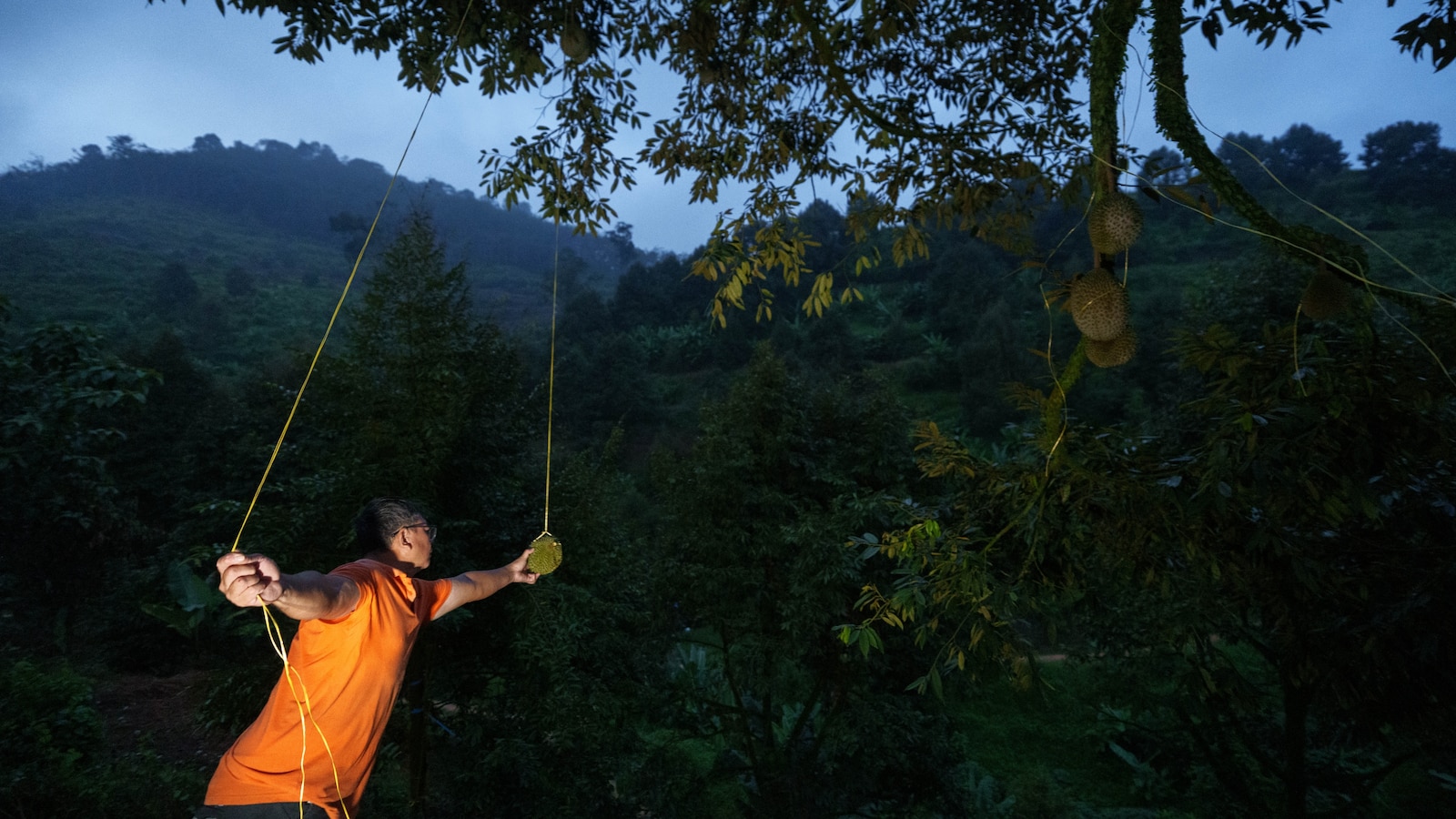
KARAK, Malaysia -- KARAK, Malaysia (AP) — Malaysian durian orchard owner Stephen Chow’s workers spend hours in the fields in the dead of night, donning headlamps to collect freshly ripened fruit coveted by Chinese consumers. But the hard work may not be enough to keep Chow out of the red.
Durian lovers prize the Malaysian premium varieties such as Musang King and Black Thorn, but their growers face a harsher reality. Climate change, caused by the burning of oil, gas and coal, is making it costlier for growers like Chow to produce quality durians, adding pressure as they compete with Thailand and Vietnam, which dominate a booming export market to China.
Extreme weather has dealt repeated blows to Chow’s orchard, which is in Karak, a small town about an hour drive from Kuala Lumpur. In 2021, heavy rainfall triggered flooding that damaged about 100 of his durian trees and his machinery. Over the following three years, persistent rain during flowering season caused pollination failure, cutting into his yield. And now, Chow is facing other challenges.
“Breaking even would already be very good. Most likely there’ll be a loss this year,” Chow said.
Between February and April, afternoon temperatures hit 33 to 35 degrees Celsius (91 to 95 degrees Fahrenheit), and rain fell mostly at night, he said. Such weather favored flowering, and Chow responded by pruning to prevent deformed or small fruit while stepping up watering and fertilization because of the heat. A rise in fuel and fertilizer prices because of the Iran war, however, meant those extra efforts came at a higher cost.
An oversupply of durians in Malaysia — driven by hot and dry weather and more orchards reaching maturity — also pushed prices down. Grade A Musang King durians from his orchard sold for the equivalent of $8.6 per kilogram (about 2.2 pounds) in local currency in early July, about half compared to the same period last year and roughly one-third of the peak price in 2024.
Durians' overpowering smell is fragrant to those who love it and foul to those who don't. Beneath a spiky shell, their flesh offers a rich, creamy texture with varying flavors. Some taste like sweet custard with fruity flourishes, others carry a hint of bitterness, an alcohol tinge or even a peanut butter-like flavor.
Official data showed Malaysia's durian crop covered 92,100 hectares (227,600 acres) in 2024, up almost 40% from 2016, a size even larger than the total land area of Singapore, the city-state island just south of Malaysia. During that period, Malaysia's production grew nearly 90% to 568,800 tonnes.
The boom was fueled by China beginning to import whole frozen Malaysian durians in 2019. Fresh durians followed in 2024, as Beijing expanded what has been dubbed “durian diplomacy” by welcoming more Southeast Asian countries to export the fruit.
The Food and Agriculture Organization of the United Nations said China procured about 95% of global durian exports between 2020 and 2022. It imported 1.87 million tonnes of fresh durians worth $7.5 billion in 2025, with the volume jumping six times in the past decade, according to China's customs data.
Consumers there can find the fruit in supermarkets, grocery stores and durian specialty shops. Shanghai resident Song Xiaohua, in her 30s, said she would eat durians once a week instead of once a month if it weren’t for its high calorie count. To her, durians taste creamy and are like both fruit and dessert.
“It feels like celebrating Lunar New Year every time I have a durian,” Song said.
Malaysia lags far behind Thailand and Vietnam in exports to China. But the Malaysian industry touts its durians as higher quality. Unlike their counterparts, Malaysian growers typically do not harvest early, instead collecting only naturally ripened fruit.
As global average temperatures rise, extreme weather events like heat waves, floods and droughts are becoming more frequent and intense worldwide, often forcing farmers to scramble to adapt.
Peninsular Malaysia recorded a significant jump in average temperature from 1969 to 2025, with an increase of 0.24 degrees Celsius (about 0.43 degrees Fahrenheit) per decade, according to the country's meteorological department.
Ooi Teik Hock, whose orchard in Perak state is near the border with Thailand, said there were fewer fruit quality problems when temperatures were lower two decades ago. Concerned about the heat, he moved his orchard from the plains to the highlands about 10 years ago, where nights are cooler and air is more humid.
Still, global warming remains a threat, fueling the proliferation of once-rare pests and forcing Ooi to use pesticides more frequently, which he said have jumped some 30% in price from three years ago.
For the first time, Ooi didn't see fruit bats, a main pollinator, at his orchard during this year's flowering season. He said it could be a result of extreme heat or the widespread use of pesticides for pest and disease control.
The weather changes also affect overall quality, especially for the Musang King variety, which is sensitive to weather conditions, said Lim Chin Khee, an adviser to the Durian Academy, which trains durian growers in Malaysia.
Too much rain during the fruit's rapid development period can cause white and grayish patches on golden yellow flesh, while water shortages during that time can cause some black spots around the flesh, he said.
With expectations that El Nino, a periodic warming of Pacific Ocean that leads to warmer temperatures, could bring Malaysia record-high temperatures between March and May, Lim advised farmers to expand water reservoirs or prepare to install tube wells as a backup if their ponds dried up.
He said producing good fruit depends equally on the weather and the farmer’s effort. And that extreme weather events would reduce supply while simultaneously driving up prices, he said.
“So for those farmers (who) are well prepared, actually when any disaster strikes, that is an opportunity,” he said.
Grower Kie Kim Hwa learned how to farm durians from his grandfather at a young age. When he took charge of the orchard in Penang Island off Malaysia's western coast, he chose to do things slightly differently than previous generations.
He installed sensors and instruments to track rainfall, humidity and wind speed, among other data, which was sent to a cloud drive for him to review anywhere and keep a record. Some were placed among the trees and grass, and others deep in the soil. Not everything required high technology: he also checked the surface of a bucket of water for insects to gauge pest levels.
The data allowed Kie to intervene early before problems arose and ultimately control fruit quality and quantity to match market demand.
“We live and die by the weather,” he said. “But we can still prepare.”
Associated Press writer Fu Ting in Washington contributed to this report.
The Associated Press’ climate and environmental coverage receives financial support from multiple private foundations. AP is solely responsible for all content. Find AP’s standards for working with philanthropies, a list of supporters and funded coverage areas at AP.org.
24/7 coverage of breaking news and live events
Source: ABC News - International