Home/Technology/Researchers devise a full-color night vision goggle

Researchers devise a full-color night vision goggle

TechnologyAugust 2, 20261 min readAttributed summary
Researchers devise a full-color night vision goggle
Wavelength and intensity in the infrared are translated into colors in the visible.
Reading Settings

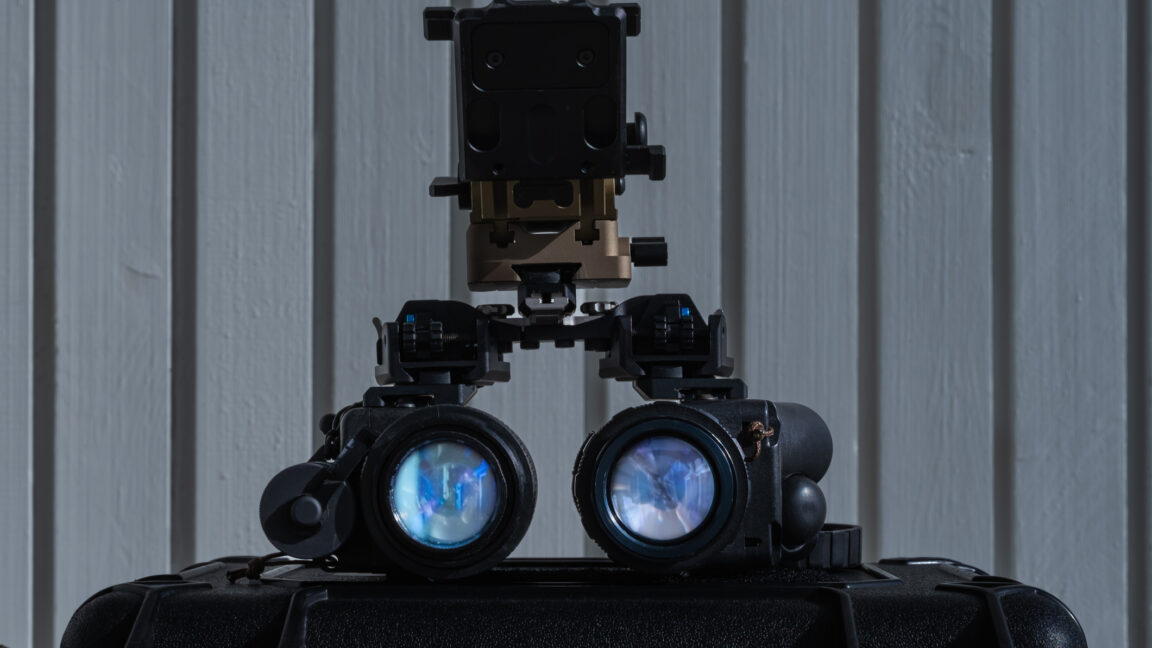
Human eyes don’t register the infrared portion of the light spectrum because infrared photons don't carry enough energy to trigger the signaling pathway inside our light-sensing cells. But we’ve been able to make devices that give us a visual representation of what’s happening in the infrared.

A team at the Beijing Institute of Technology, led by Xin Tang and Ge Mu, has now built a device that lets people see infrared in a new way. Instead of just translating it to visible shades of green as it’s done in standard night-vision goggles, it translates different infrared wavelengths into distinct parts of the visual spectrum, giving the eye something closer to natural vision.

Researchers achieved that by combining mercury telluride colloidal quantum dots, which absorb infrared light, and a dual-layer OLED, which converts that absorbed energy into visible color. Stacked together with the right internal wiring, they make incoming infrared radiation come out the other side as an ordinary-looking, full-color image.

Read full article

Comments

Source: Ars Technica

Related technology stories

The Download: the agentic web arrives and the drive for safer roads
Sourced report
technologyreview.com8 minutes ago

The Download: the agentic web arrives and the drive for safer roads

This is today’s edition of The Download, our weekday newsletter that provides a daily dose of what’s going on in the world of technology. The agentic web is here In 2001, a decade after in

6 min briefingRead signal →
Stop counting tokens, start counting what ships
Sourced report
technologyreview.com8 minutes ago

Stop counting tokens, start counting what ships

When a developer gives an AI agent a coding task, the agent does more than answer once. It plans, generates code, runs tests, and repeats the process to correct errors. A single task can use 10 to 50

6 min briefingRead signal →