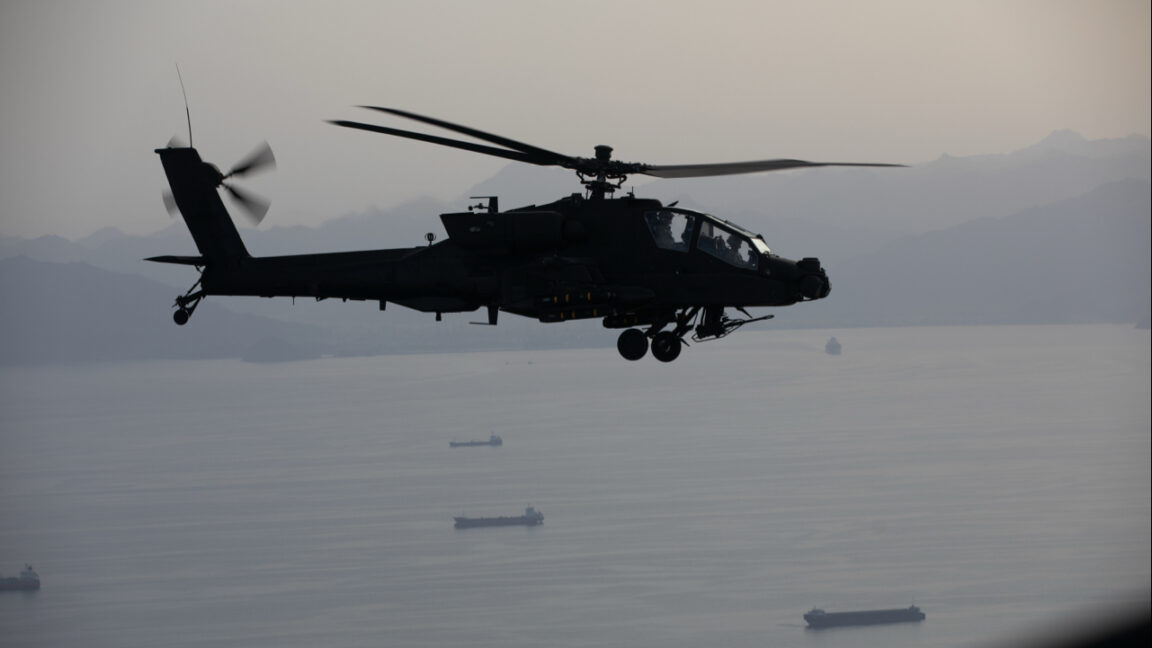
US Navy’s Task Force 59 achieved the drone rescue at sea near Strait of Hormuz.
A drone boat picked up two US Army pilots from waters near the Strait of Hormuz after their helicopter gunship went down, US military officials said. The incident apparently represents the first time the US military has used a drone for such a rescue mission at sea.
The two crew members from the US Army AH-64 Apache were “rescued by American forces” at 7:33 pm US Eastern Time after their helicopter went down off the coast of Oman on June 8, according to a US Central Command press release. That press release mentioned support from US Navy units including the US 5th Fleet’s Task Force 59, which is charged with integrating uncrewed aerial, surface, and underwater vehicles, alongside AI, into 5th Fleet maritime operations.
Anonymous US military officials initially told CBS News that the Apache air crew was rescued by an uncrewed surface drone operated by Task Force 59 from the US Fifth Fleet in Bahrain. The officials also described the incident as the first time the military had used a drone to rescue people from the water.
Similarly, an unnamed US official told ABC News that a drone with a “speed boat-like design” picked up the helicopter pilots from the water. More recently, a military spokesperson told the New York Times that the drone boat had delivered the pilots to a point in the water where they could be hoisted up to a waiting helicopter.
“The surface drone that assisted in last night’s rescue of the Apache crew off the coast of Oman was a US Navy Corsair unmanned surface vessel operated by U.S. 5th Fleet’s Task Force 59,” said US Navy Captain Tim Hawkins, a spokesperson for US Central Command, in a statement shared with Ars. “The Task Force began fielding these drones in theater in late March.”
The Corsair is an autonomous surface vessel stretching 24 feet in length developed by Saronic Technologies, a defense company based in Austin, Texas. Saronic’s website describes the Corsair as being capable of carrying up to 1,000 pounds over 1,000 nautical miles, with a top speed surpassing 34 knots.
Such a drone boat is supposedly capable of continuous, autonomous loiter operations in which the Corsair maintains its position while autonomously regulating power consumption and only engaging its engine when needed, according to a Saronic blog post. The drone boat has supposedly survived a range of sea states that included waves exceeding five feet in height.
The company also described a fleet of eight Corsairs as having operated for more than 92 continuous hours while demonstrating autonomous missions and behaviors in “comms-disabled environments” during a weeklong, 24/7 exercise in January 2026. Human mission operators were still able to monitor and control the drone boats from an onshore base when needed.
The New York Times was first to report that the Apache helicopter went down and that the crew members had been rescued on June 8. But the paper cited an anonymous source “briefed on the incident” as saying “it was not immediately clear whether the Apache was shot down by Iranian fire, experienced mechanical failure, or encountered some other problem.”
Nonetheless, in a social media post on June 9, President Donald Trump blamed “the Iranians” for having “shot down one of our highly sophisticated Apache Helicopters while patrolling over the Strait of Hormuz.” He also warned that “the United States must, of necessity, respond to this attack.”
The US Army Apache helicopters are among the low- and slow-flying US military assets capable of targeting and destroying the swarms of small boats used by Iran’s paramilitary force known as the Islamic Revolutionary Guard Corps, according to The War Zone. For example, such helicopters helped destroy six small Iranian boats that threatened commercial shipping near the contested Strait of Hormuz on May 4.
Shipping traffic in the vital Strait of Hormuz has effectively halted since the United States and Israel jointly attacked Iran on February 28, 2026. Iran has since claimed authority to determine which ships can pass through the strait and set up a toll booth system for inspection and crypto payments, while periodically attacking commercial ships, using attack drones, missiles, and small boats.
Since April, the US Navy has also had its own blockade targeting ships entering or leaving Iranian ports. The US military has conducted periodic strikes on Iranian coastal positions and small boats, shot down incoming Iranian attack drones, attempted mine-clearing operations using sea drones, and conducted patrols along the Strait of Hormuz with assets such as Apache helicopters.
The new demonstration of drone boats for maritime combat search and rescue operations will probably pave the way for future operational use, according to The War Zone. It pointed out that “pre-positioned” drones distributed ahead of time “along certain flight paths” could be especially helpful for future search-and-rescue operations in the Pacific, where the US military is preparing for potential confrontations with China’s increasingly formidable navy and air forces. It would not be surprising for at least part of the Pentagon’s nearly $54 billion drone request to cover sea drones for such purposes.
This story was updated on June 9, 2026 to include a statement from CENTCOM about the Corsair drone boat used in the rescue and additional information about the vessel from the company Saronic. The updated story also references a social media post from President Donald Trump that blamed the Iranians for downing the Apache helicopter.
Source: Ars Technica