FCC did not violate carriers’ right to jury trial, court says in 8-1 ruling.
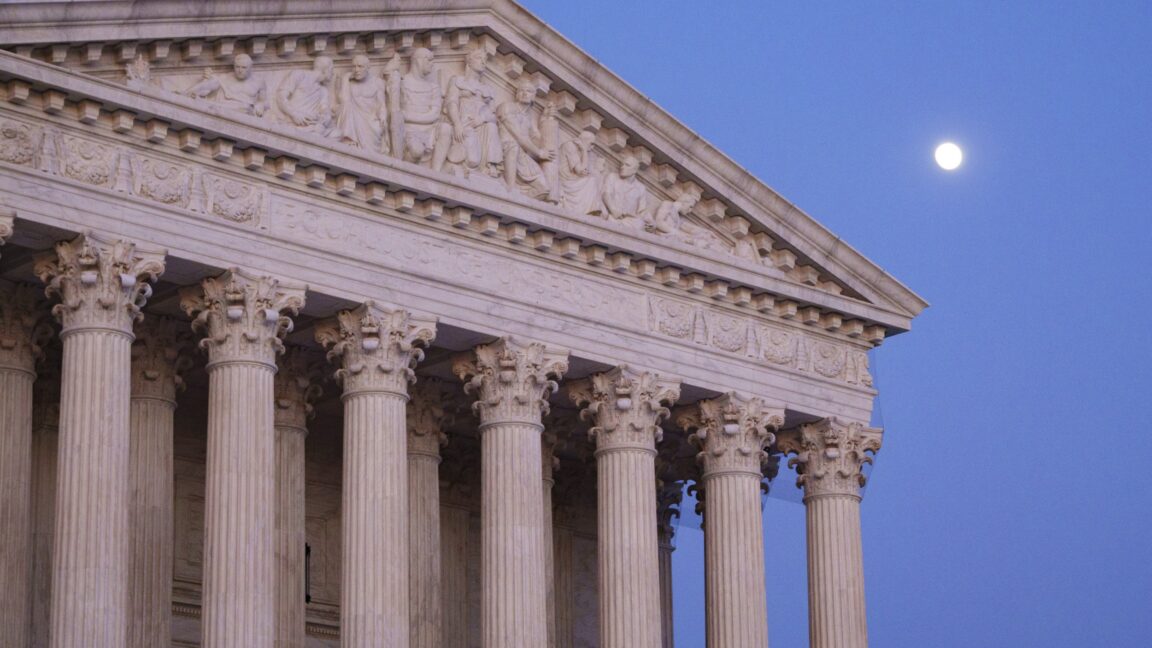
AT&T and Verizon lost an attempt to overturn fines for selling users’ real-time location data without consent, as the Supreme Court ruled today that the Federal Communications Commission process for issuing financial penalties did not violate the right to a jury trial.
AT&T convinced the US Court of Appeals for the 5th Circuit to overturn its fine last year, while Verizon lost in the 2nd Circuit. The Supreme Court took up the case to resolve the circuit split and reversed the 5th Circuit decision in today’s ruling, which was 8-1 with Justice Clarence Thomas dissenting.
AT&T and Verizon were fined a total of $104 million by the FCC in 2024 for violations revealed in 2018. The carriers paid their fines and challenged them in circuit appeals courts, where judges’ panels ruled on the cases. Carriers claimed this system deprived them of the Seventh Amendment right to a jury trial.
But in a majority opinion written by Chief Justice John Roberts, the court accepted the FCC argument that carriers could have obtained jury trials if they refused to pay the fines and the government tried to collect. Carriers could either pay the fines and challenge them in circuit appeals courts, or not pay the fines and wait for the government to collect in a process that ultimately would result in a jury trial for each carrier.
“The FCC’s forfeiture proceedings fit comfortably within” the Supreme Court’s Seventh Amendment precedents, Roberts wrote. “The orders at issue did not settle the carriers’ legal obligations because, stated simply, they did not create an obligation to pay. And the orders did not reflect the ultimate determination of any fact because, before the carriers could have been made to pay, the Government was required to prove its case to a jury.”
During oral arguments, justices expressed skepticism of AT&T and Verizon’s claims and seemed to agree that FCC fine decisions are nonbinding until enforced by a court. Justice Brett Kavanaugh described the case as a victory for carriers either way, because the government acknowledged its orders are nonbinding without a jury trial.
“It seems like you’ve won on the law going forward, one way or the other,” Kavanaugh told the attorney representing the carriers.
Today’s decision is important for upholding the FCC’s ability to investigate and propose penalties that can be enforced in court, said John Bergmayer, legal director at advocacy group Public Knowledge.
“The Supreme Court got this one right,” Bergmayer said in a press release. “AT&T and Verizon sold access to their customers’ location data, then failed to stop bounty hunters and even a rogue sheriff from using it to track people who had no idea they were being followed. The FCC investigated, found the carriers liable, and proposed penalties—which the carriers were always free to challenge in court.”
AT&T and Verizon “tried to dodge all accountability by claiming the FCC’s established process denied them a jury trial,” but the Supreme Court confirmed that this isn’t true, Bergmayer said. “This decision keeps the FCC able to do the job Congress gave it. An agency that cannot investigate carriers and propose penalties would lose one of its best tools for protecting consumers and enforcing the law,” he said.
Regarding Kavanaugh’s point during oral arguments, Bergmayer told Ars today that “you can debate the framing, but that was already the law anyway. The FCC can only enforce through the courts.” The FCC would have lost if it had argued differently, he said.
AT&T and Verizon “argue that FCC forfeiture orders cause reputational and practical harms entitling them to a jury,” the Supreme Court wrote today. “They contend that the Seventh Amendment applies to such harms, ‘even where no money is at stake.’ This argument is hard to square with the text of the Seventh Amendment, which applies only to suits ‘where the value in controversy shall exceed twenty dollars.’”
Besides what the court called the “textual implausibility” in the carriers’ legal theory, justices said the risk of reputational harm does not “exact an unduly high cost for exercising their jury right.” Reputational harm may befall any party in the preliminary stage of a legal proceeding, and “this has never been thought to pose a Seventh Amendment problem,” the ruling said.
During oral arguments, the carriers’ attorney said “legitimate parties” always pay the fines and that “it had occurred to no one for decades that these orders are not binding.”
“Refusing to take yes for an answer, the carriers insist that they actually must pay,” the court wrote. “They point out that [Section 503 of the Communications Act] uses words that sound in a mandatory register—the Commission ‘determine[s]’ whether a forfeiture is appropriate, ‘assesse[s]’ the ‘amount’ of such a penalty, and ‘impose[s]’ that penalty.”
But those words by themselves “tell us little about whether a §503(b)(4) order truly settles the carriers’ rights and duties,” the court said. When the legal phrases are put in the proper context of the overall statutory scheme, it’s clear that the FCC “is powerless to visit any adverse consequences on a regulated party who receives a forfeiture order,” the court said.
The carriers’ case relied on the Supreme Court’s June 2024 ruling in Securities and Exchange Commission v. Jarkesy, which held that the SEC system for issuing fines violated the right to a jury trial. In its ruling today, the Supreme Court said that “Jarkesy only proves our point.”
In Jarkesy, “we held that the Securities and Exchange Commission (SEC) could not impose civil penalties using its in-house administrative process,” the court said. “Those penalties were immediately enforceable; the SEC could garnish the recipient’s wages or deduct a portion of the forfeiture from his tax return. And if the SEC were required to resort to judicial means of enforcement, no jury was available—at least as to the underlying legal violation.”
By contrast, government lawyers demanding payment of an FCC fine must prove to a jury in a de novo trial that the company violated the law. “Thus, for the purpose of a §504 trial—the only means by which the Government can collect a penalty—it is as if the Commission never found any facts at all. Before a regulated party can be made to pay, the jury gets the last word,” the Supreme Court said.
The dissent by Thomas said the FCC “performed its own adjudications” instead of initiating a court proceeding against the carriers. Thomas argued that the FCC asserted in its fine orders “that it could impose these penalties without involving an Article III court,” but changed its position later, during litigation.
“The Commission now agrees that AT&T and Verizon would have been entitled to a jury trial de novo in an Article III court had they declined to pay,” Thomas wrote. The majority, Thomas said, “accepts the Government’s newfound account that under the Act, the Commission’s self-styled ‘orders’ were mere nonbinding notices that the regulated parties were free to ignore.”
Thomas supports this interpretation and said it “should govern future proceedings so as to bring the Commission’s enforcement practices into harmony with the Constitution.” But as for the case involving AT&T and Verizon, Thomas argued that the FCC did not comply with the limits described in today’s Supreme Court ruling.
“If AT&T and Verizon did not pay, they arguably were subject to immediate statutory penalties for defying Commission forfeiture orders,” Thomas wrote. “The procedure for judicial review of the orders that is the basis for this Court’s jurisdiction treated them not as requests for voluntary payment, but as ‘final orders.’”
Thomas wrote that “AT&T and Verizon did what courts ordinarily encourage: They paid under protest and filed suit to get their payments back. Today, the Court punishes AT&T and Verizon for complying with a government order that they in good faith believed was obligatory, diligently preserving their objection to that order, and then litigating that objection so effectively as to cause the Government to change its position years later.”
Defending the government during oral arguments, Assistant to the Solicitor General Vivek Suri described the fine orders as being like indictments rather than final penalties. He pointed out that the FCC’s AT&T forfeiture order said that “after the Commission issues a forfeiture order, AT&T is entitled to a trial de novo in federal district court before it can be required to pay the forfeiture.”
Despite that, Suri said the government might have been able to avoid the litigation altogether if the FCC had made the nonbinding nature clearer in the section of the forfeiture order that contained ordering clauses. “The most we’d have to do is change the language of the order,” he said.
Source: Ars Technica