Benin recently inaugurated President Romuald Wadagni as its new leader in the latest transition in the West African nation
OUIDAH, Benin -- Democracy came to the cradle of Voodoo religion in 1991, when Benin’s military dictator of many years surprisingly lost an election that he had organized.
Mathieu Kérékou had amassed power partly by banning the practice of so-called sorcerers, whose authority he deemed subversive to his own. Voodooists would have the last laugh.
The opposition figure who defeated Kérékou, Nicéphore Soglo, rehabilitated Voodoo, or Vodún as it is known in Benin, as part of national heritage and emphasized the kind of tolerance that Kérékou would try to emulate when he successfully sought reelection in 1996.
Two decades and three presidents later, this West African nation is a bastion of democracy in a region dubbed “the coup belt” for the trend since 2020 of military takeovers. President Romuald Wadagni was inaugurated on May 24 to replace Patrice Talon, who stepped down after serving two terms.
To an intriguing degree, Benin’s democratic stance reflects the resilience of the Vodún religion, which confounded Kérékou’s authoritarianism until he could no longer afford to be so rigid. The humbling of Kérékou showed that no leader, however powerful, could strangle faith in the land of Voodoo, according to devotees and scholars.
“The return to democracy recognized the existence of traditional religion,” Vodún supreme leader Daagbo Hounon Houna II told The Associated Press. “Kérékou acknowledged that (African) religions must be respected.”
Kérékou was no ordinary president. As a major in the military of Dahomey, as Benin was then known, he took power in a 1972 coup and presided over a Marxist-Leninist dictatorship. But his nationalization of state enterprises helped trigger economic collapse toward the end of the Cold War, adding to pressure for change from the Catholic Church and others in the National Conference of 1990.
That period was also marked by an assault on Voodoo religion. Vodún was considered backward to Kérékou, even as he retained the services of spiritual advisers known as marabouts. Priests were detained and shrines were lost in urban projects, angering believers.
Voodooists are believed to have retaliated against Kérékou, who grew terrified of being zombified by a curse. He recruited a Malian marabout nicknamed the Devil and experimented with other religions in search of spiritual strength, according to devotees.
Kérékou faced “the heat, and there were parts of the country he couldn’t go to,” said Léon Bani Bigou, a former lawmaker who once served as Kérékou’s adviser. “This is precisely what led him to reconsider his position regarding Indigenous religions.”
Benin's president, who had been raised Catholic, later professed Islam as Ahmed Kérékou before embracing born-again Christianity, a decision that may have been aimed at self-preservation, said Gerrie ter Haar, an emeritus professor of religion and development at the International Institute of Social Studies of Erasmus University.
It's not surprising that Kérékou “remained terrified to become a victim of a Vodún curse and had to search for stronger spiritual power" he saw in evangelical Christianity, she said.
Roughly half of Benin’s 14 million people identify as Christians, according to the U.S. State Department. Yet Vodún is “the first religion of all Beninese," said Mahougnon Kakpo, a prominent politician and lawmaker in Cotonou, Benin's commercial capital.
"The rest is hypocrisy,” Kakpo said. “Kérékou himself practiced Voodoo.”
Vodún is an animist religion in its engagement with the spirit world. Believers see grace and providence in nature, from rocks to rivers. Ceremonies involve sacrificing animals, incantation and frenzied dancing.
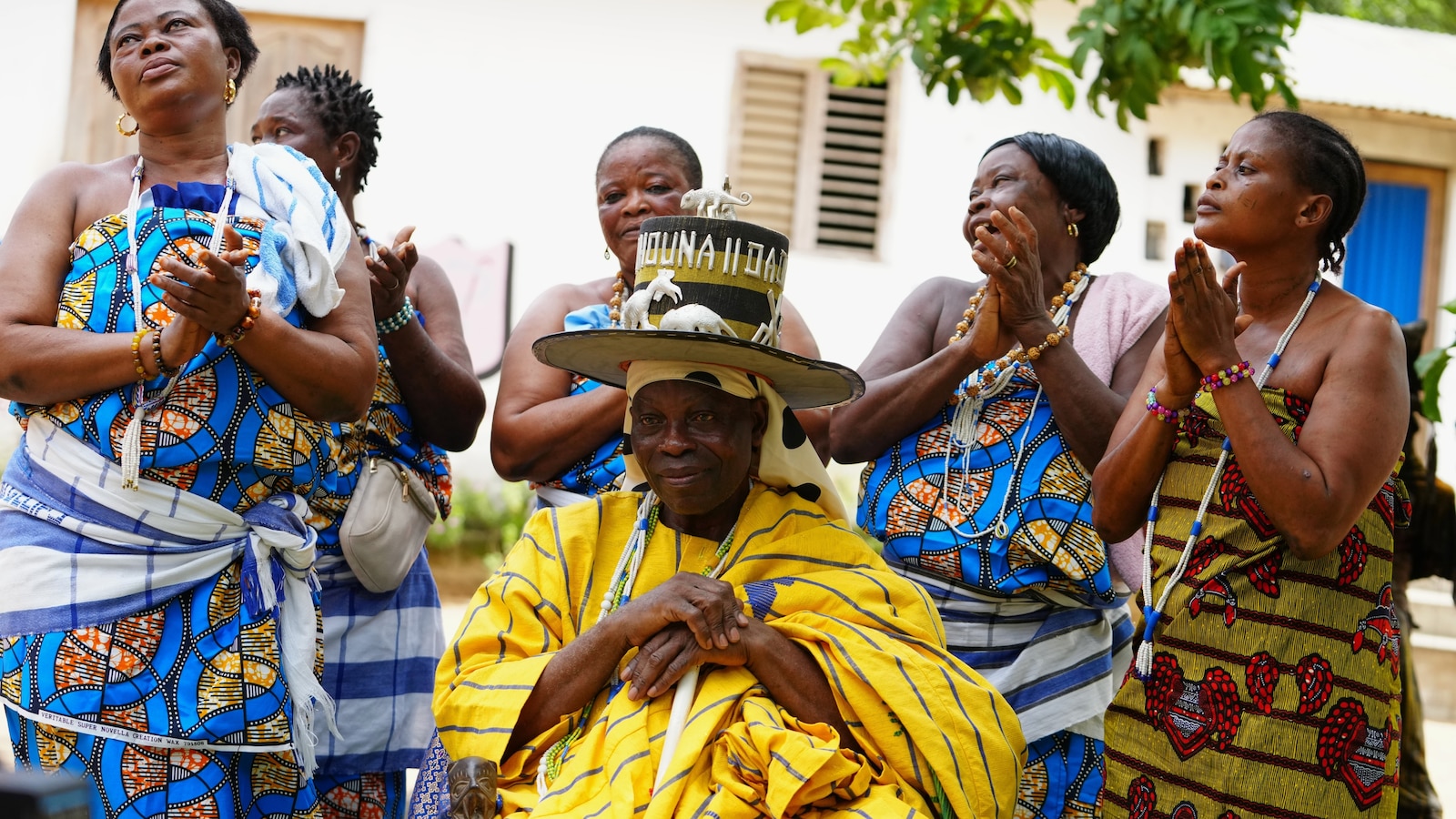
The birthplace of Vodún is Ouidah, a city on the Gulf of Guinea that once was a major slave-trading port. It's the seat of Houna II, the Vodún supreme leader.
On a recent morning, Houna II adjusted his thick robes as he settled into his antique chair to describe Voodoo’s resilience, his account punctuated by incantations from the priestesses surrounding him.
Voodoo’s “sworn leaders were not afraid to confront anyone, to leave behind what their ancestors bequeathed them no matter the cost,” he said. “It has been shown that the more you attack their religion, the more you raise their spirits.”
Kérékou was among several postcolonial African leaders who tried to replace religious authority with their own. But he failed and later recanted. That is partly why Kérékou is remembered by his people as “the chameleon.”
Gnassingbé Eyadéma, as Togo's president, successfully encouraged a personality cult, depicting himself as a savior. Eyadema, who justified some attacks on his opponents by calling them sorcerers, ruled uninterrupted from 1967 to 2005.
In Zaïre, present-day Congo, Mobutu Sese Seko took power by force and presented himself as a “god-chief,” widely feared for his perceived access to occult forces. He ruled virtually unchallenged for three decades.
Kérékou's 1991 defeat marked the first time a sitting president had been voted out of power in West Africa. Five years later, he returned as a civilian democrat, his Marxist-Leninist banners gone. And he backed the creation of the National Voodoo Board, with a festive holiday celebrated on Jan. 10 since 1996.
Kérékou failed to eradicate Vodún “because he was attacking a centuries-old social practice deeply rooted in the daily lives of Beninese people, a resource to which he and officials in his regime had been able to turn in the exercise of power,” said Narcisse Martial Yedji, a political sociologist at Université d’Abomey-Calavi. “Kérékou could not win over all the guardians of Voodoo traditions. Voodoo is not private property.”
Voodoo proved resilient, he said, and even now “priests claim that most public authorities resort to magical-religious practices and other rituals deeply rooted in the Voodoo collective consciousness.”
By 2001, seeking his last term, Kérékou was actively campaigning for the Voodoo vote in Ouidah, where pilgrims can be found carrying talismans by the sea.
There, in a forested patch on the edge of a wetland, a Vodún devotee named Irène Kpatenon pointed to the stump of a tree that was the shrine where he occasionally deposited fruits, because he heard that “Voodoo spirits like sweet things.” Kpatenon recently prayed for well-paying work.
Pilgrims to Ouidah may march along the sandy path heading to the monument known as “the Door of No Return” for the hapless victims of the trans-Atlantic slave trade. Even in that sad episode, there is a story of resistance that Houna II proudly recalled.
Enslaved Africans transported to the Caribbean, notably present-day Haiti where the religion is known as Vodou, would rebel against their owners.
In a Vodou ceremony known as the Bois Caïman pact of 1791 — during which a pig was sacrificed for its blood — some slaves plotted the rebellion that made Haiti the first free Black republic in 1804.
Haitian Vodou was suppressed, stigmatized for centuries as superstition and diluted by Catholicism. As in Benin, Vodou in Haiti survived to have a lasting influence on culture.
“Voodoo is life,” said Dossavi Yovo, a priestess in Houna II’s temple, discouraging those who would be so faithless as to mix Christianity with Vodún. “If you want to practice Voodoo, you have got to dedicate yourself to it.”
Associated Press religion coverage receives support through the AP’s collaboration with The Conversation US, with funding from Lilly Endowment Inc. The AP is solely responsible for this content.
24/7 coverage of breaking news and live events
Source: ABC News - International