Nvidia’s new chips will power laptop workstations and mini desktop PCs at first.
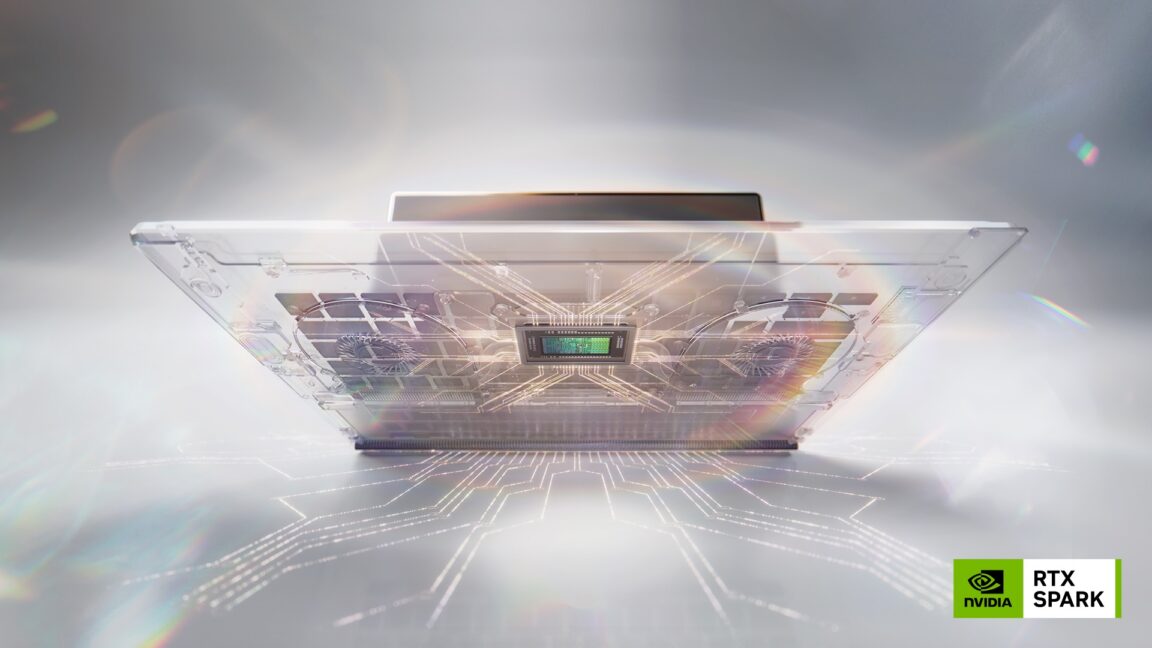
These days, Nvidia primarily sells AI data center products, and its traditional consumer devices feel like more of a side project. But the company occasionally still releases something designed for consumers. After a couple of years of rumors, Nvidia has announced an Arm-based chip designed to power Windows PCs. Dubbed RTX Spark, the new chip combines a 20-core Nvidia Grace CPU co-developed with MediaTek, up to 6,144 Blackwell-based GPU cores (the same architecture as the RTX 50-series GPUs), and support for up to 128GB of unified LPDDR5x memory.
Nvidia and its partners offered nothing about expected pricing, but both “slim Windows laptops with all-day battery life and premium displays” and “compact desktop PCs” are slated to be “available this fall” from partners including Asus, Dell, HP, Lenovo, Microsoft, MSI, Acer, and Gigabyte.
This isn’t Nvidia’s first chip for Windows PCs; earlier chips in the Tegra series powered several of the short-lived Windows RT tablets. But Tegra chips largely stopped appearing in consumer devices following the Tegra X1 in the late 2010s (variants power the original Nintendo Switch and the apparently unkillable Nvidia Shield TV box). Modern Arm-based PCs in the Windows 10 and Windows 11 eras have all used processors from Qualcomm.
Nvidia stands to benefit from the years of progress made on the Arm version of Windows since the Windows RT days. Microsoft’s x86-to-Arm code translation layer, codenamed Prism, has gotten better and faster. Many major apps now ship Arm-native versions that can run without the performance and responsiveness penalties that still crop up in translated apps. Most of the time, at least for productivity work and general computing, an Arm-based PC and an Intel or AMD-based PC look and feel indistinguishable.
And Nvidia’s entry into the market may help improve the gaming experience, one area where the Arm version of Windows still falls short. Translated games often play, but they can show lag or responsiveness issues even when running at a reasonable frame rate; many games that require kernel-level anti-cheat software to be installed still don’t run at all. Nvidia and Microsoft told The Verge that they were actively working with Riot Games to support League of Legends and Valorant on Arm PCs; with Krafton to support PUBG; and with the developers of Easy Anti-Cheat, BattlEye, and Denuvo.
The RTX Spark appears to be a consumer rebrand for the silicon Nvidia launched late last year as the DGX Spark, the heart of a tiny developer workstation for people working with AI models. And while that desktop is about as high-specced as an RTX Spark system might get—it includes 128GB of RAM and a 4TB SSD—its current $4,699 price tag suggests that the fastest RTX Spark machines won’t come cheap. (That’s also, for the record, already $700 more than the box’s $3,999 launch price, a reminder of the RAM and storage supply crunch that Nvidia has helped drive with its AI data center products.)
Knowing the DGX Spark’s specifications gives us a better idea of how RTX Spark will perform, at least in its most capable form. The Nvidia Grace CPU combines 10 high-performance Arm Cortex-X925 CPU cores and 10 medium-sized Cortex-A725 cores; Arm makes a smaller, higher-efficiency Cortex-A520 core, but it isn’t used here. That makes the RTX Spark a bit more like Apple’s M5 Pro or M5 Max, which use a mix of medium-sized performance cores and large “super” cores without any of the M5’s smaller efficiency cores.
Having 6,144 Blackwell-based GPU cores puts the RTX Spark’s GPU on the same level as the desktop version of the GeForce RTX 5070, well above the mobile version of the RTX 5070 (4,608 cores) but below the mobile version of the RTX 5080 (7,680 cores).
The GPU’s performance will be limited somewhat by the size of the power envelope in laptops and mini PCs (Nvidia says RTX Spark’s power use maxes out at 80 W, whereas a desktop 5070 can consume up to 250 W by itself), and by using slower LPDDR5x memory instead of the GDDR7 RAM that RTX 50-series GPUs use.
But for some games and for AI and machine learning workflows, the relative slowness of the RAM will be offset by the amount you can get—unified memory means the CPU and GPU can both access almost all of the RAM available in the system, giving users access to over 100GB of VRAM instead of the paltry 8GB or 12GB that you get with an RTX 5070. Unified memory pools attached to good-enough GPUs have also made systems like Apple’s Mac mini and Mac Studio and the Ryzen-based Framework Desktop useful platforms for developers and people looking to run AI models locally.
The Blackwell-based architecture will also mean that RTX Spark can take advantage of the same DLSS upscaling and frame generation features as other RTX 50-series GPUs, including the controversial upcoming DLSS 5 release.
As for the lower-end RTX Spark models, Nvidia didn’t have much to say, but we can glean some details. Rumors and leaked specs (via VideoCardz) suggested that Nvidia was working on two distinct pieces of silicon, one codenamed “N1X” and one codenamed “N1.” Both chips would come in two different flavors—one with all CPU and GPU cores fully enabled and one with some defective cores disabled, a process called “binning” that is commonly used to maximize the amount of sellable silicon you get out of a manufacturing run.
The fully enabled N1X aligns with the specs for the RTX Spark; there’s also allegedly an N1X version with 18 CPU cores and 5,120 CUDA cores. The slower, smaller N1 chip is said to include up to 12 CPU cores (8 Cortex-X925 and 4 Cortex-A725) and 2,560 CUDA cores, which is the same number as the desktop GeForce RTX 5050.
A binned version of that chip is also said to exist, with 10 CPU cores and 2,048 CUDA cores. The basic N1 is said to support up to 64GB of RAM and have a lower maximum power draw of 45 W. This would put its power envelope closer to something like Intel’s Core Ultra Series 3 (codenamed Panther Lake) chips, implying we could see versions of RTX Spark appear in premium thin-and-light laptops eventually.
Source: Ars Technica