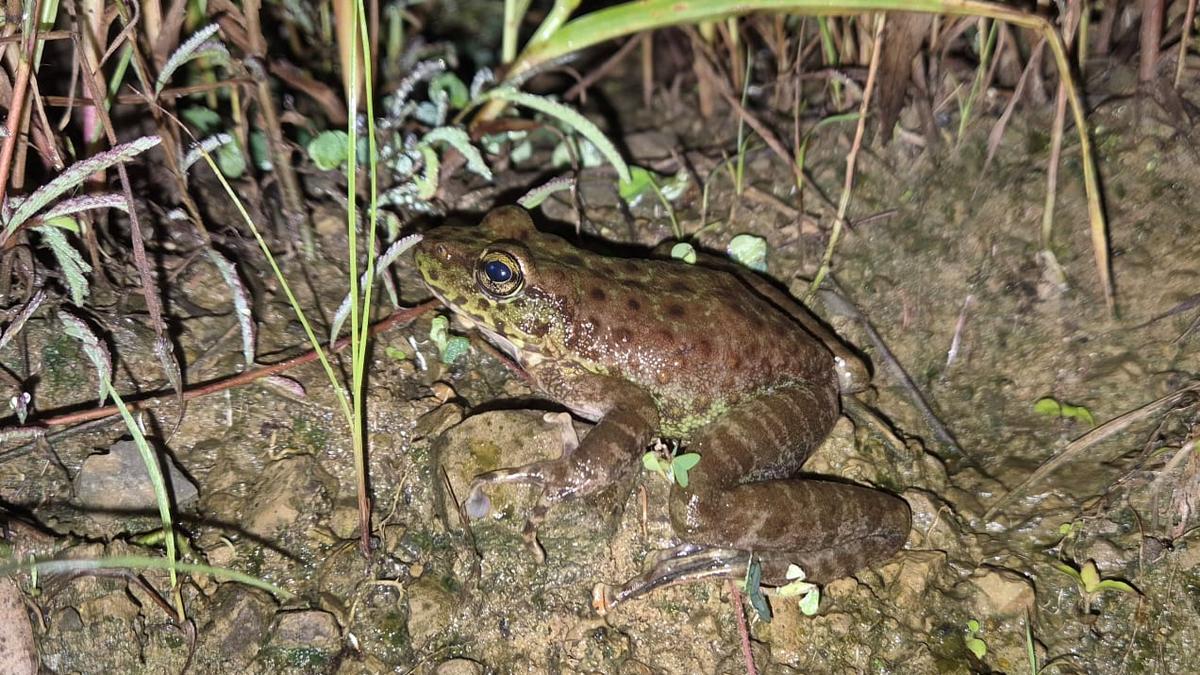
Nagaland has yielded a new-to-science cascade-dwelling frog.
A team of six scientists of the Zoological Survey of India (ZSI) recorded this species in August 2024 from hill-stream habitats near Singrep village during a field survey in Kiphire district, bordering Myanmar. The species has been named Amolops kamal after Kamal Choudhury, who was the teacher of the research paper’s lead author at Guwahati’s B. Barooah College.
The common name of this species is Nagaland cascade frog.
The authors of the study are Bhaskar Saikia, Bikramjit Sinha, A. Shabnam, Prabir Narayan Konwar, Mridul Kumar Borthakur, and K.P. Dinesh. Their study was published in the latest issue of the journal Records of the Zoological Survey of India.
The researchers said integrative taxonomic analyses, including molecular phylogenetic studies, confirmed that the specimens represent a distinct evolutionary lineage within the Amolops indoburmanensis species complex.
ZSI Director Dhriti Banerjee said the documentation of Amolops kamal highlights the rich yet understudied faunal diversity of India’s northeastern region and underscores the importance of long-term field surveys in biodiversity hotspots.
Dr. Sinha of ZSI, Kolkata, who led the field expedition, said the rugged landscapes and isolated stream ecosystems of the northeast continue to harbour poorly known amphibian lineages.
Dr. Dinesh of ZSI, Pune, underscored the importance of molecular approaches in amphibian taxonomy, particularly in the northeast, where many frog species are morphologically similar. He said that molecular data are increasingly essential for delineating species boundaries, understanding true species distributions, and identifying cryptic species complexes that may otherwise remain hidden under a single species name.
The study further demonstrated that Amolops indoburmanensis, previously considered a widespread species, may represent multiple distinct evolutionary lineages distributed across the northeast and neighbouring regions.
The Asian cascade-dwelling frog genus Amolops currently comprises 90 recognised species, with 20 species reported from India. These species are generally classified into ten species groups based on morphological similarities.
In India, the Amolops species are mainly categorised across three groups: Amolops marmoratus, Amolops monticola, and Amolops viridimaculatus. The first group is the most diverse, represented by eight species.
Amolops indoburmanensis was suspected to be a hidden species complex within the Amolops marmoratus group.
Published - May 30, 2026 11:02 am IST
Nagaland / science (general) / wildlife
Source: The Hindu - India News