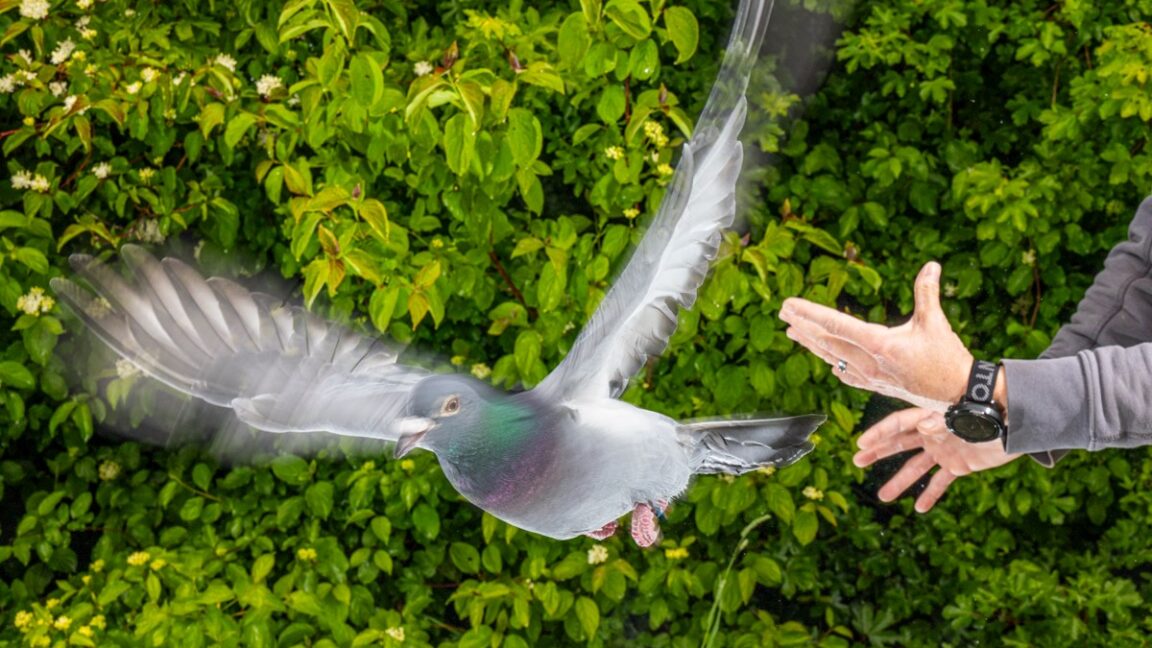
Iron-rich immune cells in the liver may act as sensors for magnetic fields, serving as an internal compass.
Scientists have long known that migrating birds and homing pigeons navigate in part by sensing the Earth’s magnetic fields, especially at night or in overcast conditions when visual landmarks or sunshine are in short supply. But exactly where this magneto-sensing occurs in the body—and the mechanism that enables it—remains a matter of intense debate. A new paper published in the journal Science suggests that homing pigeons have iron-rich immune cells in their livers that help them detect magnetic fields and transmit that information to the brain.
There are three primary hypotheses for how birds might sense Earth’s geomagnetic field. One is a compass-like mechanism, whereby the Earth exerts a pull on magnetic particles in a bird’s upper beak that relays directional information via a large nerve in the cranium. A second is that it happens biologically via cellular ion channels sensitive to voltage, enabling birds to sense changes in the magnetic field. And a third suggests that physical effects on retinal pigments enable birds to detect photons and send signals to the brain, although this mechanism is really only viable in the light.
None fully explain how animals can sense magnetic fields. However, “We had some clues that the liver and spleen have magnetic properties, because they break down red blood cells and so store much iron in the body,” said co-author Clivia Lisowski of the University of Bonn and the University Hospital Bonn. This refers to a 2015 paper suggesting that red pulp macrophages in the spleens of mice and humans are intrinsically superparamagnetic and hence more sensitive to magnetic fields. But it wasn’t clear if those properties were involved in any kind of magnetoreception.
For their homing pigeon study, Lisowski et al. used vibrating sample magnetometry and magnetic cell separation to test liver and spleen tissue samples stained with Prussian blue—which is sensitive to ferritin, a red blood cell degradation product—along with the eyes, beak, and brain. They found the strongest concentration of iron and the strongest magnetic response in the liver tissue.
To further test their hypothesis, Lisowski et al. trained 34 pigeons to home over a west-to-east route covering 19 kilometers (just under 12 miles). Once trained, half the birds were injected with clodronate liposomes to deplete macrophages in the liver, while the other half served as a control group. This was done the day before weather predictions called for overcast conditions with the sun obscured. The next day, all the pigeons were released.
All the pigeons in the control group successfully navigated their way back to the aviary; those that received the injections lost their sense of direction and did not return home until the following day, when the sun was out. A follow-up experiment with the clodronate-treated pigeons under sunny conditions did not affect their homing ability because they were able to use solar cues. This suggests that pigeons use a combination of the sun’s orientation and magnetic sensing to navigate—and the latter is a previously unsuspected mechanism for magnetic perception in animals.
The authors think these results could also explain magnetoreception in bats and blind mole rats, which don’t have functioning cryptochromes or live in environments with little to no light. They might also apply to certain species of shark capable of swimming in straight lines over long distances—such as scalloped hammerhead sharks, which seem to orient themselves using seamounts found to have geomagnetic anomalies. “Beyond magneto reception, our findings contribute to a broader emerging concept: tissue-resident macrophages can function as peripheral sensory cells, providing direct, biologically meaningful feedback to the brain,” the authors concluded.
In an accompanying perspective, Simon Spiro of the Zoological Society of London and Hal Drakesmith of the University of Oxford noted some caveats. For instance, the iron-rich cells in the liver could have been due to the diet of captive pigeons, given that many zoo-housed animals have iron overloads. They also don’t think it’s yet clear that the liver is the best and most likely organ for sensing magnetic fields. It’s possible that doping the pigeons with clodronate also depleted macrophages located elsewhere in the body, skewing the histological results.
Spiro and Drakesmith cite a 2025 study, also published in Science, that used a different, more global methodology and suggested a different mechanism: Special cells within the pigeon forebrain encode magnetic information, thereby facilitating effective navigation. Both potential mechanisms do not require light stimulation, so it’s possible there could be two or more complementary processes at work to help pigeons navigate.
“Perhaps one process dominates for long-distance navigation, whereas another is used for more specific destination-finding, with both operating with different degrees of precision,” Spiro and Drakesmith concluded. “Indeed, it could be prudent to have more than one way of getting home in the dark.”
DOI: Science, 2026. 10.1126/science.ady2486 (About DOIs).
Source: Ars Technica