The Congress on Wednesday said it “respectfully disagreed” with the Supreme Court order upholding the legality of the special intensive revision (SIR) of electoral rolls, asserting that the judgement “raised more questions than it answered”.
“The Supreme Court has given a finding on law. We can respectfully disagree with the verdict,” Congress communication chief Jairam Ramesh said in a statement posted on X.
He alleged that the Narendra Modi government has been facing an “unprecedented wave of anger for its governance failures” and the SIR has become an exercise in exclusion.
ALSO WATCH Watch: Supreme Court upholds EC’s Special Intensive Revision of electoral rolls
“...unable to face the electorate in a fair contest, it has now opted to manipulate the lists of who can and cannot vote to skew the balance in its favour. Broadly speaking, this is what the SIR is for,” Mr. Ramesh said.
He claimed that voters in Bihar and West Bengal were selectively deleted en masse and then made to face an appeals process “that is arbitrary and ultimately meaningless”.
Mr. Ramesh said the Election Commission of India (ECI) was in such haste that the Supreme Court itself had to put “guardrails”.
“Was it not this very Supreme Court that directed the ECI to publish lists of deleted voters they wished to keep hidden; that made them publish reasons for deletion which they should have done in the first place; and that mandated Aadhar be accepted when the ECI tried to refuse,” Mr. Ramesh asked.
He alleged that the SIR process was “rife with infirmities and based on mala fide” and added that legal sanction may confer prima facie legitimacy, but it “cannot cure malice in implementation”.
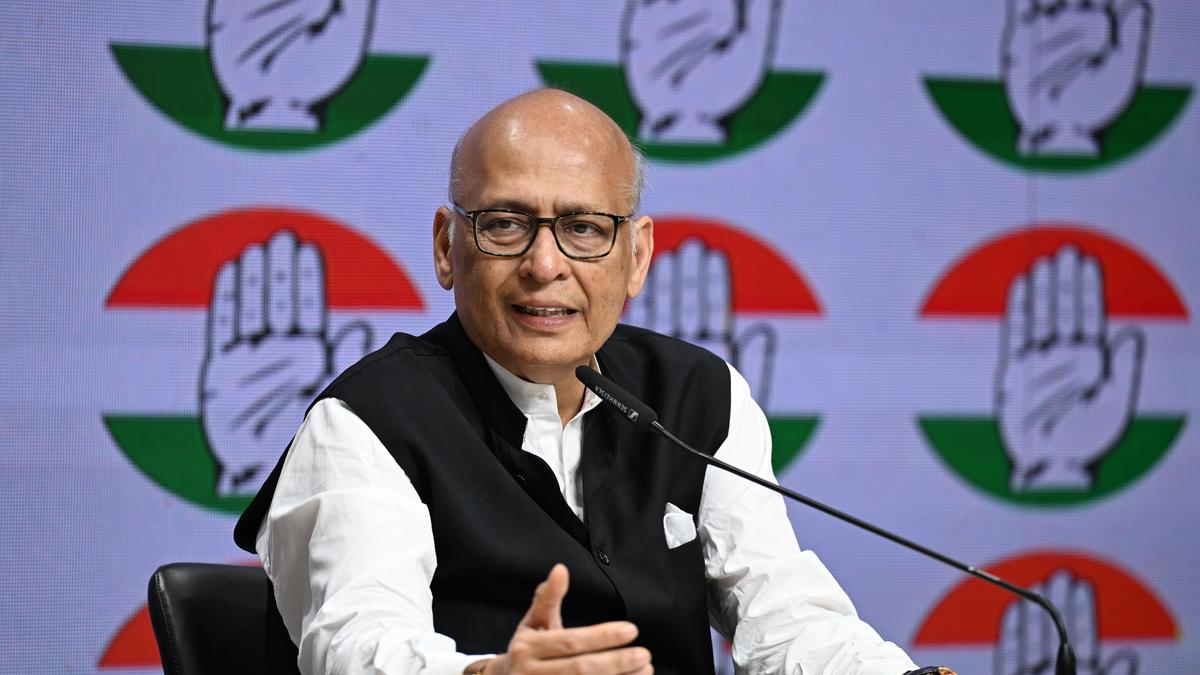
Addressing a press conference, Congress leader and Rajya Sabha MP Abhishek Singhvi said the top court had itself underlined “gaps, omissions, errors and deficiencies” in the ECI’s handling of the exercise, which later required judicial intervention and petitions from political parties and civil society groups.
Mr. Singhvi pointed out that the court had observed that citizenship could be determined only by the competent authority, primarily the Ministry of Home Affairs, and not by the ECI. He questioned whether the court should have taken stronger note of the fact that voters were excluded on citizenship-related grounds.
He also criticised the timeline for the SIR exercise, describing it as an “excessively constricted and telescoped time period”.
Referring to revisions involving crores of voters in States such as Bihar and West Bengal, he asked why the exercise could not have been conducted “a year before the elections” instead of within four to five months.
Mr. Singhvi alleged that the ECI had “put the cart before the horse” by deleting names before adjudicating objections, adding that elections held during this period could lead to “major deprivation of voting rights”.
Cited West Bengal, where nearly 4,000 of 6,000 appeals against voter deletions were reportedly upheld, he said such figures raised “a big question mark on the credibility of elections”.
Published - May 27, 2026 07:43 pm IST
court / Special Intensive Revision of electoral rolls / Election Commission of India / election / voting / Citizenship / Indian National Congress
Source: The Hindu - India News