The Quad grouping on Tuesday (May 26, 2026) expanded cooperation in critical minerals and energy while unveiling new measures to boost maritime surveillance and port infrastructure across the Indo-Pacific against the backdrop of China’s growing military posturing in the region.
Also read | Quad remains ‘vital’, says Japanese Foreign Minister
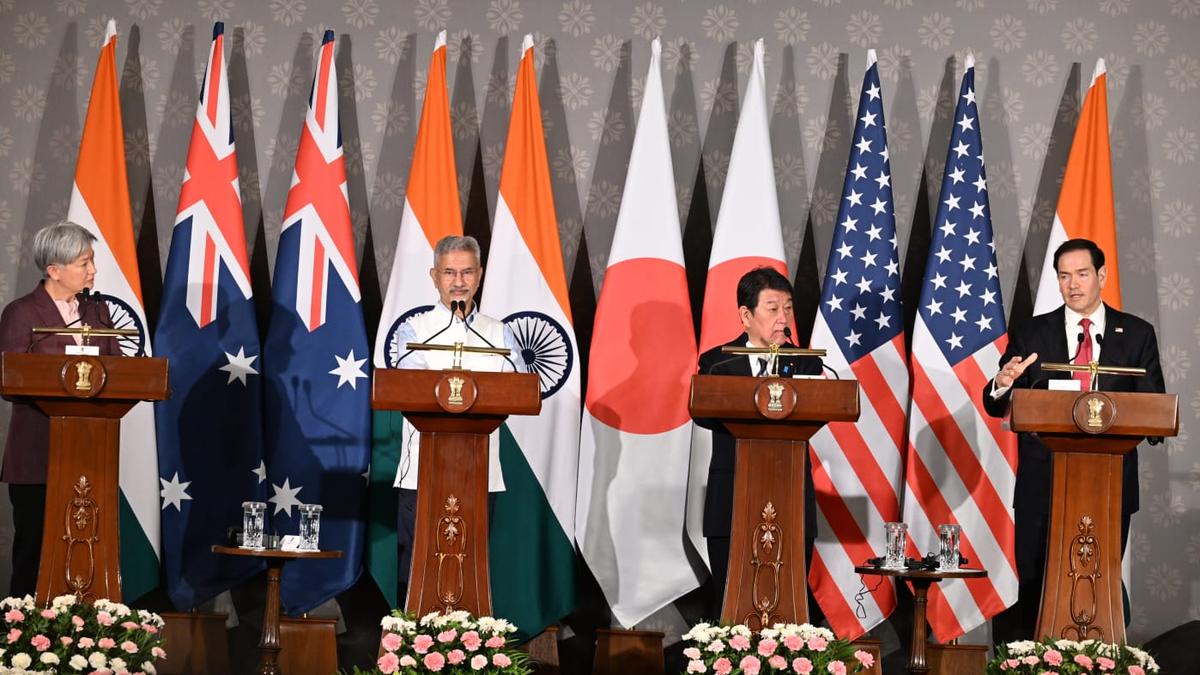
The new measures were announced following a meeting of the grouping’s foreign ministers in New Delhi. The meeting was chaired by External Affairs Minister S. Jaishankar and attended by U.S. Secretary of State Marco Rubio, Australian Foreign Minister Penny Wong and Japanese Foreign Minister Toshimitsu Motegi.
In his media statement, Mr. Rubio said the Quad meeting decided to launch an Indo-Pacific Maritime Surveillance Cooperation Initiative. Mr. Rubio also announced expansion of the Indo-Pacific Maritime Domain Awareness Initiative among the Quad nations. He also said the Quad has decided to roll out a new initiative to boost port infrastructure in the Pacific Islands.
(With inputs from PTI)
Follow live updates here:
In its joint statement after the Quad Foreign Ministers’ Meeting, the Quad partners condemned terrorism, calling for international efforts to combat it.
“We unequivocally condemn terrorism in all its forms and manifestations, including cross-border terrorism and the horrific terrorist attacks perpetrated at Pahalgam in India on 22 April 2025, and Bondi Beach in Australia on 14 December 2025. We call for decisive and sustained international efforts to combat terrorism in accordance with international law, including action against globally proscribed terrorists and terror entities and their proxies, affiliates, sponsors and financiers. We are committed to working together with our international and regional partners in a comprehensive manner to strengthen their capacity to prevent, detect and respond to threats posed by terrorism, violent extremists who engage in violent, criminal, or terrorist acts and by the use of emerging technologies for terrorist purposes.”
The Quad Foreign Ministers — belonging to Australia, U.S., India, and Japan — discussed the situation in West Asia and reaffirmed “support for ongoing diplomatic efforts and hope for lasting peace in the region.”
“We reiterate the importance of adhering to international law as reflected in the United Nations Convention on the Law of the Sea (UNCLOS) with respect to navigational rights and freedoms, and the safety and uninterrupted flow of global commerce through the Strait of Hormuz and the Red Sea. We condemn the attacks on commercial shipping vessels and oppose any future measures that are inconsistent with UNCLOS, including imposition of tolls,” a joint statement read.
The joint statement, following the Quad Foreign Ministers Meeting in Delhi, emphasised the efforts undertaken by the four countries in addressing maritime security challenges.
“We welcome India’s operationalization of the Indian Ocean Region programme of the Quad Indo-Pacific Partnership for Maritime Domain Awareness (IPMDA) through the Information Fusion Centre – Indian Ocean Region in Gurugram. We will work to develop a Common Operational Picture (COP) across the Indo-Pacific by drawing upon the existing IPMDA efforts,” it said.
The joint statement also focused critical and emerging technologies, noting that Quad countries will advance work in the coming months on next-generation communications standards; a workshop on digital identity standards; and a Track 1.5 on standards workforce development.
China on Tuesday reiterated its stance on the Australia-India-Japan-U.S. Quad group, saying cooperation between countries should contribute to regional peace, stability and prosperity, and should not target any third party.
“We also do not support the formation of exclusive cliques or bloc confrontation. No cooperation should undermine mutual trust and cooperation among regional countries,” China’s foreign ministry spokesperson, Mao Ning, told a daily press conference.
- Reuters
The year 2025 brought about unprecedented disruption in global geopolitics. The return of President Donald Trump to the White House has resulted in a significant churn in various strategic theatres across the world. The Indo-Pacific, arguably, has evolved as the most contested terrain marking the escalating competition between China and the United States. Notably, the Quad has remained a crucial facet of Washington’s engagement in the Indo-Pacific region.
Revisit Harsh V. Pant and Sayantan Haldar’s analysis on how 2025 panned out for the Quad grouping
Speaking after India and United States signed a Critical Minerals Framework, U.S. Secretary of State Marco Rubio outlined that the groundwork was laid for this on at the Critical Minerals Forum that hosted in Washington, D.C. It gained momentum later that month when India signed on to Pax Silica.
“We both [India and U.S.] have a strategic and shared interest in the fact that vibrant innovation economies such as ours cannot afford to leave the foundational materials of these industries vulnerable to single source monopolies that could deny us these things, not just in a time of conflict, but as a leverage point contrary to our sovereign national interests,” he added.
- ANI
”We [Quad] discussed the North Korean situation, including nuclear and missile problems and cyber activities, and reaffirmed our commitment towards the complete denuclearisation of North Korea,” said Japan’s Foreign Minister following the Quad Foreign Ministers Meeting.
“At the beginning of the meeting today, I emphasised the importance of our four nations to the Quad in realising Free and Open Indo-Pacific (FOIP). The point of the update of FOIP is that the countries of the Indo-Pacific should strengthen their resilience and capacity to determine their own future,” Japan’s Toshimitsu Motegi said.
- ANI
External Affairs Minister Dr S. Jaishankar and U.S. Secretary of State Marco Rubio sign India-U.S. Critical Minerals Framework on securing supply of mining and processing of critical minerals and rare earths.
- Kallol Bhattacharjee
U.S. Secretary of State Rubio announces Quad’s initiative on Indo-Pacific energy security that will help strengthen regional energy resilience.
Through this initiative, he says, the partners will work to identify areas of cooperation in technology, management, policy, international market analysis, and emergency response exercises.
Mr. Rubio moves on to speak on the third key topic of discussion today -- the Quad Critical Minerals Framework.
This, he says, will guide each of the countries to leverage economic policy tools and coordinate investment to strengthen critical mineral supply chains including in mining, processing, and recycling.
Mr. Rubio goes on to announce the Quad’s second initiative which will involve the four countries partnering on issues of port infrastructure.
This is particularly in response to insufficient port capacities in the Pacific islands. Mr. Rubio adds that the initiative will begin with Fiji to advance its port infrastructure.
This will be the first time that the Quad partners work together on a port infrastructure project.
Speaking to the press, U.S. Secretary of State Rubio reiterates that the goal of the Quad counties was to turn it into a forum of action.
Mr. Rubio goes on to announce the launch of Indo-Pacific Maritime Surveillance Co-operation initiative, which is going to leverage the individual countries’ maritime surveillance capabilities in the Indo-Pacific to enhance information sharing.
Related to this, he says, is also the expansion of the Indo-Pacific Maritime domain awareness initiative.
Mr. Rubio also informs that India has committed to hosting the next iteration of the Quad at Sea Mission.
Ms. Wong says that the Quad today is taking forward a number of new initiatives. These include energy initiatives, and continued work on critical minerals.
“We are also announcing the strongest ever commitment from the Quad to the Pacfic through the ‘Quad: Ports of the Future’ partnership,” the Australian Minister adds.
On maritime security, the Minister says that Australia will be coordinating maritime surveillance efforts initially in the Indian ocean.
Ms. Wong says that the countries are also working together to strengthen cooperation against scam centers, particularly in Southeast Asia.
We recognise our responsibility to provide real choices, particularly as strategic circumstances in our region are deteriorating, said Australia Foreign Minister Penny Wong in her remarks to the press following the Quad meet.
Noting that the Indo-Pacific region is facing acute economic stress, Ms. Wong says that the Quad countries recognise the impact on the region’s energy security following the closure of the Hormuz Strait.
“We recognise the efforts of Secretary Rubio towards a diplomatic resolution to ensure that the freedom of navigation is restored,” Ms. Wong adds.
Mr. Jaishankar says that the goal of the Quad countries is to intensify cooperation among ourselves while helping others.
As democratic nations, Mr. Jaishankar says, the Quad countries also devoted time to discussing the threat of terrorism. “Nations subject to terrorist attacks have the right to defend themselves.”
In the coming days, the Indo-Pacific will become even more important to the world, the External Affairs Minister said.
Addressing the press following the Quad Foreign Ministers meeting, EAM Jaishankar said that the discussions focused on the Indo-Pacific. He notes that the maritime domain has seen a steady expansion of collaboration.
“We spent some time on the question of safe and unimpeded maritime commerce, and reaffirmed the significance of scrupulously observing international law,” he says.
Mr. Jaishankar says that the discussions also touched on the current energy and fertiliser availability as well as that of critical minerals and resources.
Japan Foreign Minister Toshimitsu Motegi, in his opening remarks, says: “The Indo-Pacific nations should strengthen resilience and the necessary capacity to determine their own future, including economic security.”
U.S. Secretary of State Marco Rubio, addressing the gathering, says that the goal collectively of the Quad over the last year has been to turn it from a forum where the four countries gather to discuss problems, to a space where they actually do something about it.
“We are beginning to do that very aggressively and very impressively,” Mr. Rubio says.
The areas on which the four countries are working on have become even more relevant, he says, in light of events around the world.
Mr. Rubio stresses on making further progresses on operationalising the relationship, and the areas these countries can cooperate on.
Mr. Rubio concludes his statement by noting that the four countries bring to the table unique capabilities “that collectively we can bring to bear on some of the most significant problems in the world.”
Recalling EAM Jaishankar’s remarks from an earlier Washington Quad meeting, Australian Foreign Minister Penny Wong says that it must be ensured that the countries within the Indo-Pacific have the freedom of choice on security and the development of the region.
“That is central to how Australia approaches our engagement in the Quad,” she says.
Ms. Wong notes that the Ministers meet today at a time of accelerating contest, a deteriorating strategic environment, and acute economic stress
Addressing the Quad Foreign Ministers meeting, EAM Jaishankar said that the Indo-Pacific region has its own set of concerns.
“This will require enhancing strategic confidence, enhancing maritime security, promoting economic choices and fostering a deeper collaborative ethos.”
As maritime democracies, pluralistic societies, and market economies, we share a responsibility towards a free and open Indo-Pacific, says Mr. Jaishankar adding that the region must remain a driver of global growth.
In his opening remarks, the External Affairs Minister S. Jaishankar said that while the focus of the meeting will be on the Indo-pacific region, at the global level the Quad Foreign Ministers will have to address issues like: supply-chain resilience, connectivity chokepoints, manufacturing resource concentrations and gap in critical infrastructure.
“Each one of them offers in offers a new argument for more partnerships, stronger growth and realising the promise of technologies,” he says.
Is a comprehensive India-Australia Free Trade Agreement (FTA) in the offing? With the Australian Foreign Minister Penny Wong in India for the Quad Foreign Ministers’ meeting, there is anticipation that a Comprehensive Economic Cooperation Agreement (CECA) may be inked.
This would expand the 2022 Economic Cooperation and Trade Agreement (ECTA) that had opened 100% of the Australian market to India while India reciprocated with roughly 70% market access covering nearly 91% of trade value. Canberra has since been pushing for parity, both privately and publicly.
As Australian Foreign Minister visit India for the Quad Foreign Ministers Meet, Vaibhav Jain and Raja Karthikeya write on the trade relations between India and Australia
The Quad remains a “vital framework”, Japanese Foreign Minister Toshimitsu Motegi said, responding to concerns that the four-nation grouping had lost its relevance, and indicated in an interview that ‘Cooperation over Critical Minerals’ needed for green energy and hi-tech would be at the top of the agenda for the Quadrilateral Foreign Ministers’ Meeting (FMM) on Tuesday (May 25, 2026). Japan is working on critical minerals’ projects in India, Mr. Motegi also said, but called for improved infrastructure, more tax subsidies, and protection for intellectual property rights.
“The Quad remains a vital framework among countries that share fundamental values and strategic interests. It has delivered concrete results across a wide range of areas, including maritime security, economic security, and cybersecurity,” Mr. Motegi said, in written responses to questions from The Hindu ahead of the FMM, but side-stepped queries on why the mechanism finds little mention in the strategy documents.
Foreign Ministers of the Quad will meet for the first time in nearly a year, as External Affairs Minister S. Jaishankar hosts U.S. Secretary of State Marco Rubio, Australian Foreign Minister Penny Wong, and Japanese Foreign Minister Toshimitsu Motegi in Delhi on Tuesday (May 26, 2026) at Delhi’s Hyderabad House. The Foreign Ministers will also call on Prime Minister Narendra Modi, a Ministry of External Affairs advisory said.
Suhasini Haidar writes on today’s Quad Foreign Ministers meeting:
Quad Foreign Ministers meet to address India-U.S. tensions, U.S.-China relations, and the Iran conflict on May 26, 2026.
Published - May 26, 2026 08:01 am IST
international organisation / Japan / India-Japan / India-Australia / Australia / India-United States / USA / Live news
Source: The Hindu - India News