Spent upper stages are the most dangerous kind of space debris.
Up until a decade ago, China had never launched as many as 20 orbital rockets a year. But beginning in 2022, the Asian country launched 64 rockets and last year reached a record total of 93, marking it as the second-most productive space power in the world.
Further growth is anticipated from both the company’s state-owned enterprises as well as a rapidly expanding number of private launch companies. There is nothing wrong with this, as China’s rapid growth in launch has been mirrored by the United States and, in particular, SpaceX.
However there is an issue with these launches, as China appears to be ignoring long-established norms about disposing of the upper stages of rockets. These are the parts of the vehicle that separate from the first stage of a rocket and push a satellite or spacecraft into orbit.
In the early decades of spaceflight, the Soviet Union, the United States, and other spacefaring species paid little heed to these upper stages, also known as “rocket bodies.” They were ejected into all manner of orbits, there to remain for decades before ultimately succumbing to the slow pull of Earth’s gravity at higher altitudes.
But in the last 20 years or so, most countries (and the private companies operating within their borders) have taken a more responsible attitude toward disposing of these upper stages. This is because, as it turns out, having large, multi-ton blocks of metal spinning uncontrollably around low-Earth orbit becomes a problem over time.
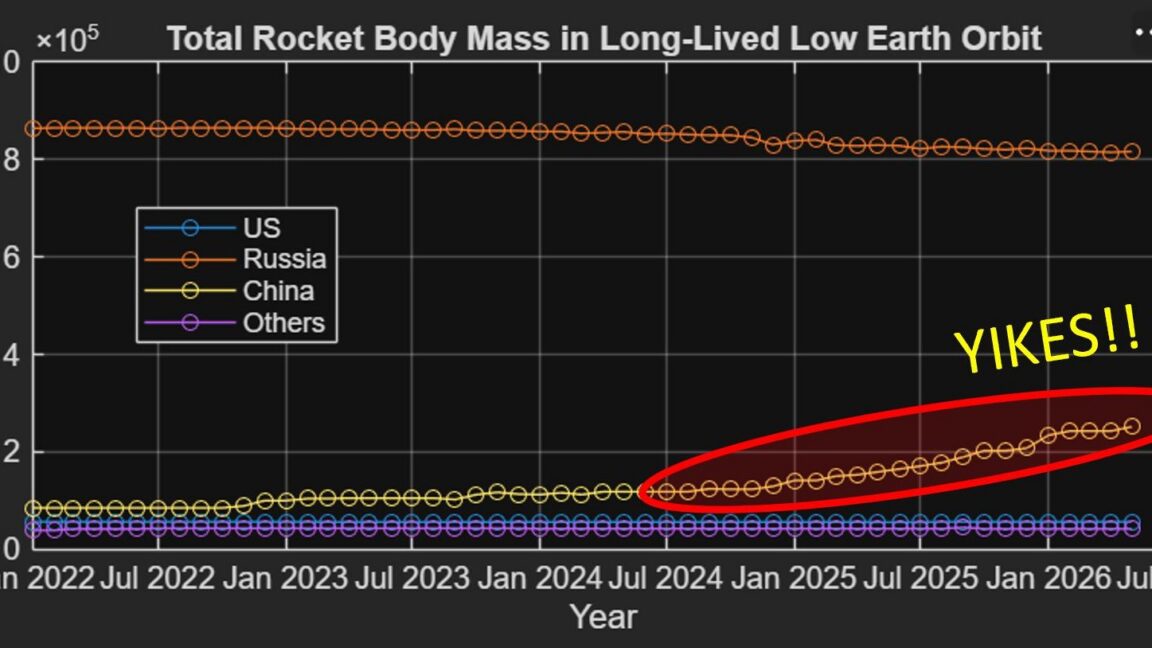
The Soviet Union, and later Russia, is the biggest offender, with about 800 metric tons of rocket bodies in long-lived orbits between 600 km and 2,000 km above the Earth’s surface, according to data from the European Space Agency’s Space Debris Office as well as Jonathan McDowell’s General Catalog of Artificial Space Objects. The United States, by comparison, has about 57 metric tons of spent upper stages in these orbits. However these numbers are more or less holding steady or, in the case of Russia, slowly declining as stages fall out of orbit.
By contrast there is striking growth in China’s rocket body mass. In the past five years, the mass of Chinese rocket bodies in long-lived orbits has risen from less than 100 metric tons to 252, according to a new analysis by Space Domain Awareness expert Jim Shell.
“China… continues to abandon many rocket bodies in high low-Earth orbit,” Shell wrote on LinkedIn early Monday. “The total mass of orbital debris is a key variable influencing the long-term sustainment of space. There is broad agreement that abandoning rocket body upper stages in long-lived orbits is not a best practice. In fact, all the major space-faring nations have acknowledged this.”
The recent growth of Chinese upper stages has been driven by the country’s increased launch rate as it begins to deploy satellite megaconstellations, Shell said.
China’s space industry is just at the beginning of launching megaconstellations to compete with SpaceX’s Starlink satellite service, suggesting that if the country does not curb this practice it will deteriorate an already congested space environment. Chinese constellations such as Guowang and Spacesail are typically at higher altitudes, above 800 km, and China may launch 1,000 or more rockets over the next decade to support these constellations.
Although satellites outnumber spent rocket bodies by more than 10-to-1, the former are typically smaller and can be maneuvered when there are conjunctions. Rocket bodies are dead objects that cannot be steered. For this reason, the vast majority of space objects rated as the “most concerning” pieces of space debris are rocket bodies.
The best practice for modern launches is to reserve some propellant in a rocket’s upper stage to dispose of it. For lower-altitude launches, such as Falcon 9 vehicles boosting Starlink satellites, the rocket initiates a disposal burn to return the upper stage to an oceanic location far from land, often Point Nemo. For higher-altitude launches, some rockets also put their stages into a heliocentric orbit, which is described in this paper.
Source: Ars Technica