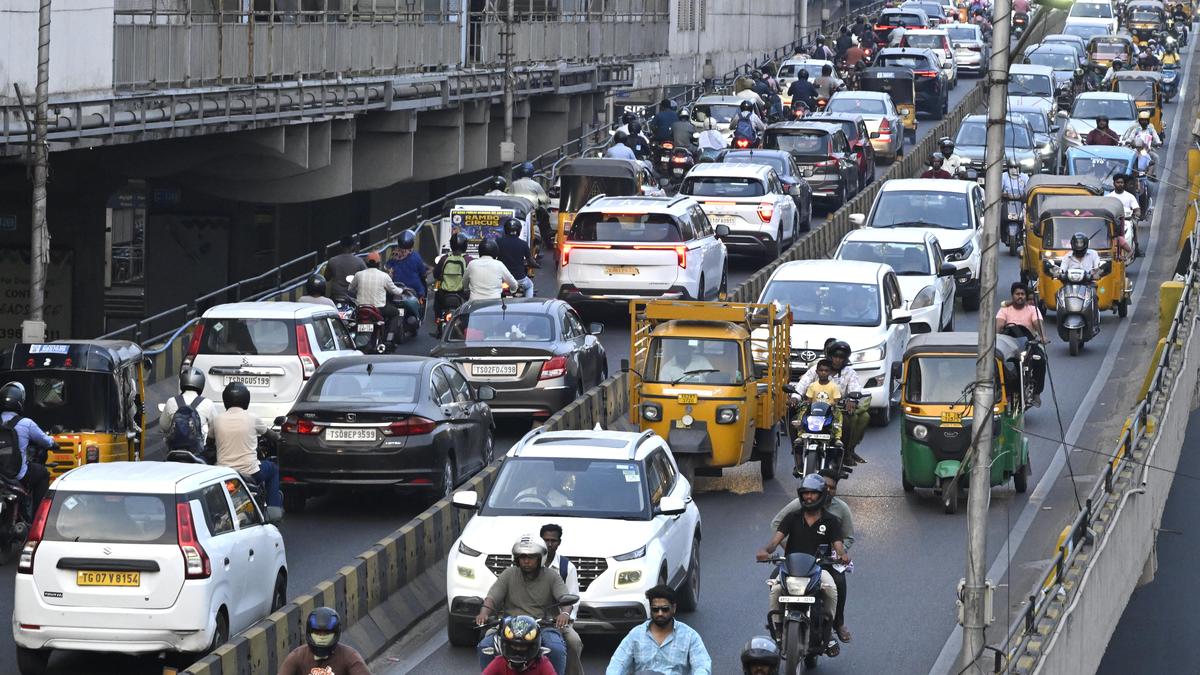
Hyderabad’s traffic congestion is no longer merely an infrastructure problem but a direct consequence of shrinking public transport, rising dependence on private vehicles and poor urban planning, mobility experts said during a town hall on the city’s transport future held on Thursday (May 21, 2026).
The discussion was dominated by statistics: nearly 60-70% of trips in Hyderabad are currently made using private vehicles. Public transport and non-motorised transport together account for barely 30%.
“No city can manage traffic if 100% people travel by private transport. It is impossible, even with world-class infrastructure,” said Loksatta Founder Jayaprakash Narayan. “Hyderabad must move towards a 60-65% public transport share to avoid long-term mobility collapse. The first principle is improving the quality of public transport, making it reliable, predictable, safe and comfortable,” he said.
The townhall highlighted how Hyderabad’s urban growth has far outpaced its mobility systems.
Advisor to Telangana Government on Urban Transport N.V.S. Reddy, Former IAS Janardhan Reddy , Loksatta Founder Jayaprakash Narayan, SCSC CEO Naved Khan and WRI India Fellow Srinivas Alavilli during the townhall | Photo Credit: Special Arrangement
Society for Cyber Security Council (SCSC) CEO Naved Khan said Cyberabad’s planning model had overlooked integrating structured transportation into large residential and commercial developments.
“The movement pattern was predictable. People travel daily from the same residential areas to the same office clusters. Mass transit systems should have been integrated into city planning from the beginning,” he said.
World Resources Institute (WRI) India Fellow Srinivas Alavilli described Hyderabad’s declining bus fleet, falling MMTS ridership and stagnating metro expansion as the city’s “biggest missed opportunities”.
Commuters crowd the platforms at Ameerpet Metro Station. | Photo Credit: SIDDHANT THAKUR
“Unlike metros, buses do not require land acquisition or years of construction. You can immediately deploy them wherever demand exists,” said Mr Alavilli. He described the decline of the MMTS as a “massive institutional failure”, citing how ridership has collapsed from nearly 1.9 lakh passengers to only around 40,000 today.
He also flagged the lack of growth in [Hyderabad] Metro coaches and network expansion as another warning sign, stressing that stronger Metro connectivity was essential to reduce dependence on private vehicles and hence the congestion crisis.
Mr. Khan said 70-80% of the city’s traffic problems were behavioural rather than purely infrastructural. “Lack of civic sense, impatience and road rage worsen traffic far beyond the infrastructure limitations,” he said.
Citing government data, former IAS officer Janardhan Reddy noted that traffic challans worth nearly ₹12,000 crore had been imposed across India, but only around ₹3,000 crore had been realised. “It is not just about issuing fines. The larger issue is whether we are able to educate and change behaviour,” Mr. Reddy said.
Hyderabad isn’t short of roads, it’s short of smart mobility planning: experts
Commuters say free rides won’t fix Hyderabad’s MMTS problem
Has Hyderabad’s average travel speed gone up from 20.1 kmph in 2024 to 23.4 kmph in 2025?
Nearly two lakh vehicles in 15 minutes as school runs strain Cyberabad traffic beyond IT rush
Published - May 22, 2026 12:38 pm IST
traffic / Roads and Rails / road accident / road safety / road transport / transport / mass transit / Hyderabad Metro
Source: The Hindu - India News