The 2027 Audi Q9’s digital matrix lights satisfy new NHTSA rules on minimizing glare.
MUNICH—Headlight technology in the US is about to get smarter. When Audi’s Q9 SUV goes on sale here later this year, it will feature the automaker’s latest adaptive beam headlights, which manage the nifty trick of providing better, brighter illumination while minimizing glare for both the driver and other road users. Such technology is old hat to our European readers, but it’s finally debuting on our roads after years of lobbying and intensive, lengthy testing to satisfy the new federal regulations. And after trying out the headlights during a recent trip to Europe, I can say, “It’s about time.”
Despite America’s reputation as an innovation powerhouse, we have lagged behind Europe and Japan in automotive lighting technology for decades, thanks to 1960s-era regulations that allowed only low- and high-beam headlights, nothing else. For years, OEMs like Audi, BMW, Mercedes-Benz, Toyota, and Volvo lobbied the National Highway Traffic Safety Administration to allow them to bring more modern technology to these shores to no avail.
At first, it was laser high beams, which could project their beams much farther down the road than conventional halogen or xenon lights. Lasers are cool, but adaptive driving beam technology is even cooler. Each headlight is actually a multipixel LED, and by turning some of those pixels off, the headlight beam can be shaped to mask the light to selectively dim oncoming vehicles instead of switching to low beams.
Toyota was the first company to ask the government to let it import adaptive driving beam lights in 2013—the same year Audi introduced the technology in Europe in the A8—but it wasn’t until 2022 that NHTSA finally agreed that the tech had major safety benefits and should be allowed on US roads. In Europe and Japan, where adaptive driving beam technology has been legal for many years, approval followed road tests by vehicle regulators and independent testing authorities.
But NHTSA said that wasn’t stringent enough for the US, where automakers don’t get type approval for new products but instead certify themselves, then tell the government they comply with the safety rules. Instead, NHTSA set out a long list of tests that lights must pass to demonstrate that they don’t dazzle oncoming traffic.
Completing that process took about a year, Audi told me, with months of test driving and lab tests to satisfy the relevant federal motor vehicle safety standard. There are 25,600 addressable elements in each headlight, enabling highly accurate beam gating. Audi didn’t have any full-size Q9s ready during our visit, but since the diminutive Q3 also offers the same digital matrix LED headlights in Germany, it sent us out after dark to get a flavor of what to expect when the tech finally lights up the tarmac over here.
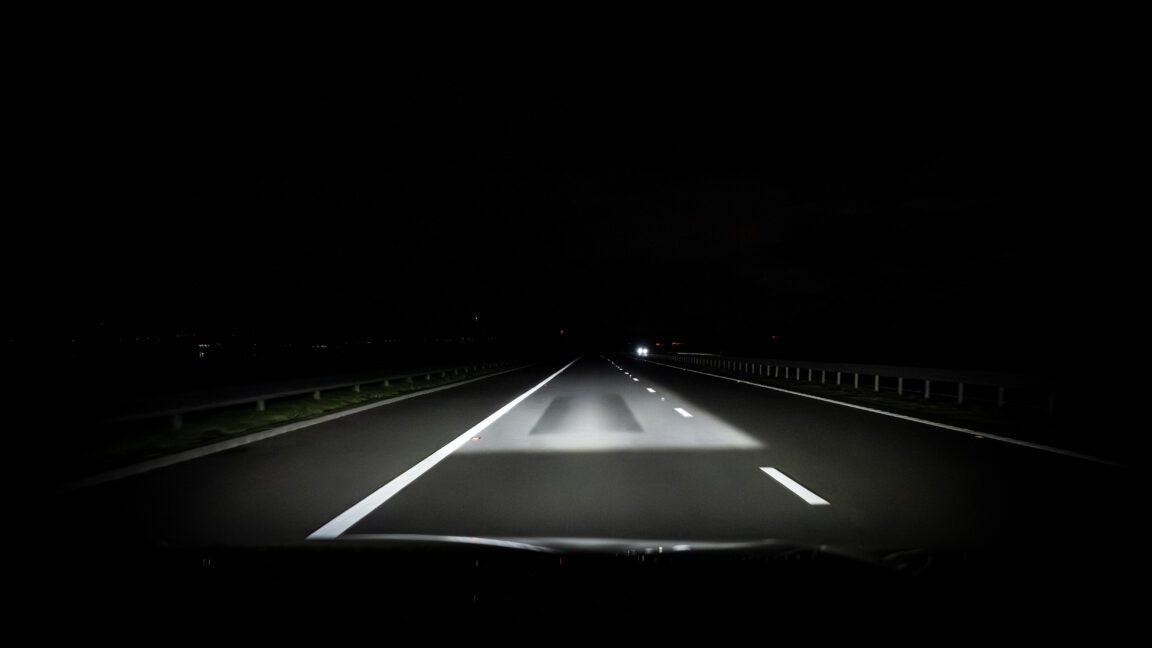
On our night drive, the headlights set to auto beams were extremely effective, illuminating much more of the view ahead than you’d get with normal low beams but clearly cutting off the sections of the beam that would otherwise light up other traffic. The lights also gated out road signs at a certain distance, again to reduce glare. And no, this did not prevent us from reading the signs.
The euro-spec adaptive beam digital matrix lights have a couple of other party tricks that do not make it to the US. NHTSA might have relented on active beam shaping, but it still has some way to go before it’s convinced that a car’s lights should be allowed to project onto the road surface while the car is in motion.
You might wonder why anyone would want that, but imagine headlights that project a light carpet ahead of the car (once above a certain speed) to highlight a road lane as a visual lane departure warning. Or imagine signaling to overtake or change lanes and having the headlights illuminate the adjacent lane during the maneuver. The light carpet will also show you the distance to the car ahead, and the headlights can project an ice warning onto the road surface during low temperatures.
The good news is that US-spec cars will have the necessary hardware to do all of those things, and should NHTSA relent, all it takes is a software update to enable them.
Source: Ars Technica