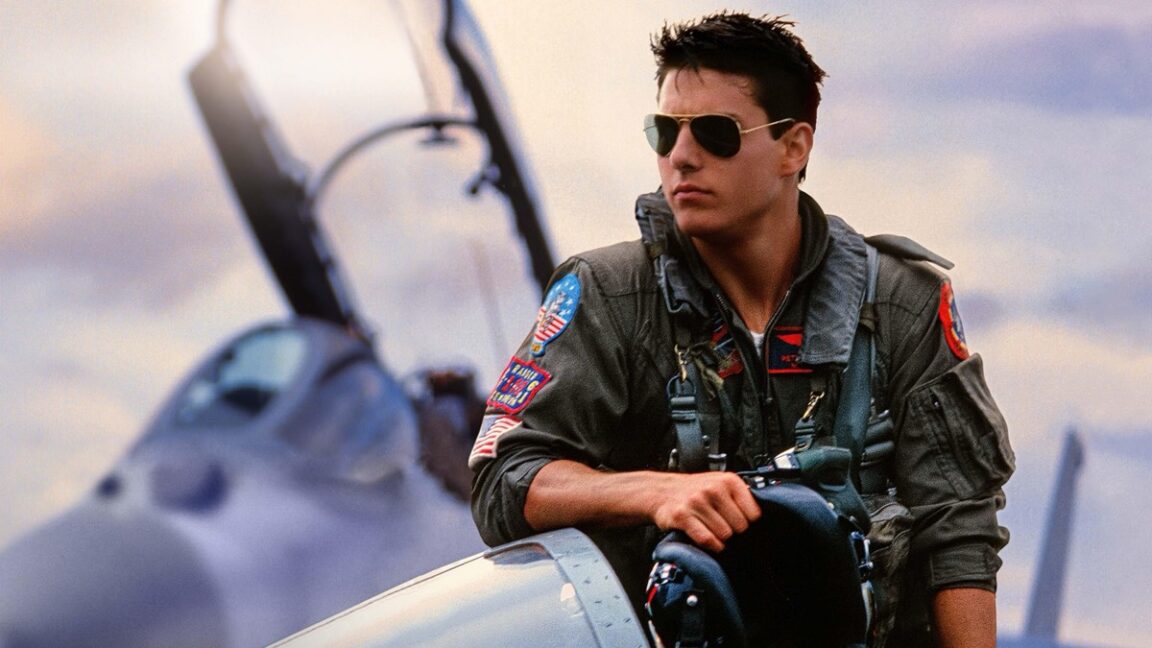
Tony Scott’s 1986 blockbuster and the 2022 sequel are the best recruitment tools the US Navy could hope for.
When the action film Top Gun hit the big screen in 1986, critical reviews were mixed, but audiences were thrilled. The film racked up $358 million globally, making it the highest-grossing film of that year. Its success spawned a few video games and a critically acclaimed blockbuster 2022 sequel, Top Gun: Maverick, and the eye-popping flight sequences definitely boosted enlistment numbers for the US Navy. Those scenes are still the best thing about Top Gun, 40 years later.
(Spoilers below because it’s been 40 years.)
The film was inspired by a 1983 article in California magazine detailing the lives of fighter pilots at Naval Air Station Miramar in San Diego (aka “Fightertown USA”) and featuring plenty of aerial photography alongside the text. Producers Jerry Bruckheimer and Don Simpson tapped Jim Cash and Jack Epps Jr. to write the screenplay, with Epps sitting in on declassified classes at the academy and even taking a flight aboard an F-14.
Tony Scott, then a relative newcomer with just one feature film (1983’s The Hunger) to his name, was hired to direct. However, he had shot a commercial for Saab featuring one of the company’s cars racing against a Saab 37 Viggen fighter jet, so the producers figured he had the chops for Top Gun.
The film wastes no time getting us in the air. Our hero, Maverick (Cruise) and his radar intercept officer, Goose (Anthony Andrews) are flying maneuvers in an F-14A Tomcat in the Indian Ocean, along with Maverick’s wingman, Cougar (John Stockwell) and his RIO. They encounter two hostile MiG-28s (a fictitious craft represented in the film by the Northrup F-5). Maverick scares one away with a well-timed missile lock, but the other MiG locks onto Cougar before getting chased away by Maverick. Just to make sure we understand how Maverick got his nickname, the pilot inverts his plane and flies directly above the hostile MiG, giving his adversary the finger as Goose snaps a commemorative Polaroid.
Cougar, however, is badly shaken by the encounter—so much so that he freezes up and can’t land his plane. So Maverick defies orders to land immediately (they are low on fuel) and flies back to Cougar to lead him safely back to the carrier. That earns Maverick a reprimand and establishes him as a cocky, arrogant rule-breaker with a fierce loyalty to his fellow pilots. Despite this, because Cougar has “lost the edge” and quits his commission, Maverick and Goose get to take his place at the titular Top Gun.
Maverick’s got the flying chops, the abrasive confidence, and nerves of steel, but can he learn to set his ego aside and be a team player? His archrival, Tom “Iceman” Kazansky (Val Kilmer), doesn’t think so, especially when Maverick abandons his wingman in a training run to make a showy, aggressive pass at an instructor’s plane. Everyone ends up failing the exercise because of it. Iceman thinks Maverick is dangerous—which the latter naturally tries to turn into an asset: “I am dangerous.”
Lt. Commander Rick “Jester” Heatherly (Michael Ironside) shares Iceman’s concerns, admitting that while Maverick’s flying is impressive, he might not trust him in actual combat. And training for combat is why they’re all there.
This is an ’80s blockbuster, so of course Maverick ultimately redeems himself and saves the day in an actual air skirmish—and also gets the girl, a civilian Top Gun instructor named Charlie (Kelly McGillis). But first, he suffers a major personal loss. Maverick and Goose accidentally fly through the jet wash of another plane, both engines flame out, and they go into a flat spin that not even Maverick can recover from.
The pair eject, but Goose hits the jettisoned canopy of the aircraft, and the impact kills him. Maverick isn’t to blame but nonetheless feels responsible. The loss chastens him just enough to take the edge off his insubordinate recklessness.
We all know that the best thing about Top Gun continues to be those incredible, pulse-pounding in-flight sequences and gorgeous orange-hued shots of crew and grounded planes at the base and on aircraft carriers. Scott shot most of the air footage from a Learjet, augmented by mounted cameras inside the F-14 cockpits and exteriors. That’s why he shot the whole thing in Super-8: The larger anamorphic lenses wouldn’t fit in the cockpits. The US Navy supplied aircraft, carriers, and crews, and the flight deck footage captured normal operations, with nothing staged.
The stunt pilots included future NASA astronaut Scott Altman, who performed the aforementioned infamous “flipping the bird” maneuver and the tower-buzzing moments. There was one casualty: aerobatic pilot Art Scholl, who performed a lot of the in-flight camera work. Scholl fell afoul of the flat spin maneuver; he couldn’t recover and crashed his biplane into the Pacific Ocean near Carlsbad, California. Neither his body nor the plane was ever recovered, but Scott dedicated the film to Scholl.
The film’s weaknesses are… well, almost everything else.
Confession: I’ve never been a huge Cruise fan, particularly in his early career. He didn’t really come into his own until much later; Tropic Thunder, Minority Report, Edge of Tomorrow, and Magnolia are my favorite of his roles, and he acquitted himself admirably in the excellent Top Gun: Maverick.
I still find his performance in the original abrasive and insincere. It takes skill as an actor to make a character like Maverick genuinely likable, and Cruise was not at that level yet in the mid-’80s, coasting on his boyish good looks instead. The film tries to include some vulnerable moments to show the sensitive soul lurking behind the swagger, mostly in scenes with Charlie, but it’s a shallow sentimentality and not very effective. The uninspired dialogue doesn’t help.
As for Charlie, the character started out as an aerobics instructor in the earliest script drafts and was then changed from a fellow officer to a civilian contractor/astrophysicist at the Navy’s request—otherwise, her romance with Maverick would count as fraternization. (The character was inspired by mathematician Christine “Legs” Fox, a civilian specialist in tactical development for aircraft carrier defense at Miramar.)
But while it might not be fraternization—and the film takes pains to show Charlie giving a brutally objective assessment of Maverick’s piloting despite their involvement—sleeping with a student is certainly unprofessional and would probably have gotten her fired in real life. So this is a very dated Hollywood depiction of a female career scientist.
Equally dated is the famous bar scene where Maverick, Goose, and several other drunken officers serenade Charlie—not yet introduced as their instructor—with “You’ve Lost That Lovin’ Feeling” because they’ve made a bet that Maverick can seduce her. It’s supposed to be charming, but the scene plays more aggressively in 2026, particularly when Maverick literally follows Charlie to the ladies’ room, leers at her, and suggests that they could do it right there on the sink.
She shoots him down, and he deserves it. The scene was even problematic 35 years ago—the US Department of Defense Office of Inspector General cited Top Gun’s influence as a contributing factor in the 1991 Tailhook scandal.
Top Gun also has its fair share of technical errors and Navy protocol violations, despite the best efforts of technical advisor Rear Admiral Pete “Viper” Pettigrew—depicted by Tom Skerritt in the film as CDR Mike “Viper” Metcalf. But one expects that in a Hollywood blockbuster. If you want verisimilitude, I highly recommend the National Geographic documentary series, Top Guns: The Next Generation.
Much like C.S.I. did for forensics and The X-Files‘ Dana Scully did for the FBI, Top Gun (and Top Gun: Maverick) are still the best recruitment tools the US Navy could hope for, on the strength of that glorious aerial footage alone. Just be prepared to do the actual hard work if the films inspire you to become a fighter pilot.
Source: Ars Technica