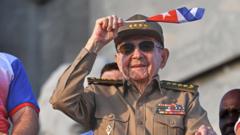
China and Russia have condemned a US decision to charge Cuba's former president Raúl Castro with murder.
The Chinese foreign ministry called on the US to stop using "coercion" and "threats" against its ally, while the Kremlin said the pressure being exerted on Havana "borders on violence".
The US has accused Castro over the 1996 downing of two planes, an incident that killed four people and fuelled diplomatic tensions between Washington and the Caribbean island.
US President Donald Trump has repeatedly sought to exert pressure on Cuba and has openly discussed toppling its communist regime.
The US has imposed fresh sanctions on the country and imposed an effective blockade on oil shipments to Cuba, exacerbating a fuel crisis there and leading to extended blackouts and food shortages.
Kremlin spokesman Dmitry Peskov told Russian state media on Thursday that the US pressure campaign against Russia's long-time ally, including the indictment Castro, "cannot be condoned".
"We believe that under no circumstances should such methods - which border on violence - be used against either former or current heads of state," he added.
Chinese foreign ministry spokesman Guo Jiakun had earlier said the US should "stop threatening force at every turn", and that Beijing "firmly supports Cuba".
He said Beijing opposed "any attempt by external forces to exert pressure on Cuba under any pretext".
Guo continued: "The United States should cease using sanctions and judicial apparatus as tools of coercion against Cuba and refrain from making threats of force at every turn."
Castro was charged alongside five others on Wednesday over their alleged involvement in the shooting down of the two planes, which had been travelling between Cuba and Florida when they were struck.
He was accused of offences that carry penalties of life in prison or death.
The aircraft, which were operated by the Cuban-American dissident group Brothers to the Rescue, had been carrying three US citizens when they were downed, all of whom were killed.
At the time, Castro - who stepped down as president in 2018 - was head of the country's armed forces.
The incident caused outcry among Cuban exiles living in the US and has long been a source of contention between Washington and Havana.
Cuba's President Miguel Díaz-Canel has described the charges as "a political manoeuvre, devoid of any legal foundation".
Since capturing former Venezuelan President Nicolás Maduro in January, Trump has openly mused that Cuba was "ready to fall".
It was a federal indictment against the left-wing authoritarian Maduro that was used by the Trump administration as its justification for its raid on the Venezuelan capital, Caracas, to seize him and his wife, Cilia Flores. The pair are now due to stand trial in New York on charges including drug trafficking.
US Secretary of State Marco Rubio declined to comment on whether or how the administration was planning to get Castro to the US to stand trial.
He told reporters in Florida on Thursday that the former Cuban leader "openly admits and brags about" giving the order to shoot down the planes.
Asked about the US using force to achieve regime change in Cuba, Rubio said the administration's preference was a negotiated settlement, but added: "He has the option to do that if there's a threat to the national security of the United States - and he has shown his willingness to do that when he identifies such a threat."
On Wednesday, he issued a message to the Cuban people in Spanish that similarly cast the Trump administration's moves as "offering a new path", trading a kleptocratic regime for the sorts of freedoms enjoyed by Cuban-Americans.
Cuban officials have been in talks with the US on finding solutions to the two countries' differences for several months, with a single Russian shipment of oil that was allowed to reach the island running out earlier this month.
But in the meantime, the White House has continued to ratchet up pressure on Havana.
Earlier this month, Trump signed an executive order imposing sanctioning against officials in Cuba's energy, defence, financial and security sectors, as well as individuals the US alleges have carried out human rights abuses or stolen public assets.
US surveillance flights near the island have also reportedly increased and the CIA director demanded that Cuba "no longer be a safe haven for adversaries" while on a visit there last week.
Cuba had until recently survived crippling Western sanctions due to the help of regional allies, such as Maduro's government in Venezuela, which was believed to have sent it around 35,000 barrels of oil a day prior to his capture.
Source: BBC News - World