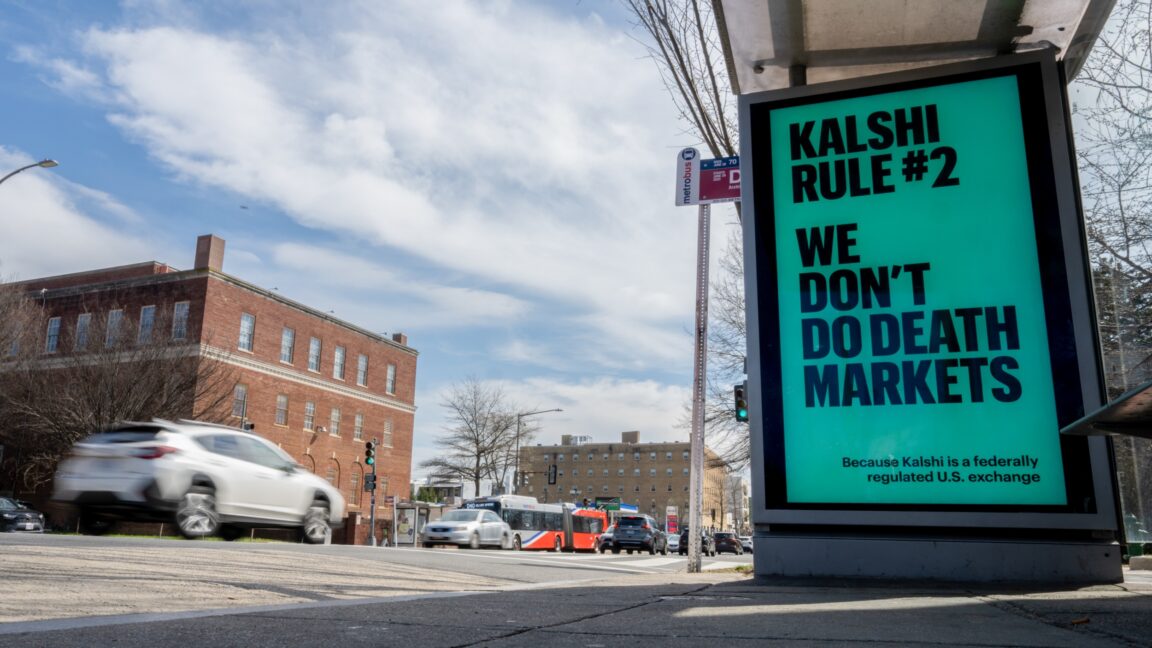
State law makes it a felony to create, operate, or advertise prediction markets.
The Trump administration yesterday sued Minnesota in an attempt to block the first state law that prohibits prediction markets.
While other states imposed restrictions on prediction markets, Minnesota banned them outright in a law signed by Gov. Tim Walz on Monday. The US Commodity Futures Trading Commission announced a lawsuit against the state, saying that Minnesota’s “new legislation represents the most aggressive move by a state to shut down CFTC-regulated markets and undermine the federal regulatory regime set up by Congress more than 50 years ago.”
“This Minnesota law turns lawful operators and participants in prediction markets into felons overnight,” CFTC Chairman Michael Selig said. “Minnesota farmers have relied on critical hedging products on weather and crop-related events for decades to mitigate their risks. Governor Walz chose to put special interests first and American farmers and innovators last.”
The Minnesota law makes it a felony to create, operate, or advertise a prediction market. The CFTC asked the court for preliminary and permanent injunctions to prohibit Minnesota from enforcing the law, which is scheduled to take effect on August 1. The case was filed in US District Court for the District of Minnesota.
The Minnesota law defines a prediction market as “a system that allows consumers to place a wager on the future outcome of a specified event that is not determined or affected by the performance of the parties to the contract.” The law’s specified events include but are not limited to sports games, wars, mass shootings, acts of terrorism, elections, court cases, deaths or assassinations, weather conditions, and pop culture events such as awards or release dates.
Minnesota Attorney General Keith Ellison will defend the state law in court. “I’m very concerned about the harms of prediction markets on Minnesotans,” Ellison said in a statement provided to Ars. “Prediction markets are designed to be addictive and prey especially on young people and low-income folks. They help the ultra-rich get richer and the rest of us get poorer. My office and I are reviewing this lawsuit and will respond in court.”
The Commodity Exchange Act, a US law, gives the CFTC exclusive jurisdiction over designated contract markets (DCMs). The CFTC argues that this preempts state laws regulating prediction markets such as Kalshi and Polymarket, which are registered with the CFTC as DCMs.
The CFTC won a court ruling in April that prevented New Jersey from regulating prediction markets under laws that prohibit betting on college sports and require licenses to offer other types of sports wagers. In that case, the US Court of Appeals for the 3rd Circuit ruled that “Kalshi’s sports-related event contracts are swaps traded on a CFTC-licensed DCM, so the CFTC has exclusive jurisdiction.”
The 3rd Circuit case was decided by three judges in a 2-1 ruling. Cases in other circuits could turn out differently, though the CFTC yesterday boasted that it also won a ruling against Arizona.
“In a lawsuit filed by the CFTC, a federal court in Arizona recently issued a preliminary injunction blocking Arizona from using its gambling laws to criminally prosecute prediction market operators,” the federal agency said. “The Commission has also filed lawsuits against Connecticut, Illinois, and New York, and has filed amicus briefs in the US Court of Appeals for the Sixth and Ninth Circuits and the Supreme Judicial Court of Massachusetts.”
In the Arizona case, a US District Court judge decided “that federal law preempts state gambling laws insofar as they seek to regulate derivatives exchanged on markets regulated by the CFTC.” But the Arizona case is now stayed pending a ruling from the 9th Circuit appeals court, which last month heard oral arguments in a different case involving Nevada.
In the underlying Nevada case, Crypto.com sued the state after the Nevada Gaming Control Board sent it a cease-and-desist letter. The state board had decided that Crypto.com’s event contracts are sports wagers and thus subject to Nevada’s gambling laws. A District Court judge sided with Nevada, ruling that “Crypto’s event contracts are not ‘swaps’ falling within the CFTC’s exclusive jurisdiction.”
The CFTC lawsuit against Minnesota offers another chance for a judge to decide whether event contracts are swaps. The CFTC complaint argues that the contracts are a type of swap under the Commodity Exchange Act, which defines them as “any agreement, contract, or transaction” that, among other things, “is dependent on the occurrence, nonoccurrence, or the extent of the occurrence of an event or contingency associated with a potential financial, economic, or commercial consequence.”
US senators recently voted to ban themselves from making bets on prediction markets. Some congressional candidates had been caught betting on their own campaigns, and a US Army soldier was recently arrested for insider trading after being accused of making Polymarket wagers on the timing of the military’s capture of Venezuelan President Nicolás Maduro. Sen. Alex Padilla (D-Calif.) has called for “legislation to rein in Trump administration officials who may be profiting off insider knowledge, including military operations.”
While the CFTC is seeking public comment on how it should regulate prediction markets, the Trump administration isn’t likely to impose a major crackdown on them. Polymarket and Kalshi both have Donald Trump Jr. as an advisor, and a Trump Jr.-backed venture capital firm invested in Polymarket.
Minnesota Rep. Emma Greenman, a Democrat who authored the state’s prediction market ban, said the bill “passed with bipartisan support in the House and Senate, showing broad support for protecting our young people, our communities, and our public decision-making from these shadowy prediction gambling markets. It is critical we act this year to address this explosion of gambling on almost anything and rein in these Big Tech billionaires who skirt the law to circumvent our state authority and hurt our children just to line their own pockets.”
Source: Ars Technica