Taiwan President Lai Ching-te says that if given the chance he would tell U.S. President Donald Trump he hopes to continue U.S. arms purchases that are essential for peace
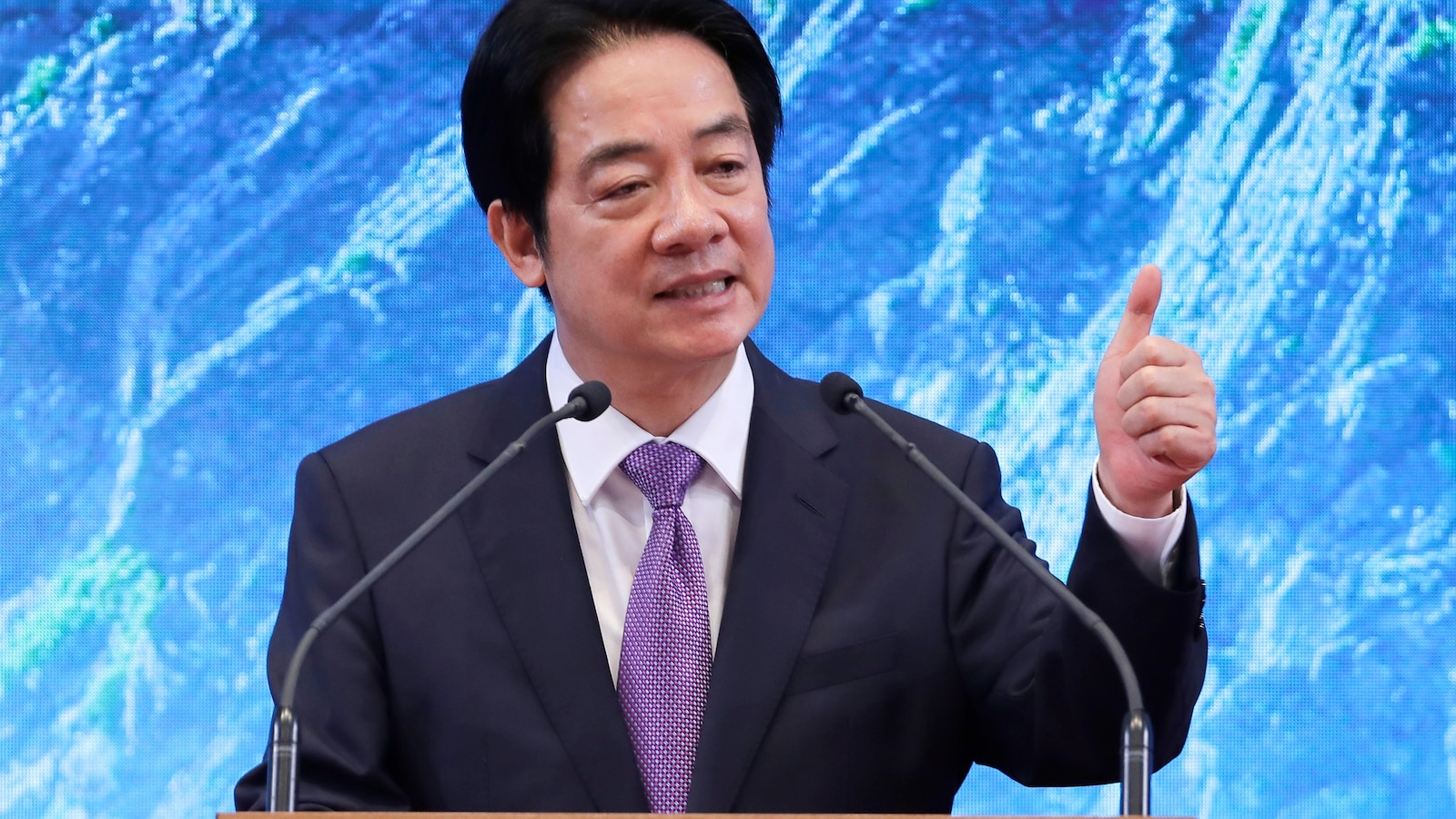
TAIPEI, Taiwan -- Taiwan President Lai Ching-te said Wednesday that if given the chance he would tell U.S. President Donald Trump of his hope to continue U.S. arms purchases, which Lai called essential for peace, while offering assurances that the island's future would not be decided by external forces.
Lai is marking two years in office, the halfway point of his term, under growing pressure from China, which sees Taiwan as a breakaway province to be retaken by force if necessary. Trump's recent narrative on Taiwan also raised concerns about U.S. traditional support for the island even without formal diplomatic ties.
Lai said if he could talk to Trump, he would emphasize that peace and stability in the Taiwan Strait was crucial for global security, alleging China was the “destroyer” of the strait's peace.
Lai said he also would tell Trump that Taiwan's increasing defense budget was a response to threats and purchases of U.S. arms would be an essential means to safeguard the strait's stability. Lai said he believes “only strength can bring peace.”
“No country has the right to annex Taiwan,” Lai said he would tell Trump at the news briefing. “Democracy and freedom should also not be seen as provocation.”
Lai looks forward to more cooperation between Taiwan and the U.S. and other democratic countries in promoting peace in the strait, he added.
Chinese President Xi Jinping last week issued a strong warning to the U.S., telling Trump during their Beijing summit that the “Taiwan question” is the most important issue in ties between China and the U.S. and the two nations will “have clashes and even conflicts” without proper handling.
Trump in December approved a record-breaking, $11 billion arms package to Taiwan. In an interview aired Friday on Fox News as the U.S. president wrapped up his visit to China, Trump said his approval of a new $14 billion arms package to Taiwan depended on China, describing the deal as “a very good negotiating chip.”
Trump later told reporters he needed to talk to the person who is running Taiwan, without naming Lai, who Beijing deemed a separatist.
In his speech Wednesday, Lai said democracy is not a gift from the sky.
“Taiwan’s future cannot be decided by external forces, nor can it be held hostage by fear, division, or short-term interests,” he said, without specifying who the external forces are.
He added that Taiwan was willing to engage in healthy and orderly exchanges with China under the principles of equality and dignity, but firmly rejects united front tactics that “package unification as peace.”
Beyond geopolitics, Taiwan is a major manufacturer of artificial-intelligence servers, computer chips and precision instruments. The AI boom has propelled Taiwan’s leading technology companies to record profits and revenues. But observers worry the island's heavy reliance on computer chipmakers and other technology companies carries risk if the AI craze becomes a bubble.
Lai said he would roll out a $3.1 billion plan to accelerate the upgrading and transformation of small and medium-sized businesses and traditional industries and to have the tech industries drive traditional sectors.
China’s Taiwan Affairs Office spokesperson Chen Binhua said in Beijing that Lai's remarks were filled with lies, deception, hostility and confrontation, according to China's official Xinhua News Agency.
Chen accused Lai of stubbornly insisting on Taiwan independence, calling him a “destroyer of cross-strait peace” and saying Lai was pretending to be sincere when he vowed to promote cross-strait dialogue in an attempt to deceive the Taiwanese and fool international public opinion, the report said.
No matter who was elected and how the election was held in Taiwan, “it cannot break the unchangeable rule that Taiwan’s future can only be decided jointly by all Chinese people, including Taiwan compatriots,” Chen said, according to Xinhua.
China and Taiwan have been governed separately since 1949 when the Communist Party rose to power in Beijing following a civil war. Defeated Nationalist Party forces fled to Taiwan, which later transitioned from martial law to multiparty democracy.
The U.S. and Taiwan had formal diplomatic relations until 1979, when President Jimmy Carter’s administration recognized and established relations with Beijing. Still, the U.S. is required by law to ensure Taiwan can defend itself.
24/7 coverage of breaking news and live events
Source: ABC News - International