The Tasmanian government has apologised for a decades-old scandal in which body parts taken from autopsies were secretly kept - and in some cases put on display - without the consent of families.
The wrongdoing was uncovered last year after an investigation found that between 1966 and 1991 pathologists may have "actively sourced" 177 human specimens collected during autopsies before handing them to a university museum.
The samples were given to the museum without approval of family members or the coroners who were responsible for the bodies.
On Tuesday, several family members were in parliament as the state's health minister apologised for the "enduring distress, anger, pain, grief and trauma".
"Although these historical practices ended 35 years ago, the deep impact this has had on the families and loved ones of the deceased continues to this day," Bridget Archer told parliament.
"It's important to remember that these were not just body parts or specimens or human remains. They were people."
For Cheryl Springfield, the apology was a welcome development but more was needed.
"It's in the right direction, but it's not going to fix it all," she told local media before the apology.
Her brother David Maher died in 1976, aged 14, in a car accident and when she found out that his body parts were part of the investigation, she was devastated.
"It's been absolutely a nightmare from that moment we were told."
That disbelief has also been felt by John Santi, who was 13 in 1976 when his older brother Tony died, aged 19, in a motorcycle accident.
"We buried him 50 years ago, only to find out 50 years later that these people had stolen his brain," Santi told Australian Associated Press (AAP).
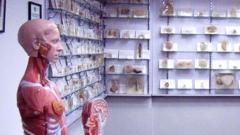
Concerns about specimens displayed at the University of Tasmania RA Rodda Museum in Hobart were first raised in 2016 after three bone samples were suspected of having been obtained without the consent of family members.
This led to the state coroner ordering an investigation into the museum's collection in April 2023, and after months of inquiries, the findings were handed down in September.
Coroner Simon Cooper found that the "now-dead forensic pathologist Dr Royal Cummings was the person who provided the large majority of coronial specimens to the museum".
"However, it also appears that his predecessors and successors also engaged in the practice," Cooper said last year.
"It also appears that pathologists may have actively sourced specimens from coronial autopsies to give to the museum," he added.
Autopsies ordered by coroners are usually done as part of investigations into an unexpected or unusual death as well as deaths in custody.
Shortly after Tuesday's apology, University of Tasmania's deputy vice-chancellor for health Prof Graeme Zosky acknowledged the gravity of the situation.
"While we recognise an apology cannot fix the hurt and distress families have felt, we are sorry," Zosky said, adding that university staff had met with many of the affected family members.
The RA Rodda Pathology Museum was established in 1966 to support teaching and research in medical sciences.
The 177 specimens - which included organs and tissue samples - that were investigated were removed from display in 2018.
Source: BBC News - World