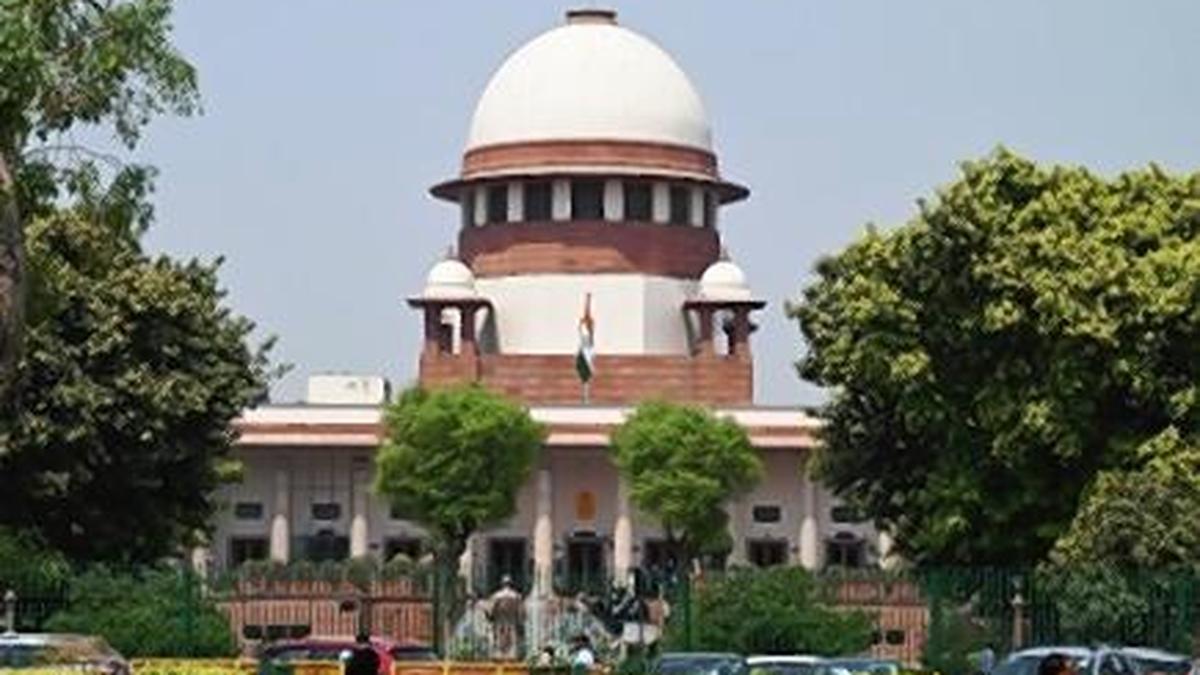
The Supreme Court on Monday (May 18, 2026) questioned its own judgment denying former JNU student leader Umar Khalid personal liberty while granting relief to a Jammu and Kashmir man accused in a narco-terrorism case in which he has been incarcerated as an undertrial for the past five years. The court said bail is the rule even in UAPA cases.
Editorial | Hierarchy of roles: On no bail for Umar Khalid
The judgment laid bare the deep concern the court felt about certain judgments in the recent past which persistently thinned out the right to personal liberty in UAPA cases.
A Bench of Justices B.V. Nagarathna and Ujjal Bhuyan followed the principle laid down by a three-judge Bench of the court in the K.A. Najeeb case of 2021, signalling a definite pro-personal liberty swing.
The court emphasised that binding precedents like the Najeeb judgment, championing individual rights, must be complied with and not ignored by the apex court and lower courts. Smaller Benches have hollowed out the reasoning of larger Benches like in the Najeeb judgment without expressly disagreeing with them
The court criticised its own recent judgments, including the recent one titled Gulfisha Fatima versus State of Delhi, in which Khalid and co-accused Sharjeel Imam were denied bail in a UAPA case related to the Delhi riots 'larger' conspiracy case despite spending over six years as undertrials.
The court said the current case had brought to the forefront the interface between the Section 43D(5), the draconian bail provision of the UAPA, and the right to speedy trial and personal liberty under Article 21 of the Constitution.
The court said if prima facie accusations made by the investigating agency was blindly accepted as true to deny bail, the pre-trial incarceration would begin to acquire a post-trial punitive character, and even then no court would ever grant bail, no matter the length of incarceration because the case was already “prima facie made out”.
Justice Bhuyan said the Najeeb verdict had upheld that the more stringent a statute was, the quicker should be the conduct of trial. The stringency of the UAPA bail provision should not be used by the state to turn delay itself into punishment for an undertrial.
The judgment was based on a special leave petition challenging a judgment of the High Court of Jammu & Kashmir and Ladakh in August last year.
The High Court had concluded that the accused did deserve bail considering the rigorous thresholds for bail under Section 43D(5) of the UAPA and resrrictions under the narcotic law.
Published - May 18, 2026 12:16 pm IST
Source: The Hindu - India News