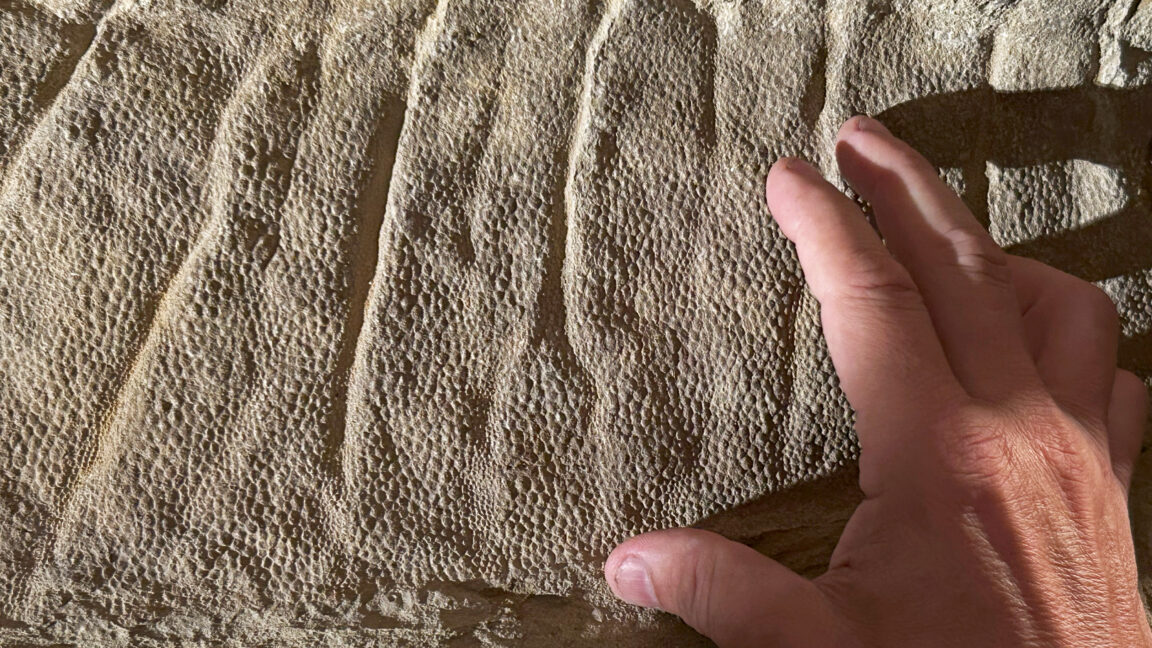
Edmontosaurus annectens, a large herbivore duck-billed dinosaur that lived toward the end of the Cretaceous period, was discovered back in 1908 in east-central Wyoming by C.H. Sternberg, a fossil collector. The skeleton, later housed at the American Museum of Natural History in New York and nicknamed the “AMNH mummy,” was covered by scaly skin imprinted in the surrounding sediment that gave us the first approximate idea of what the animal looked like.
More than a century later, a team of paleontologists led by Paul C. Sereno, a professor of organismal biology at the University of Chicago, got back to the same exact place where Sternberg dug up the first Edmontosaurus specimen. The researchers found two more Edmontosaurus mummies with all fleshy external anatomy imprinted in a sub-millimeter layer of clay. For the first time, we uncovered an accurate image of what Edmontosaurus really looked like, down to the tiniest details, like the size of its scales and the arrangement of spikes on its tail. And we were in for at least a few surprises.
Evolving images
Our view of Edmontosaurus changed over time, even before Sereno’s study. The initial drawing of Edmontosaurus was made in 1909 by Charles R. Knight, a famous paleoartist, who based his visualization on the first specimen found by Sternberg. “He was accurate in some ways, but he made a mistake in that he drew the crest extending throughout the entire length of the body,” Sereno says. The mummy Knight based his drawing on had no tail, so understandably, the artist used his imagination to fill in the gaps and made the Edmontosaurus look a little bit like a dragon.
Read full article
Comments
Source: Ars Technica