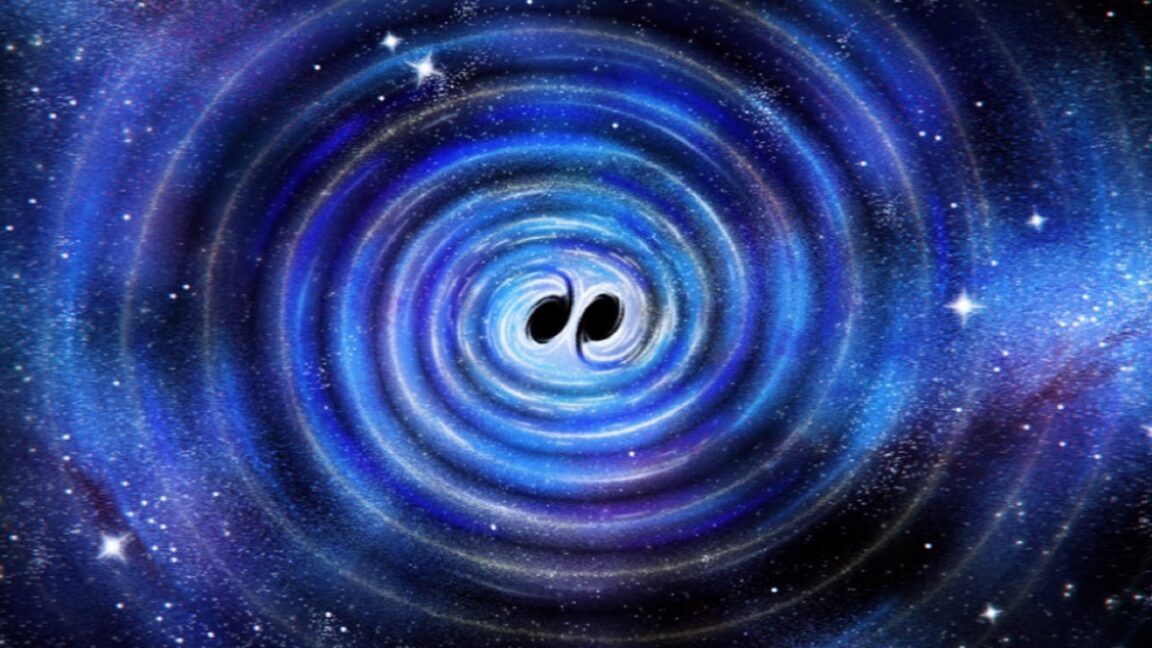
Back in 1971, the late physicist Stephen Hawking made an intriguing prediction: The total surface area of a black hole cannot decrease, only increase or remain stable. So if two black holes combine, the newly formed black hole will have a larger surface area. This became known as Hawking's area theorem. Analysis of the gravitational signal from a black hole merger detected in January provides the best observational evidence to date in support of Hawking's theorem, according to a new paper published in the journal Physical Review Letters.
The breakthrough just happens to coincide with the 10-year anniversary of the LIGO collaboration's Nobel Prize-winning first detection of a black hole merger. A second paper has been submitted (but not yet accepted), placing theoretical limits on a predicted third tone at a higher pitch that could be lurking in the event's gravitational wave signal.
Now known as LIGO/Virgo/KAGRA (LVK), the collaboration searches the Universe for gravitational waves produced by the mergers of black holes and neutron stars. LIGO detects gravitational waves via laser interferometry, using high-powered lasers to measure tiny changes in the distance between two objects positioned kilometers apart. LIGO has detectors in Hanford, Washington, and in Livingston, Louisiana. A third detector in Italy, Advanced Virgo, came online in 2016. In Japan, KAGRA is the first gravitational-wave detector in Asia and the first to be built underground. Construction began on LIGO-India in 2021, and physicists expect it will turn on sometime after 2025.
Read full article
Comments
Source: Ars Technica