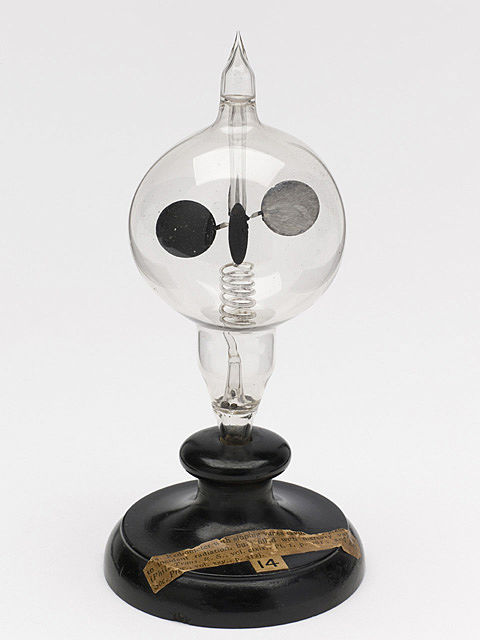
Most people would recognize the device in the image above, although they probably wouldn't know it by its formal name: the Crookes radiometer. As its name implies, placing the radiometer in light produces a measurable change: the blades start spinning.
Unfortunately, many people misunderstand the physics of its operation (which we'll return to shortly). The actual forces that drive the blades to spin, called photophoresis, can act on a variety of structures as long as they're placed in a sufficiently low-density atmosphere. Now, a team of researchers has figured out that it may be possible to use the photophoretic effect to loft thin sheets of metal into the upper atmosphere of Earth and other planets. While their idea is to use it to send probes to the portion of the atmosphere that's too high for balloons and too low for satellites, they have tested some working prototypes a bit closer to the Earth's surface.
Photophoresis
It's quite common—and quite wrong—to see explanations of the Crookes radiometer that involve radiation pressure. Supposedly, the dark sides of the blades absorb more photons, each of which carries a tiny bit of momentum, giving the dark side of the blades a consistent push. The problem with this explanation is that photons are bouncing off the silvery side, which imparts even more momentum. If the device were spinning due to radiation pressure, it would be turning in the opposite direction than it actually does.
Read full article
Comments
Source: Ars Technica